
Historic Quaker Houses of Chester County, PA
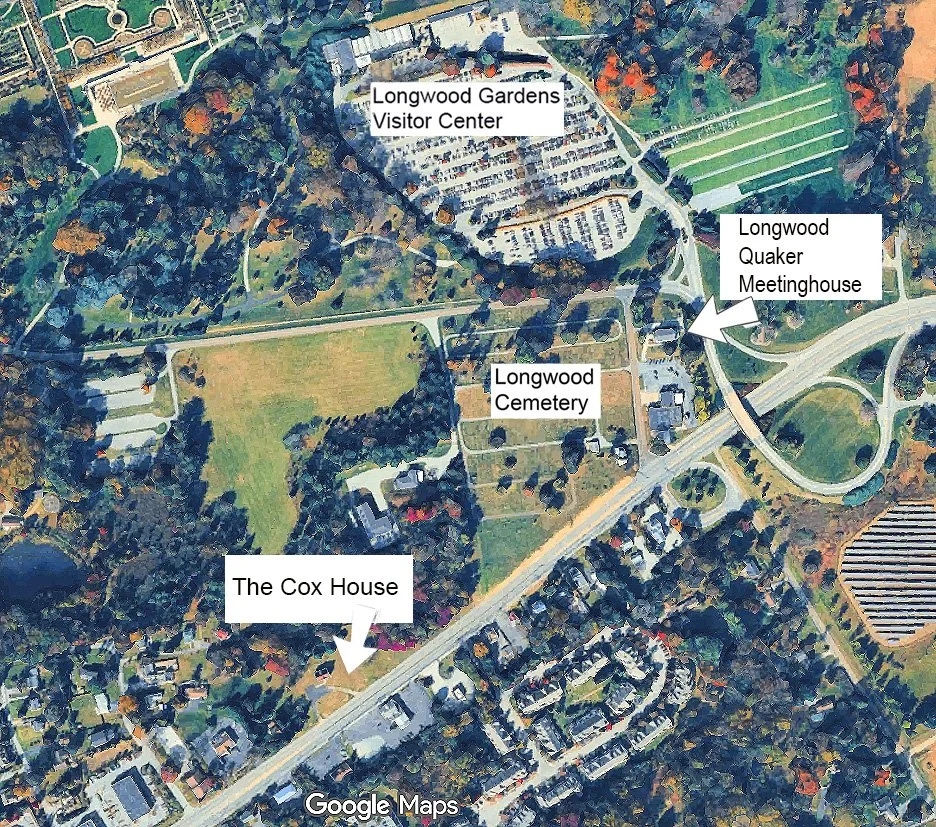
The Cox House - Longwood Farm
Owned by Longwood Gardens
The Source of Longwood Garden’s Name
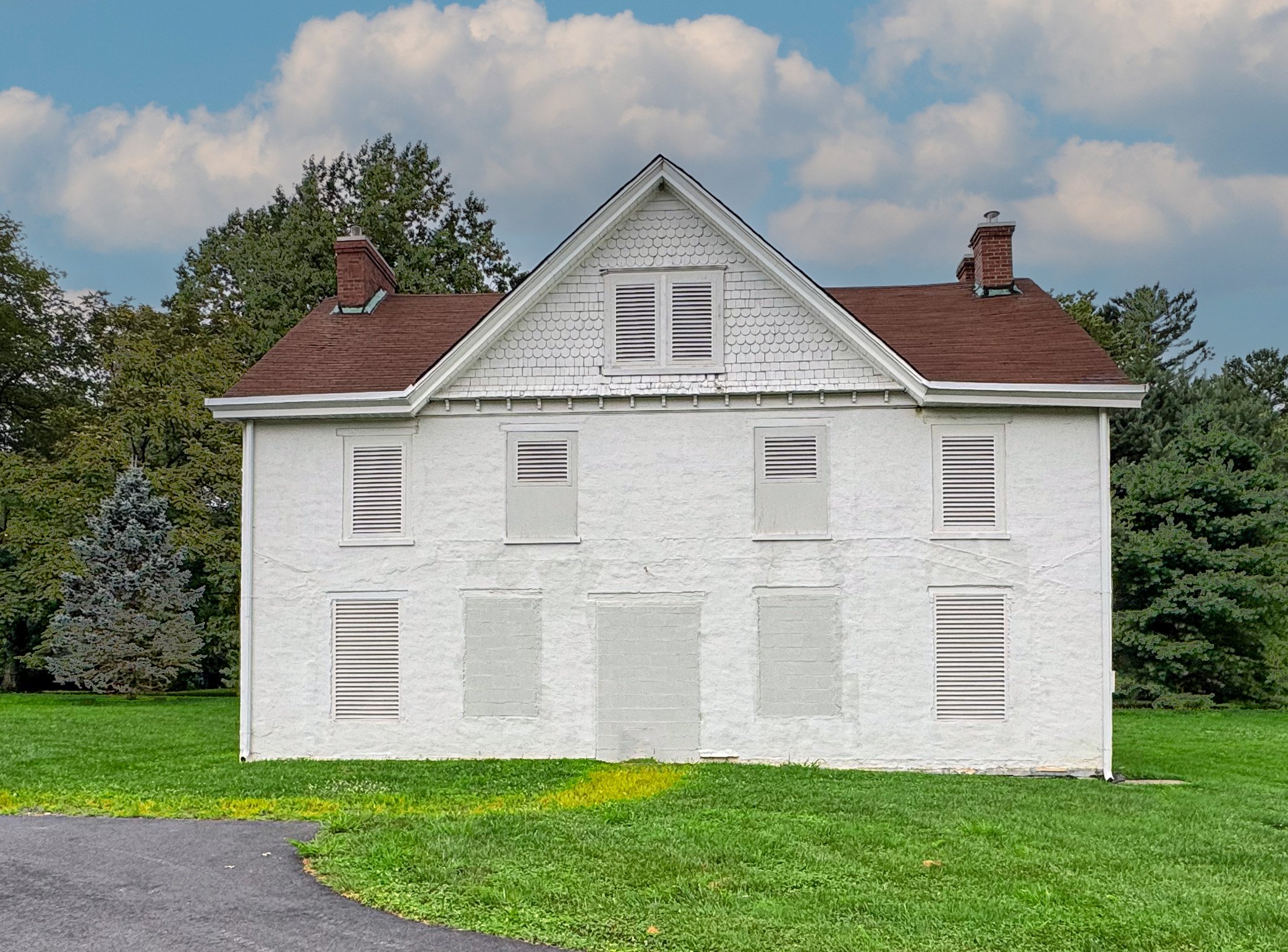
Above: The Cox House of Longwood Farm is the namesake of Longwood Gardens. Image source: Lee J. Stoltzfus
Anti-Slavery Activists John and Hannah Cox
Owners of the Cox House
at Longwood Farm:
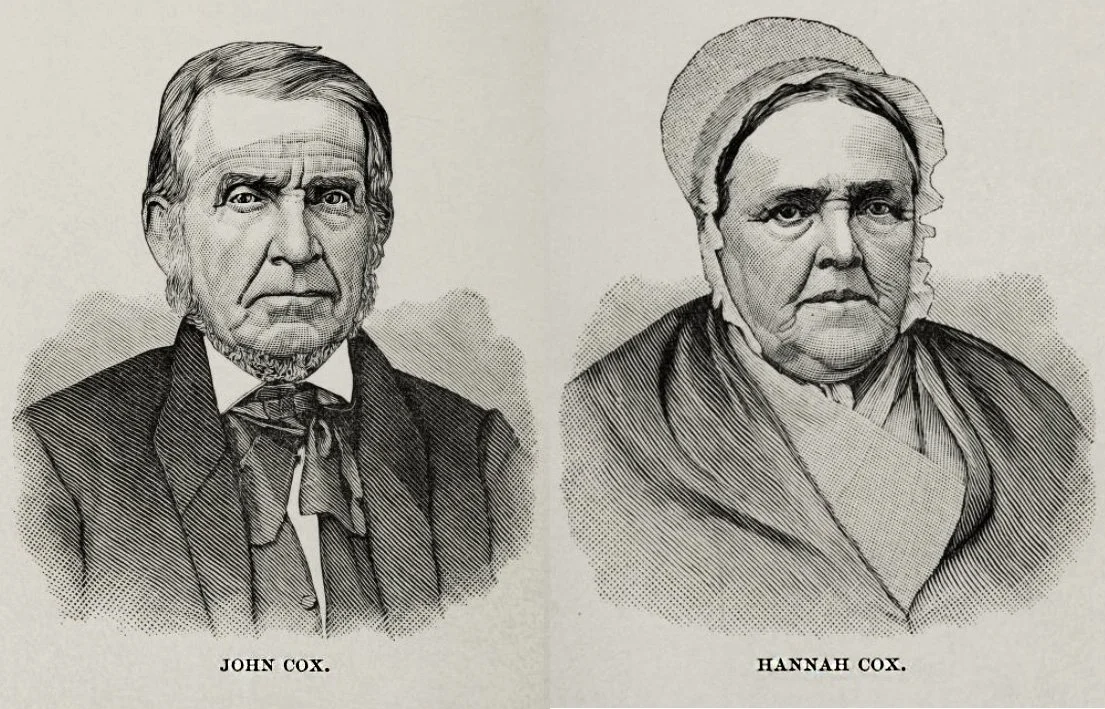
Above: Image source: History of the Underground railroad in Chester and the neighboring counties of Pennsylvania, Smedley, 1883, Internet Archive.
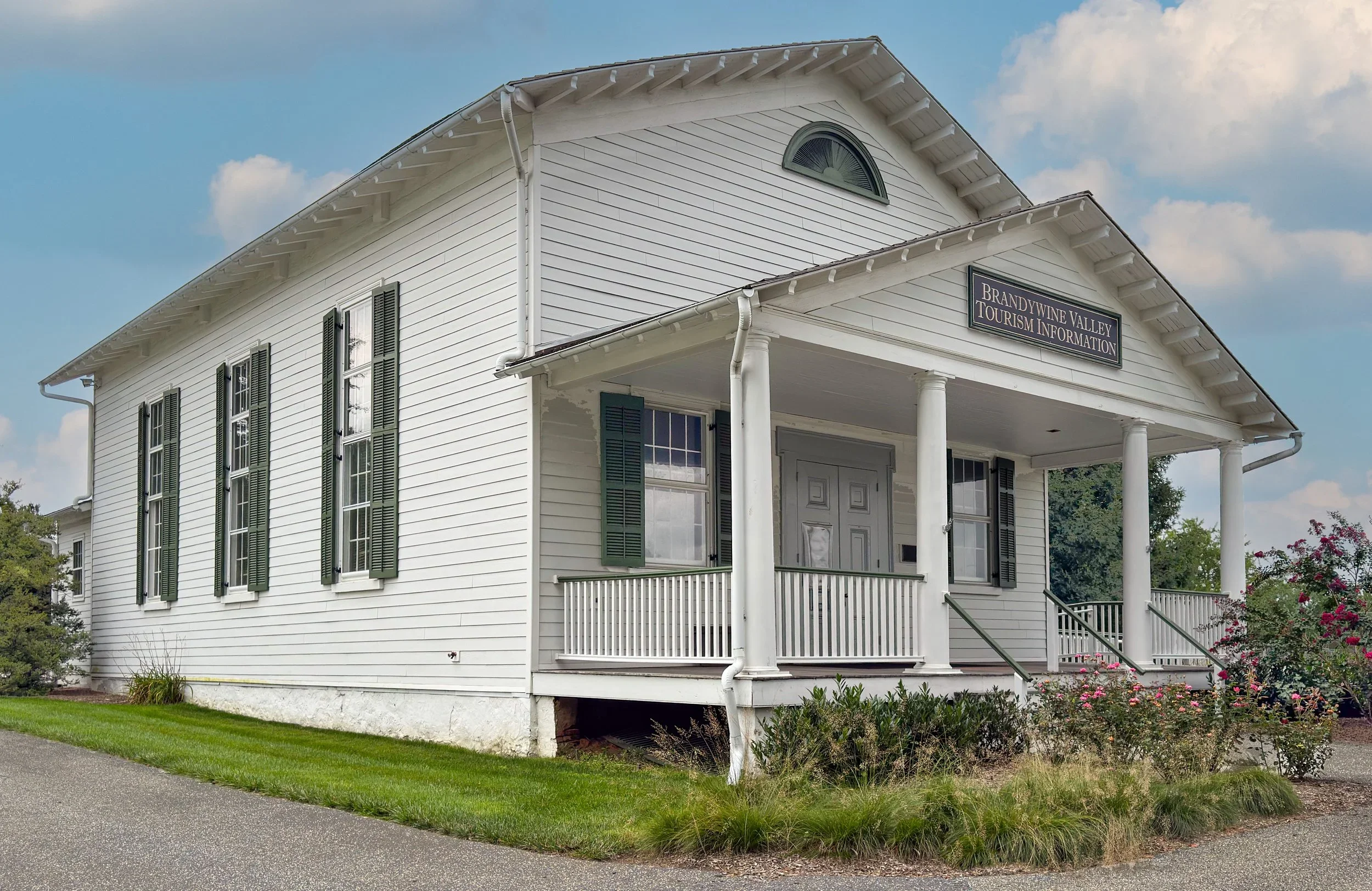
The Longwood Quaker Meetinghouse in 1865:
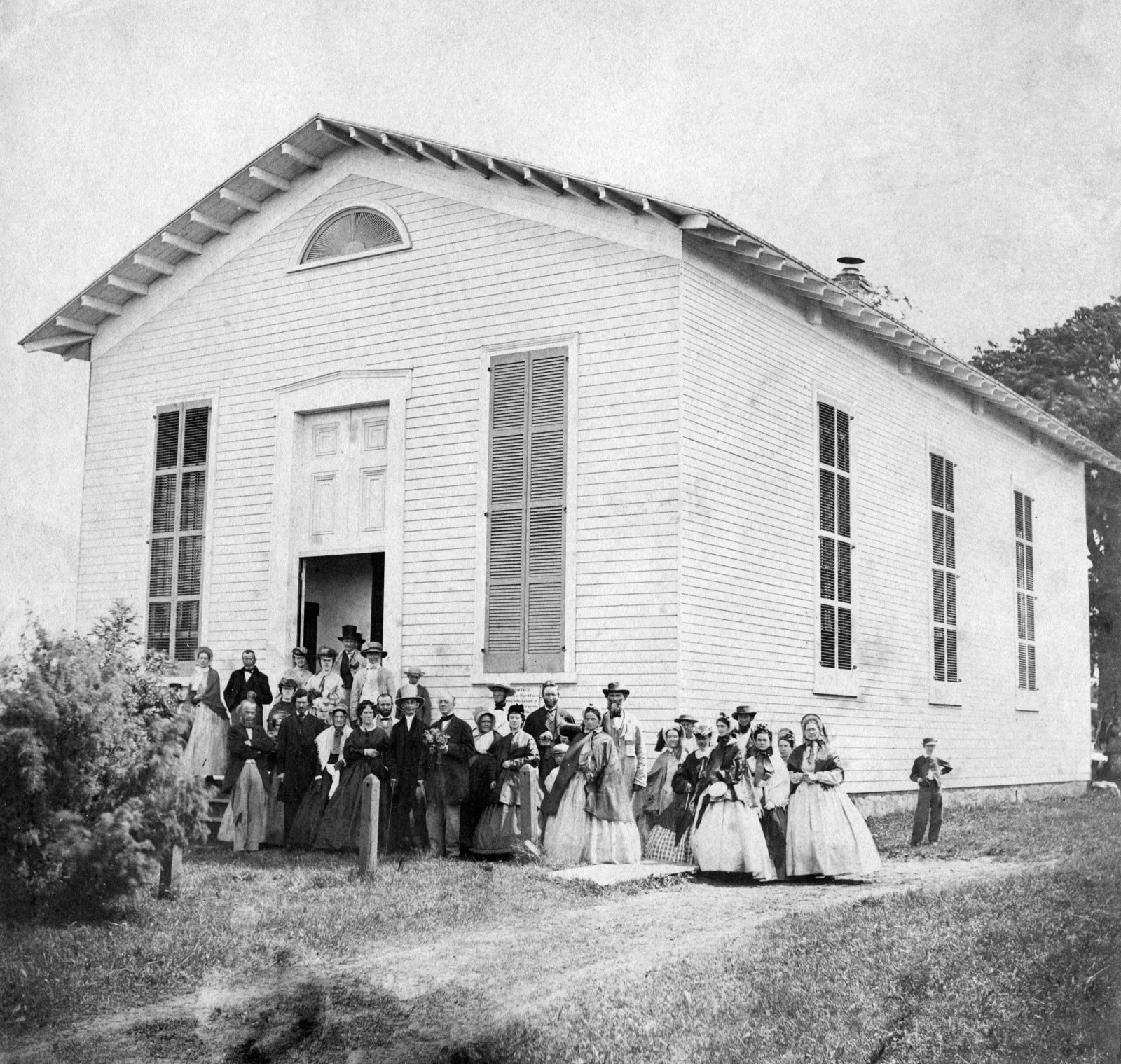
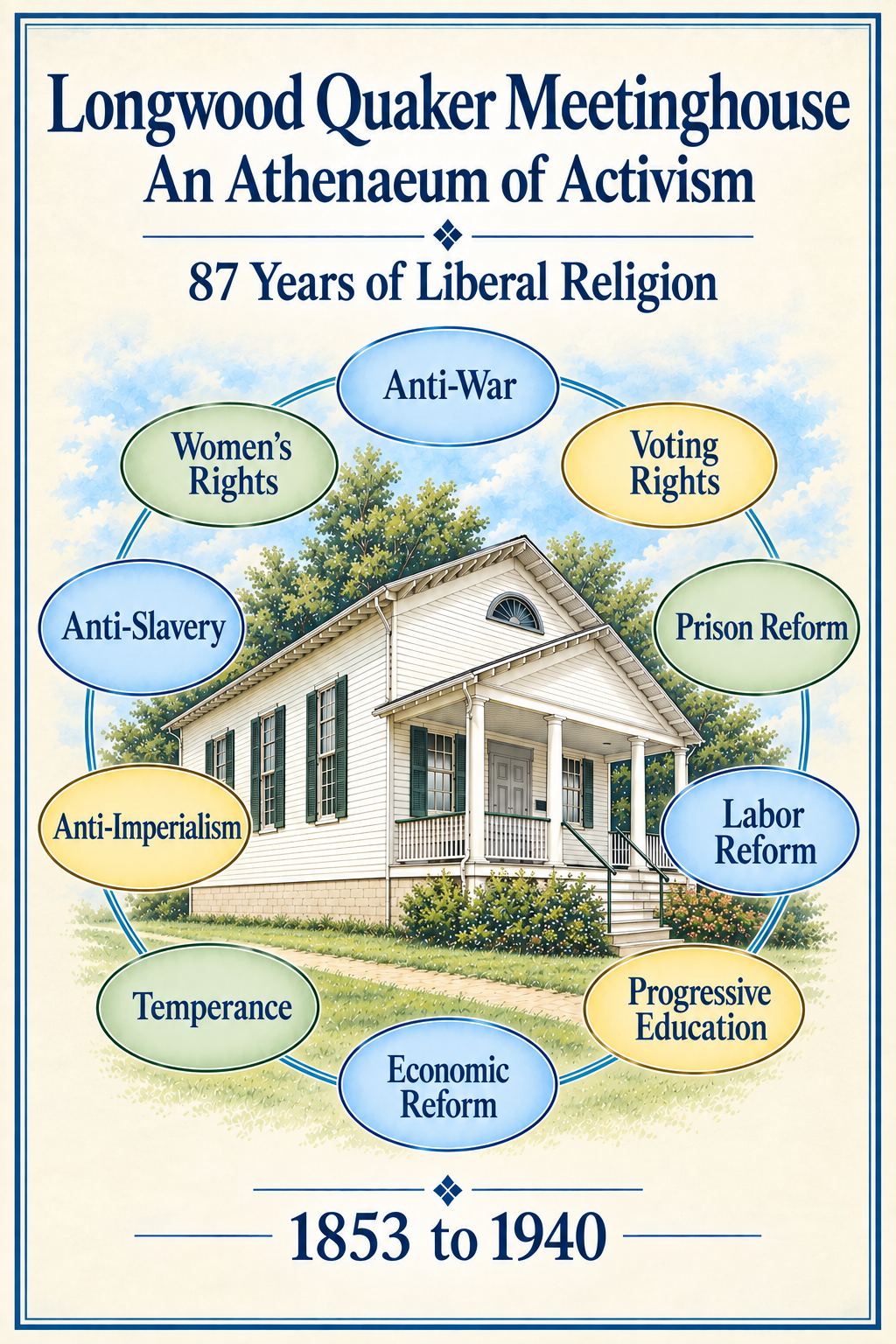
Above: For 87 years the Longwood Quaker Meetinghouse was a forum of reform for leading American activists advocating for human rights and social justice. The building is a de facto temple of free speech.
In 1940:
Pierre du Pont Purchased the Meetinghouse
To Add to his Longwood Gardens:
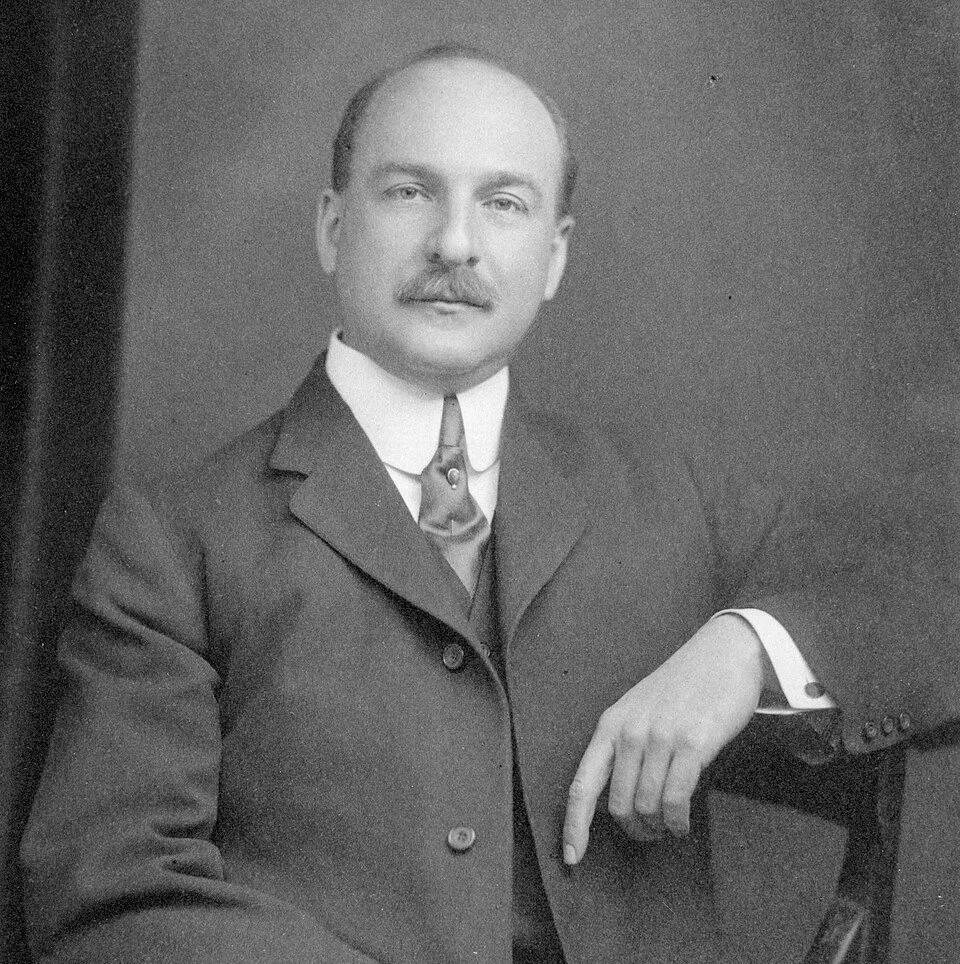
Above: Pierre du Pont, founder of Longwood Gardens, purchased the Longwood Quaker meetinghouse in 1940, the last year of the meeting. Image source: Wikimedia
Nationally Renowned Reformers
Who Spoke at Longwood Quaker Meetinghouse
A Sample:
William Lloyd Garrison
A Fearless Leader
of the Anti-Slavery Movement:
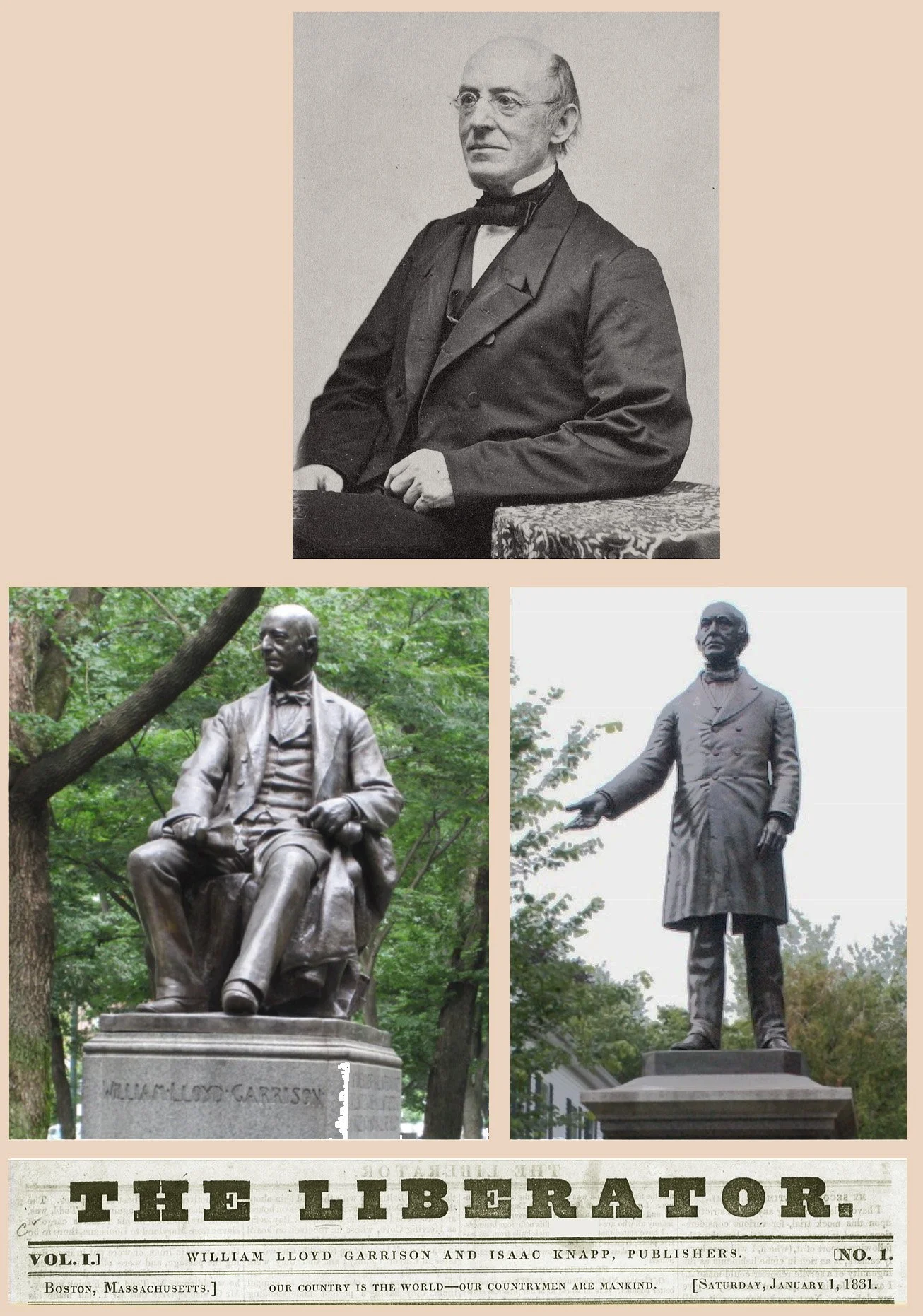
William Lloyd Garrison faced death threats, and mob violence for his anti-slavery activism. In 1835 a Boston pro-slavery mob dragged him through the streets until he was rescued. A mob erected a hangman’s gallows in front of his house and burned him in effigy.
But Garrison refused to be silenced. He continued speaking, organizing, and publishing.
Biographies of William Lloyd Garrison
A Sample:
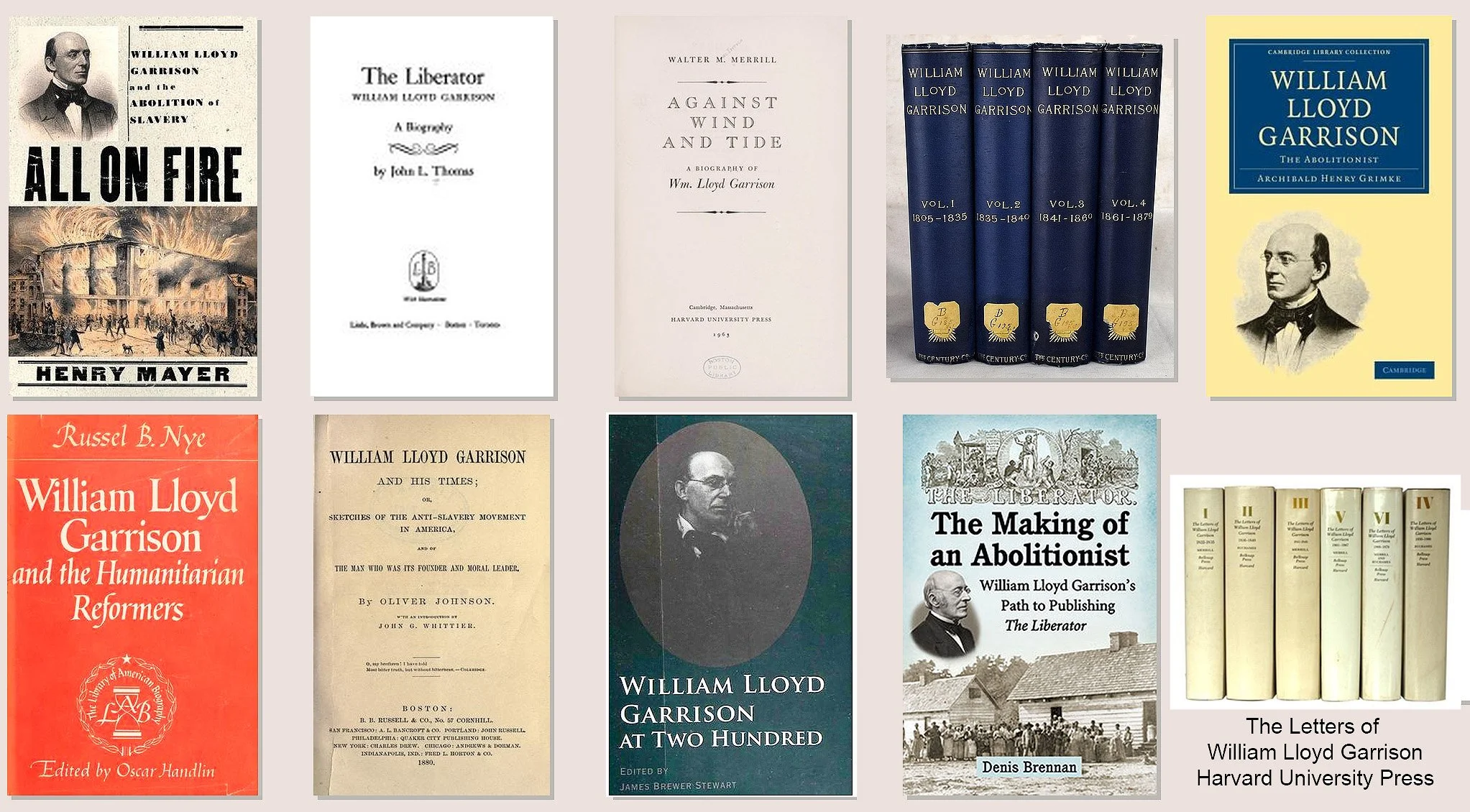
Above: William Lloyd Garrison was the most famous white abolitionist editor in the U. S. He was a founder of the American Anti-Slavery Society. Through The Liberator and relentless lecture work he demanded a radical commitment to immediate emancipation. He also advanced nonresistance, racial equality, and women’s right to participate fully in reform. He was not a Quaker. Image sources: Portrait: Library of Congress, Left statue: wfrjr.com, Right statue: James R. Murray, Book covers: Google Books, etc.
Lucretia Mott
“The Greatest American Woman of Her Era”
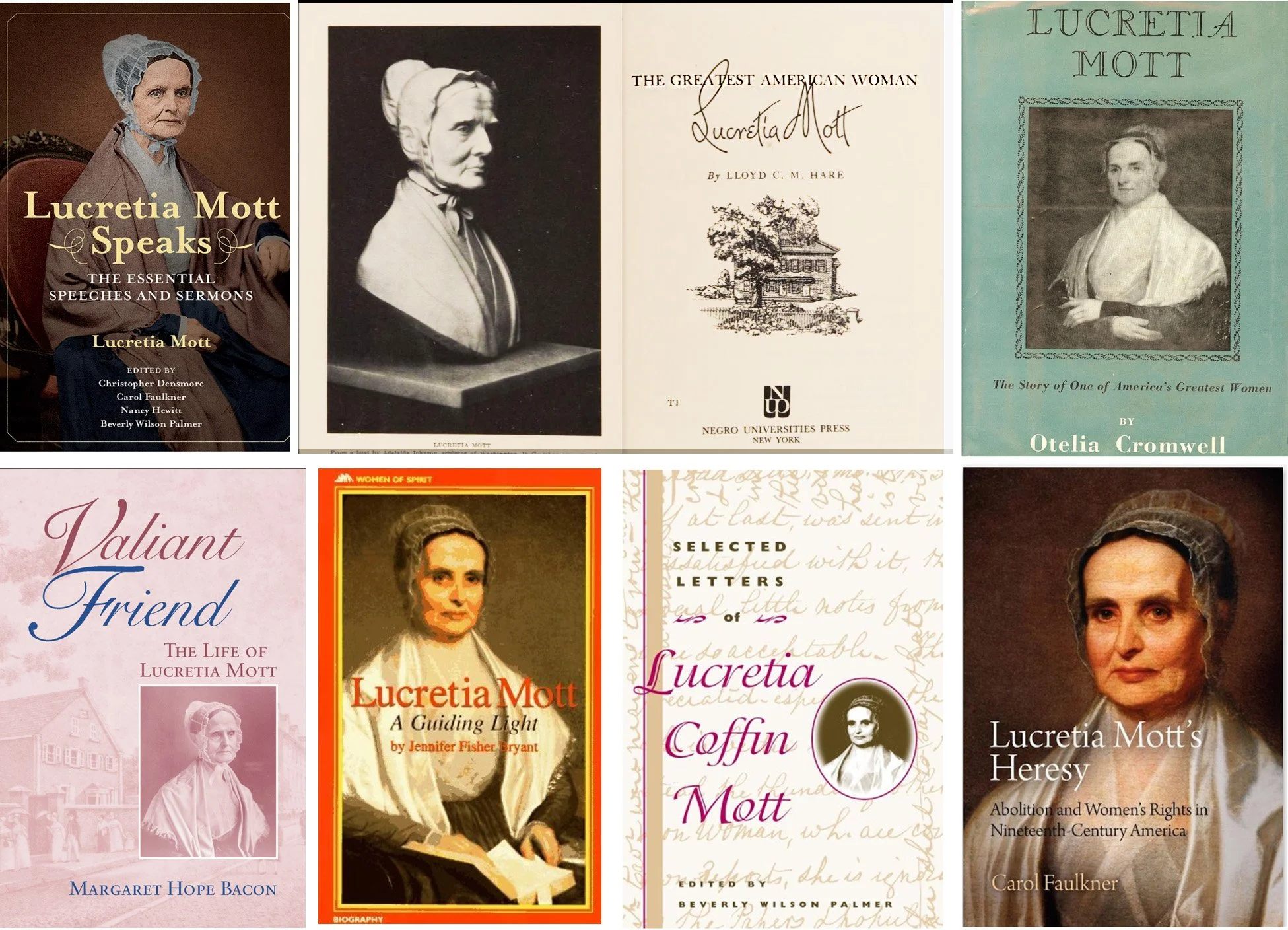
Above: Quaker minister Lucretia Mott was the leading white female anti-slavery activist in the U. S. She also an advocates of women’s rights. A founder of the Philadelphia Female Anti-Slavery Society and an organizer of the 1848 Seneca Falls convention. She also championed peace, religious liberty, and racial equality.
Lucretia Mott has often been described as the greatest American woman of her era.
Oliver Johnson
Anti-Slavery Editor and Reform Journalist:
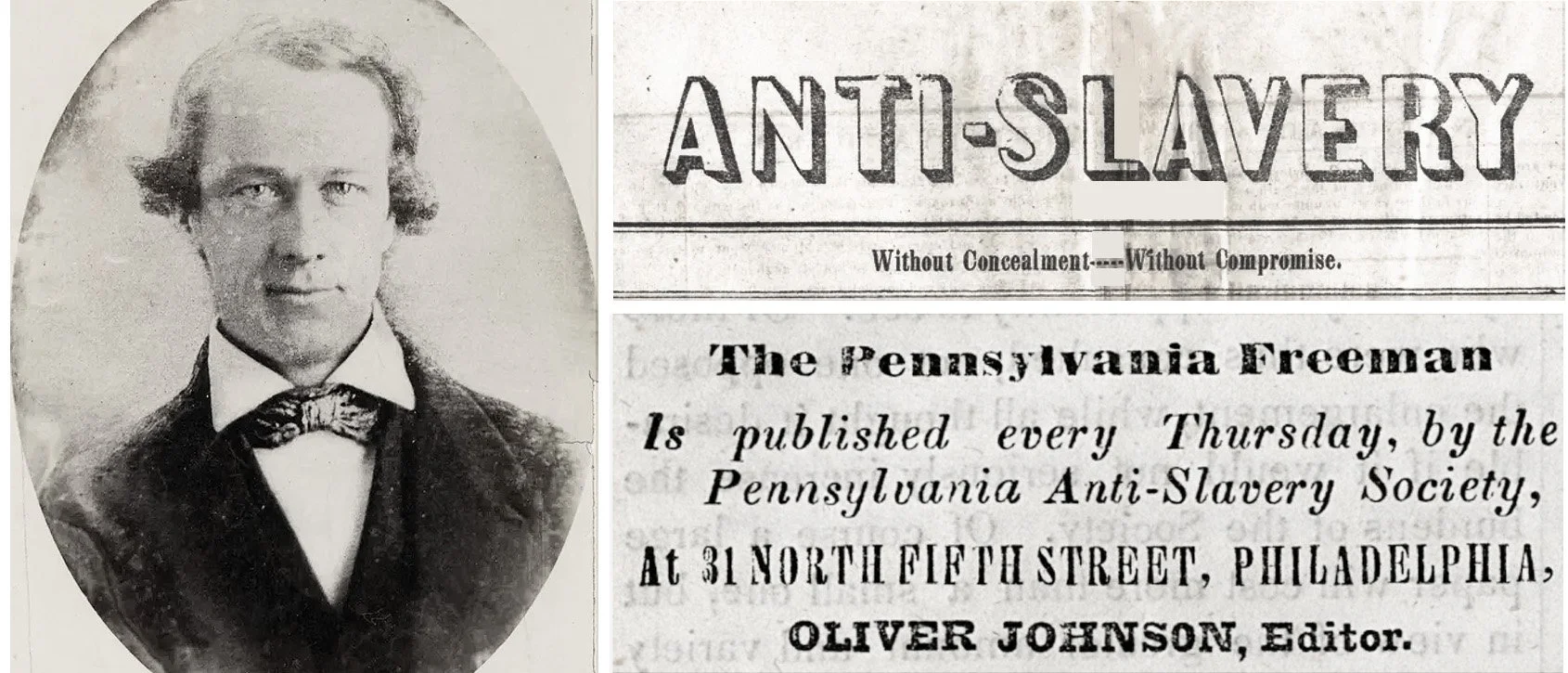
Above: Oliver Johnson was a leading Quaker anti-slavery journalist, editor, and lecturer. He edited or helped direct the Pennsylvania Freeman, the Anti-Slavery Bugle, the National Anti-Slavery Standard, and later The Independent. He used the press to advance emancipation, equal rights, and liberal religion. He was not a Quaker.
Johnson was a longtime clerk of the Longwood Yearly Meeting of Progressive Friends. He served as the meeting’s principal officer and one of its most influential leaders. Portrait source: Burlington Free Press.
Chandler Darlington and Hannah Darlington
Chester County Quaker Activists:
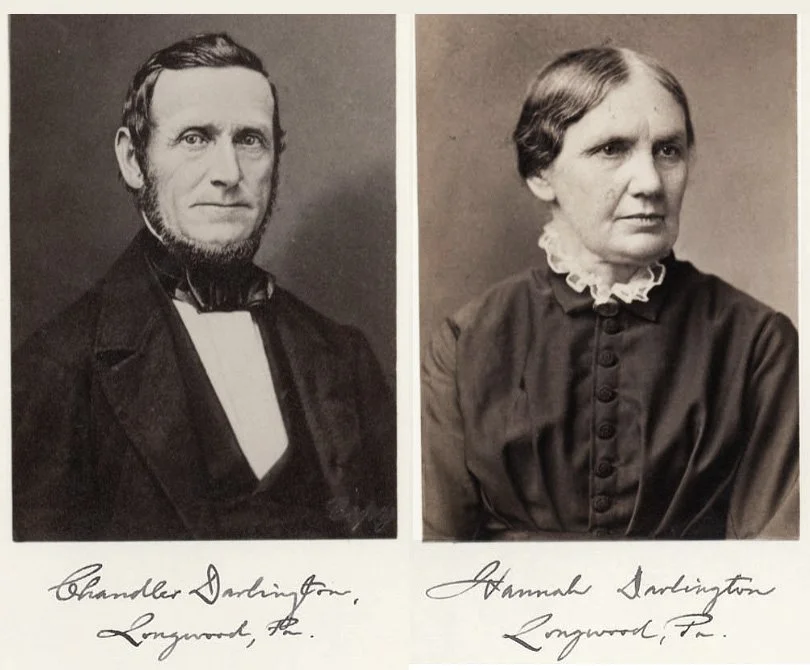
Above: Chandler Darlington was a Quaker anti-slavery activist from Kennett Square. He was a conductor on the Underground Railroad, and a signer of the American Anti-Slavery Society’s 1833 Declaration of Sentiments. He and his wife, Hannah Darlington, hosted nationally known reformers and helped make the Longwood Progressive Friends a platform for abolition, racial equality, women’s rights, peace, and religious freedom.
Hannah Monaghan Darlington, wife of Chandler Darlington, was a Quaker anti-slavery activist, Underground Railroad conductor, temperance advocate, and early women’s-rights organizer. She attended the first National Woman’s Rights Convention in 1850, served as its secretary, and organized the influential Pennsylvania Woman’s Rights Convention at West Chester in 1852. Image source: Massachusetts Historical Society.
Thomas Garrett
A Fearless Organizer
of the Underground Railroad:
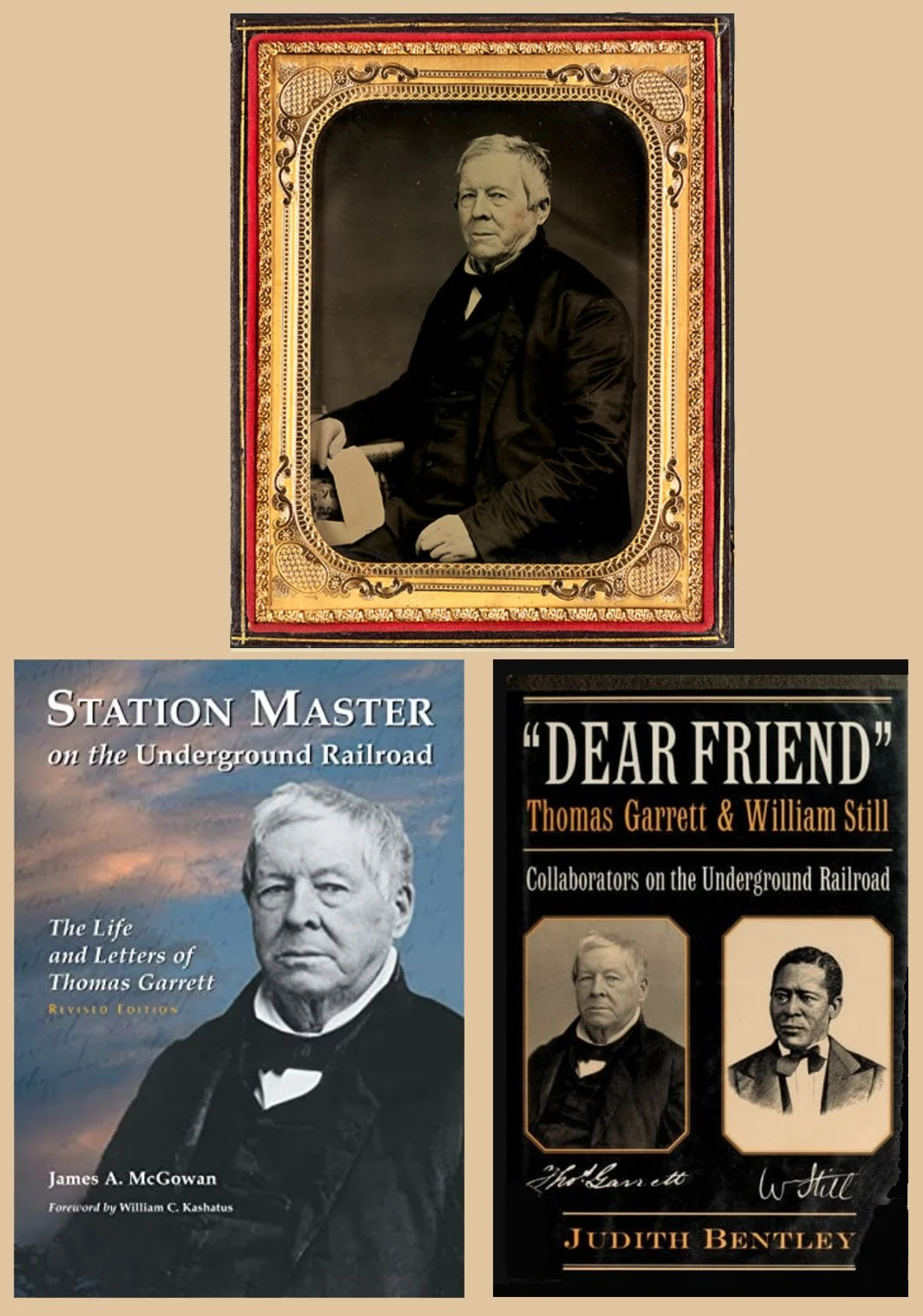
Thomas Garrett was a Wilmington Quaker abolitionist and one of the Underground Railroad’s best-known station masters. Despite prosecution and financial ruin under the Fugitive Slave Law, he continued assisting freedom seekers, worked closely with Harriet Tubman and William Still, and is credited with helping thousands reach freedom.
Garrett’s Underground Railroad work came at great personal and financial risk. In 1848, he was convicted in federal court for helping the Hawkins family escape slavery and faced judgments that cost him much of his personal wealth. Yet he refused to abandon the cause, publicly declaring that anyone who knew of an enslaved person needing assistance should send that person to him. Image source: Portrait: Eastern Illinois University.
J. Williams Thorne
Quaker Abolitionist, Educator, and Reformer:
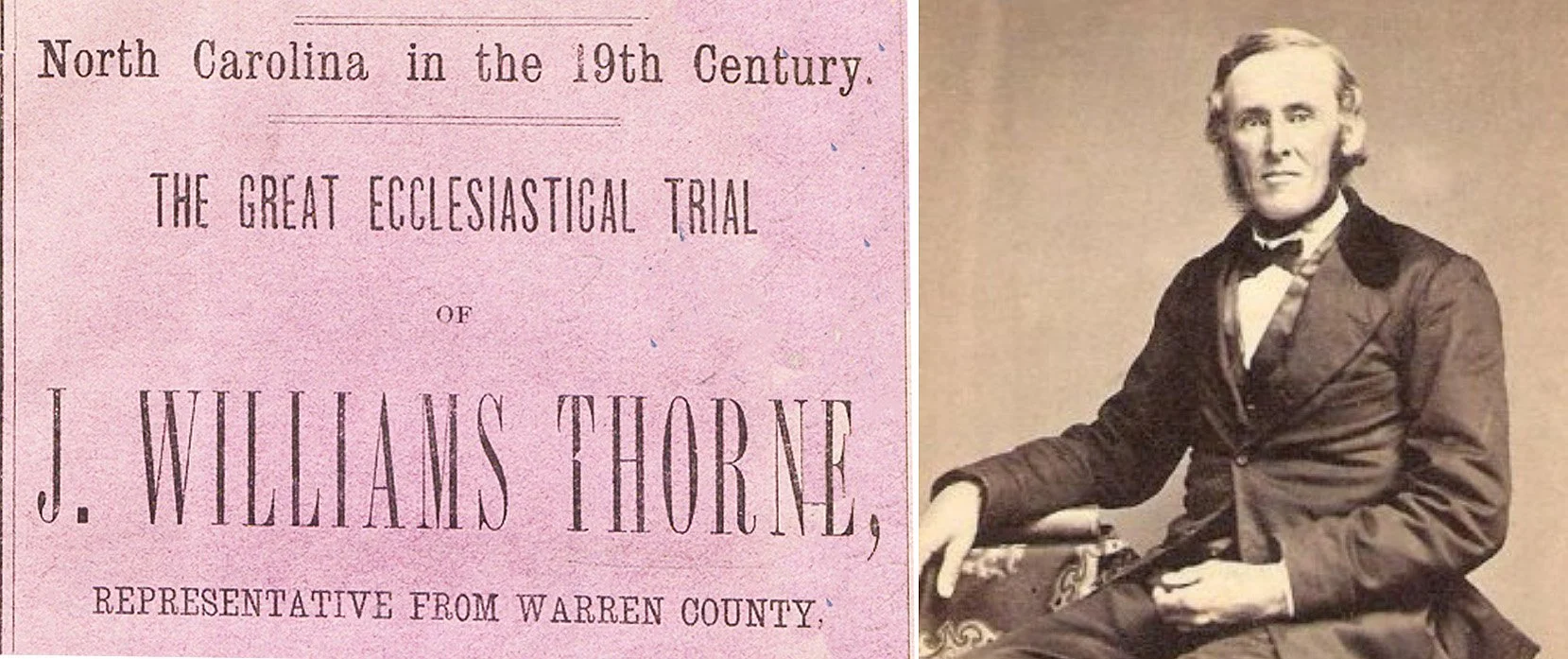
Above: Joseph Williams Thorne was a Chester County Quaker farmer and Underground Railroad host who later entered Reconstruction politics in North Carolina. He advocated Black civil rights, public education, temperance, and freethought.
In 1873 Thorne published a twelve-page religious tract criticizing orthodox Christianity and defending freedom of religious thought. His political opponents later used the pamphlet to portray him as religious outsider, and to support his expulsion from the North Carolina legislature. Image sources: Pamphlet: Cornell University Library, Portrait: AncestorsFamilySearch.
Joseph A. Dugdale and Ruth T. Dugdale
Quaker Abolitionists and Progressive Reformers:
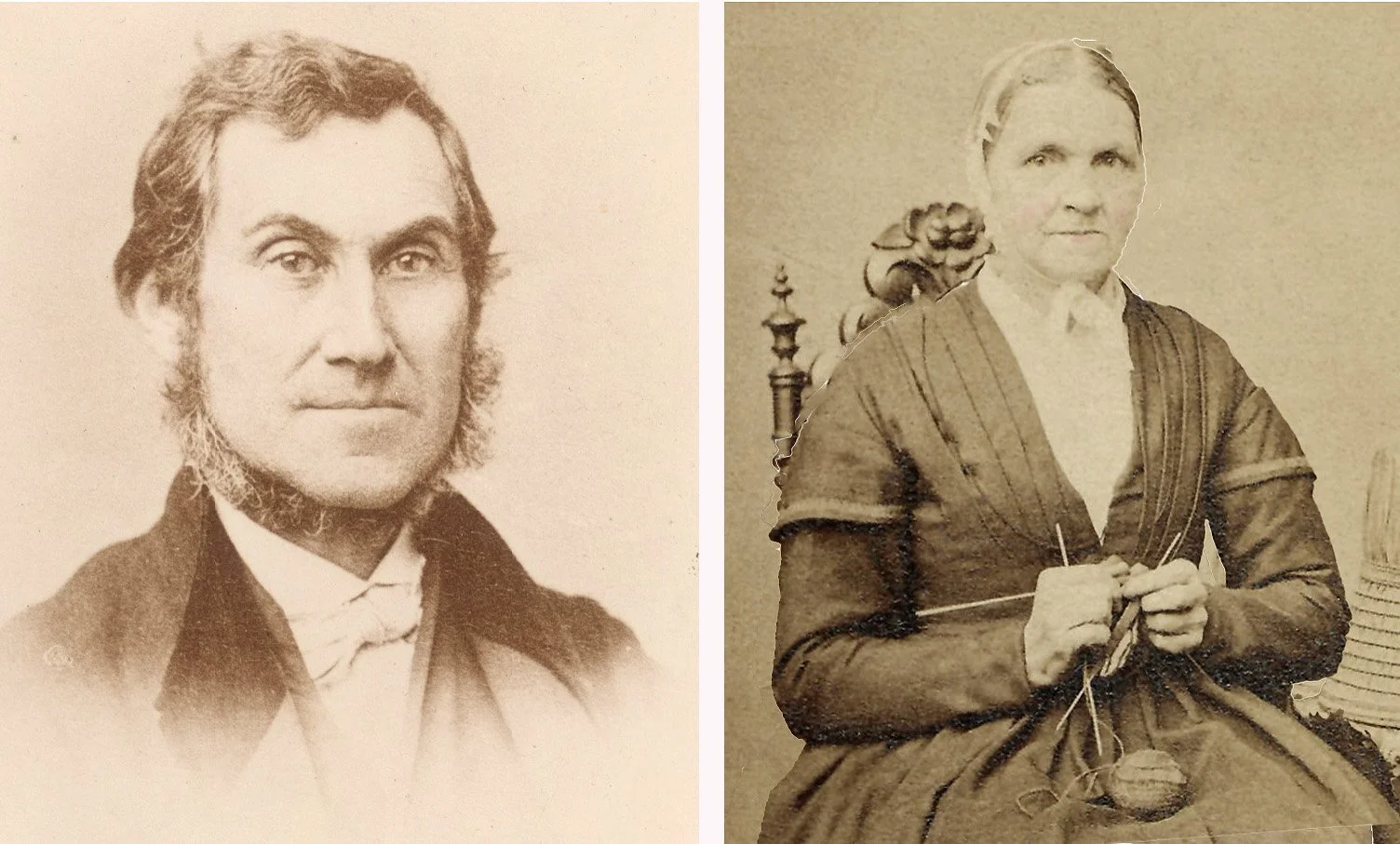
Joseph A. Dugdale was a Quaker abolitionist, women’s-rights advocate, and a principal organizer of the Pennsylvania Yearly Meeting of Progressive Friends. His national reform connections and work at early women’s-rights conventions helped make Longwood an unusually open platform for activism regarding abolition, religious liberty, and equality.
Ruth Townsend Dugdale (Mrs. Joseph Dugdale) was a Quaker abolitionist and early woman’s-rights organizer whose work joined the local Chester County movement to national conventions. She was among the Pennsylvania women remembered in the early history of woman suffrage for sustaining both antislavery and women’s equality campaigns. Portraits source: TriCollegeLibraries.
Alfred H. Love
Anti-War Activist, Nobel Peace Prize Nominee:
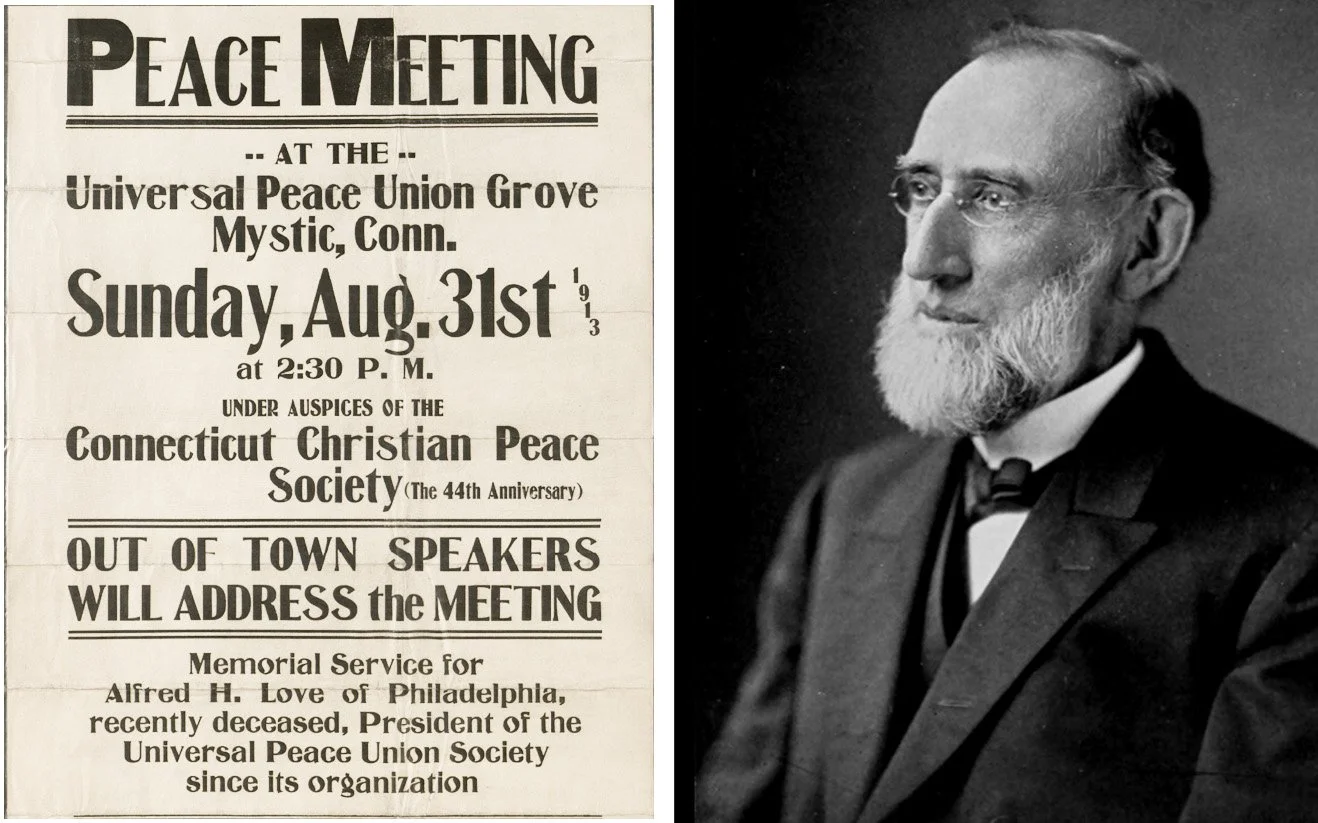
Above: Alfred H. Love of Philadelphia was a Quaker merchant, abolitionist, and one of the most persistent American peace advocates of his era. He founded the Universal Peace Union in 1866 and linked nonviolence to racial justice, labor reform, Native rights, woman suffrage, and humane treatment of animals.
During the Civil War he refused military service. He also refused to sell textiles from his woolen-goods company to the army, a decision that led to the failure of the business. After the war he founded the Universal Peace Union, serving as its president from 1866 until his death in 1913. He was also vice president of the Pennsylvania Abolition Society and was nominated for the Nobel Peace Prize in 1903, 1904, and 1906. Images: Poster: TriCollegeLibraries, Portrait: The National Cyclopedia of American Biography.
Samuel Joseph May
Unitarian Minister and Activist:
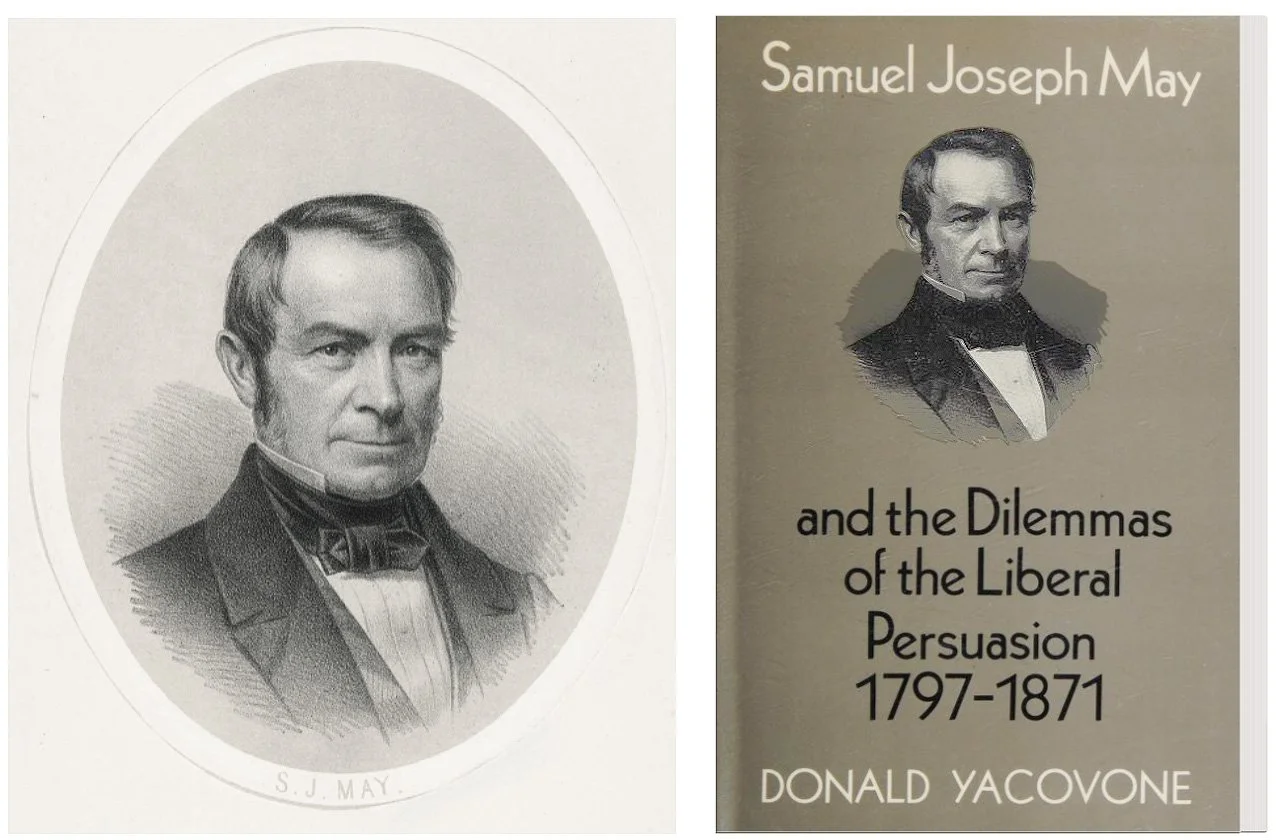
Samuel Joseph May Publications
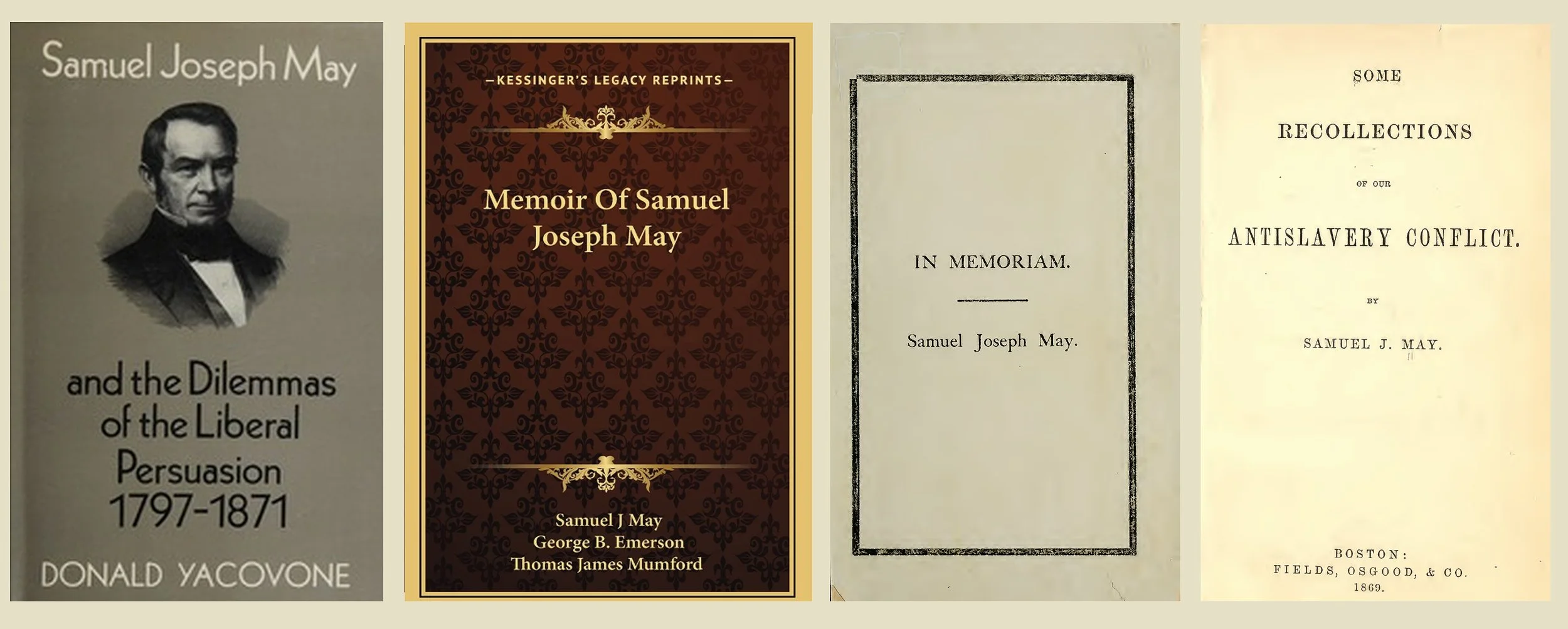
Above: Samuel Joseph May was a nationally influential Unitarian minister, abolitionist, and reform lecturer. He was a founder of the American Anti-Slavery Society and became one of the country's most persistent advocates for immediate emancipation. He also supported integrated education, women’s rights, peace, temperance, and resistance to the Fugitive Slave Law.
In 1833 he established the anti-slavery newspaper The Unionist. His writings included The Rights and Condition of Women and Some Recollections of Our Antislavery Conflict (1869), an important firsthand account of the abolitionist movement. Image source: Portrait: Massachusetts Historical Society, Book cover: Internet Archive.
National Reform Speakers in the Progressive Friends Proceedings, 1853-1872
A researched guide to nationally prominent and nationally active abolitionists, suffragists, peace advocates, religious liberals, public lecturers, editors, journalists, and other reform figures named in the supplied speaker index.
How to read this guide: The supplied file is an Excel index of the published proceedings, although it was described as a PDF. The Longwood Progressive Meetinghouse first hosted the annual gathering in 1855. Entries from 1853 and 1854 therefore belong to predecessor meetings and are identified separately.
What “appearances” means: Each count represents a separate indexed speaking or participation entry. An appearance might be a formal address, brief remarks, a discussion contribution, a report, a reading, or a song. The guide gives both the number of annual meetings and the number of indexed appearances because one person could appear several times during a single meeting.
Selection standard: National fame is not a perfectly objective category. This roster includes people with a recognized national reputation, a national organization role, a national lecture or publishing career, or documented work in a reform network extending beyond one state. It does not attempt to list every locally important Progressive Friend.
Speakers ranked by frequency of appearance at Longwood, 1855-1872
Order: Profiles are arranged by indexed Longwood appearances, from most frequent to least frequent. Ties are ordered first by the number of annual meetings and then alphabetically. Speakers with no recorded Longwood appearance are listed separately at the bottom.
Oliver Johnson
Oliver Johnson was a major anti-slavery journalist, editor, and lecturer. He edited or helped direct the Pennsylvania Freeman, the Anti-Slavery Bugle, the National Anti-Slavery Standard, and later The Independent. He used the press to advance emancipation, equal rights, and liberal religion.
Longwood record: 17 annual meetings; 73 indexed appearances, covering every Longwood meeting from 1855 through 1872 except 1861, when no annual meeting was held. 1855 (5): correspondence, religion, reform, amusements, and tobacco. 1856 (7): support for reform, labor, First-day meetings, amusements, slavery, and tobacco. 1857 (4): religion and reform, itinerant reform, education, and capital punishment. 1858 (7): the meeting’s purposes, itinerant reform, racial equality, worship, peace, liberal religion, and sectarianism. 1859 (5): the call to the meeting, Spiritualism, sectarianism, slavery, and Theodore Parker. 1860 (3): worship, slavery and the national crisis, and kindness to animals. 1862 (3): resuming the meeting, public prayer, and religious expression. 1863 (4): opening business, the meeting’s purposes, the Slaveholders’ Rebellion, and universal emancipation. 1864 (2): slavery, war, and reform; religion and reform. 1865 (4): the end of slavery, religion after emancipation, temperance, and freedpeople. 1866 (5): religion, Reconstruction, political equality, and memorials. 1867 (1): liberal theology. 1868 (4): memorials, freedpeople and racial equality, music, and farewell reflections. 1869 (4): opening business, “Our Country,” crime, and temperance. 1870 (2): prison reform; religion and common schools. 1871 (7): the meeting’s history, memorials, Theodore Parker, religion, the woman question, temperance, children’s rights, and labor. 1872 (6): the meeting’s principles, religion, peace, arbitration, the Constitution and schools, and prison reform.
William Lloyd Garrison
William Lloyd Garrison was the nation’s most famous white abolitionist editor and a founder of the American Anti-Slavery Society. Through The Liberator, relentless lecture work, and a radical commitment to immediate emancipation, he also advanced nonresistance, racial equality, and women’s right to participate fully in reform.
Longwood record: 7 annual meetings; 46 indexed appearances. 1857 (10): popular religion and moral responsibility; slavery and reform; itinerant reform; Spiritualism; war, capital punishment, temperance, tobacco, women’s equality, and farewell reflections. 1862 (3): public prayer; slavery, emancipation, and the rebellion; the memorial urging Lincoln to emancipate enslaved people. 1864 (2): George Thompson and antislavery; religious reading. 1865 (5): the end of slavery, rebellion, peace, memorials, universal suffrage, temperance, and freedpeople. 1868 (7): memorials; freedpeople and racial equality; woman’s rights; the meeting’s testimonies; Black suffrage in the North; farewell reflections. 1870 (9): prison discipline and prison reform; temperance; woman suffrage; tobacco; religion and common schools; closing reflections. 1871 (10): memorials; Theodore Parker; religion; the woman question; temperance; religious life; kindness to animals; peace; labor.
Chandler Darlington
Chandler Darlington was a Chester County abolitionist, Underground Railroad participant, and a signer of the American Anti-Slavery Society’s 1833 Declaration of Sentiments. He and his wife, Hannah, hosted nationally known reformers and helped make the Progressive Friends a platform for abolition, racial equality, woman suffrage, peace, and religious freedom.
Longwood record: 15 annual meetings; 44 indexed appearances. 1855 (3): amusements, tobacco, and slavery. 1856 (4): First-day meetings, amusements, woman’s rights, and tobacco. 1858 (5): itinerant reform, caste and racial equality, public worship, war and peace, and liberal religion. 1859 (4): Spiritualism, committee work, marriage, and the meeting’s testimony. 1860 (1): slavery and the national crisis. 1862 (3): public prayer and emancipation. 1863 (2): the Slaveholders’ Rebellion and universal emancipation. 1864 (1): religious sentiment across the ages. 1865 (2): universal suffrage and equal political rights; temperance. 1866 (2): religion, Reconstruction, and the meeting’s purposes. 1867 (4): war and peace; religion; liberal theology; religion and reform. 1868 (4): meeting property, freedpeople and racial equality, religious liberty, and closing reflections. 1869 (2): labor and capital; temperance. 1870 (2): prison reform; tobacco. 1871 (5): memorials, religion, temperance, children’s rights, and labor. Earlier record: 1 appearance at Old Kennett in 1853 on the organization and principles of the Progressive Friends.
J. Williams Thorne
Joseph Williams Thorne was a Chester County Quaker farmer and Underground Railroad host who later entered Reconstruction politics in North Carolina. He advocated Black civil rights, public education, temperance, and freethought.
In 1873 Thorne published a twelve-page religious tract criticizing orthodox Christianity and defending freedom of religious thought. His political opponents later used the pamphlet to portray him as religious outsider, and to support his expulsion from the North Carolina legislature.
Longwood record: 12 annual meetings; 37 indexed appearances, combining entries under “J. W. Thorne” and “J. Williams Thorne.” 1855 (2): correspondence, religion, reform, and amusements. 1860 (2): slavery and the national crisis; kindness to animals. 1862 (1): peace, emancipation, and national reform. 1863 (1): universal emancipation. 1865 (2): universal suffrage and equal political rights; temperance. 1866 (1): Reconstruction. 1867 (4): war and peace; religion; liberal theology; religion and reform. 1868 (3): freedpeople and racial equality; Black suffrage; farewell reflections. 1869 (3): crime; labor and capital, money and interest; temperance. 1870 (6): prison reform, temperance, racial progress and civil rights in North Carolina, woman suffrage, tobacco, and public schools. 1871 (8): memorials, religion, temperance, religious life, kindness to animals, children’s rights, peace, and labor. 1872 (4): religion; education and child development; peace and arbitration; temperance.
Joseph A. Dugdale
Joseph A. Dugdale was a Quaker abolitionist, woman’s-rights advocate, and principal organizer of the Pennsylvania Yearly Meeting of Progressive Friends. His national reform connections and work at early woman’s-rights conventions helped make Longwood an unusually open platform for antislavery, religious liberty, and equality.
Longwood record: 6 annual meetings; 29 indexed appearances. 1855 (3): opening and introduction of Theodore Parker; worship; tobacco. 1856 (5): opening worship and business; education; support for reform work. 1857 (4): opening worship; the meeting’s purpose; education. 1858 (4): education; itinerant reform; caste and racial equality; war and peace. 1859 (8): worship, religion and reform, committee work, criminal justice, marriage, correspondence, testimony, and closing. 1860 (5): opening and introduction of A. D. Mayo; religion and reform; worship; cruelty to animals; memorial to Theodore Parker. Earlier record: 7 indexed appearances at the 1853 and 1854 predecessor meetings.
Alfred H. Love
Alfred H. Love was a Philadelphia merchant, abolitionist, and one of the most persistent American peace advocates of the nineteenth century. He founded the Universal Peace Union in 1866 and linked nonviolence to racial justice, labor reform, Native rights, woman suffrage, and humane treatment of animals.
In 1906 he was nominated for a Nobel Peace Price by eight U. S. Senators.
Longwood record: 8 annual meetings; 18 indexed appearances. 1856 (2): capital and labor; amusements. 1858 (3): itinerant reform meetings; war and peace; religious revival and liberal religion. 1859 (2): capital and labor; treatment of criminals. 1860 (3): religion and reform; general reform work; slavery and the national crisis. 1862 (2): correspondence and reform; slavery, emancipation, and the rebellion. 1863 (1): the work of Progressive Friends during the national crisis. 1867 (2): war and peace; liberal theology. 1868 (3): memorials; freedpeople and racial equality; woman’s rights.
Biographical source: Mary Baker Eddy Library
Samuel J. May
Samuel Joseph May was a nationally influential Unitarian minister, abolitionist, educator, and reform lecturer. A founder of the American Anti-Slavery Society, he also supported integrated education, woman’s rights, peace, temperance, and resistance to the Fugitive Slave Law.
Longwood record: 2 annual meetings; 13 indexed appearances. 1856 (12): “False Ideas of God”; religion and reform; education; support for reform work; capital and labor; treatment of criminals; religious reading; First-day meetings; amusements; slavery; and farewell reflections. 1868 (1): woman’s rights.
Lucretia Mott
Lucretia Coffin Mott was one of the nation’s foremost abolitionists, Quaker ministers, and advocates of women’s rights. A founder of the Philadelphia Female Anti-Slavery Society and an organizer of the 1848 Seneca Falls convention, she also championed peace, religious liberty, and racial equality.
Longwood record: 4 annual meetings; 12 indexed appearances. 1856 (4): conceptions of God; liberal religion; support for reform; farewell reflections and woman’s rights. 1857 (4): openness to truth; itinerant reform; Spiritualism; education. 1867 (2): the country and liberal ideas; religion and reform. 1871 (2): the woman question; religious truth, spiritual life, and farewell reflections. Earlier record: 1 appearance at Old Kennett in 1853.
W. H. Hoisington
W. H. Hoisington was a nationally traveling Spiritualist and reform lecturer listed on mid-nineteenth-century lecture circuits. His Longwood contributions show how Spiritualism overlapped with antislavery, religious reform, opposition to capital punishment, peace, and humane treatment of animals.
Longwood record: 2 annual meetings; 11 indexed appearances. 1857 (7): religion and reform; religion and slavery; itinerant reform; Spiritualism; slavery; capital punishment; farewell reflections. 1860 (4): religion and reform; slavery and the national crisis; cruelty to animals.
Biographical evidence: national lecturer list in The Spiritual Republic
Mary Ann White Johnson was an abolitionist, woman’s-rights advocate, and prison reformer who had worked as assistant matron in the women’s prison at Sing Sing. She served on committees in the national woman’s-rights movement and, with her husband Oliver Johnson, remained active in the antislavery and Progressive Friends networks.
Longwood record: 6 annual meetings; 10 indexed appearances, combining “Mary A. W. Johnson” and “Mary Anne W. Johnson.” 1856 (3): amusements; woman’s rights; tobacco. 1857 (1): Spiritualism. 1859 (3): Spiritualism; treatment of criminals; marriage. 1869 (1): labor and capital, money and interest. 1870 (1): prison reform. 1871 (1): temperance. Earlier record: 2 appearances at Old Kennett in 1853.
Rowland Johnson
Rowland Johnson was a Philadelphia abolitionist, Underground Railroad operative, and nationally prominent officer of the American Anti-Slavery Society. Raised in the Johnson family’s Germantown antislavery household, he also supported woman’s rights, peace, and religious reform.
Longwood record: 4 annual meetings; 9 indexed appearances. 1857 (4): religion, slavery, and reform; nomination of clerks; itinerant reform; Spiritualism. 1859 (2): religion and reform; treatment of criminals. 1860 (2): religion and reform. 1867 (1): war and peace. Earlier record: 4 indexed appearances at the 1853 and 1854 predecessor meetings.
Theodore Tilton
Theodore Tilton was a nationally known newspaper editor, abolitionist, Reconstruction advocate, and lecturer for woman suffrage and equal rights. As editor of The Independent, he made the paper an influential forum for emancipation and postwar reform before his career was overtaken by public scandal.
Longwood record: 3 annual meetings; 9 indexed appearances. 1862 (2): religious reading; slavery, emancipation, and the rebellion. 1864 (3): slavery, the rebellion, and memorials; racial prejudice; religion and reform. 1866 (4): religion, Reconstruction, and the meeting’s purposes; political equality; Reconstruction; religion.
Hutchinson Family and Joshua Hutchinson
The Hutchinson Family Singers were among the nation’s most popular nineteenth-century touring musicians and used close-harmony songs to advance abolition, temperance, woman’s rights, and labor reform. Their performances turned reform arguments into memorable public culture, and individual family members, including Joshua Hutchinson, continued the work as the original group changed.
Longwood record: 3 annual meetings; 8 indexed musical appearances, combining 5 entries credited to the Hutchinson Family with 3 credited to Joshua Hutchinson. 1855 (2): “Spero Meliora”; Longfellow’s “Psalm of Life.” 1864 (3): reform songs and closing music. 1865 (3, Joshua Hutchinson): an opening song; “It Is Well”; a reform song.
Thomas Garrett
Thomas Garrett was a Wilmington Quaker abolitionist and one of the Underground Railroad’s best-known station masters. Despite prosecution and financial ruin under the Fugitive Slave Law, he continued assisting freedom seekers, worked closely with Harriet Tubman and William Still, and is credited with helping thousands reach freedom.
Longwood record: 7 annual meetings; 7 indexed appearances. 1855 (1): capital and labor. 1856 (1): tobacco. 1858 (1): war and peace. 1860 (1): meeting finances. 1862 (1): nominations and business. 1866 (1): meeting business and reform. 1869 (1): crime and criminals. Earlier record: 2 indexed appearances at the 1853 and 1854 predecessor meetings.
Bartholomew Fussell
Dr. Bartholomew Fussell was a Quaker physician, abolitionist, Underground Railroad participant, and founding member of the American Anti-Slavery Society. He also helped initiate the movement for women’s medical education that led to the Female Medical College of Pennsylvania.
Longwood record: 3 annual meetings; 7 indexed appearances. 1856 (2): amusements; tobacco. 1857 (2): itinerant reform and support for reform lecturers; Spiritualism. 1858 (3): caste and racial equality; war and peace; temperance. Earlier record: 1 appearance at Old Kennett in 1853 on the organization, religious liberty, equality, and purposes of the Progressive Friends.
Frances D. Gage
Frances Dana Barker Gage was a nationally known abolitionist, woman-suffrage advocate, temperance reformer, writer, and lecturer. During the Civil War she worked among formerly enslaved people in the South, and she continued afterward to demand universal suffrage and equal civil rights.
Longwood record: 3 annual meetings; 7 indexed appearances. 1863 (2): conditions among freedpeople in the South; farewell reflections. 1865 (4): religion and reform after emancipation; “The Cause of Woman”; universal suffrage and equal political rights; freedpeople. 1866 (1): woman’s rights, Reconstruction, and equal suffrage.
John W. Chadwick
John White Chadwick was a nationally respected Unitarian minister, author, and advocate of Free Religion. He defended religious liberty and evolutionary thought while supporting peace, woman suffrage, child welfare, and other social reforms.
Longwood record: 1 annual meeting; 7 indexed appearances. 1871 (7): Theodore Parker; religion; the woman question; “The Life Which Now Is”; kindness to animals; children’s rights; farewell worship.
Sumner Stebbins
Dr. Sumner Stebbins was a Chester County physician, antislavery reformer, and widely circulated temperance and health writer. His public work connected moral reform, opposition to slavery, prison reform, and challenges to orthodox medical practice.
Longwood record: 4 annual meetings; 6 indexed appearances, combining “Dr. Sumner Stebbins” and “Sumner Stebbins.” 1860 (1): slavery and the national crisis. 1869 (2): crime and criminals; temperance. 1870 (2): prison reform and prison discipline; temperance. 1871 (1): temperance. Earlier record: 1 temperance address at Old Kennett in 1853.
Edward M. Davis
Edward Morris Davis was a Philadelphia Quaker abolitionist and son-in-law of Lucretia Mott. He supported the Underground Railroad, equal rights, and education for African Americans, and his property became the site of Camp William Penn, the first federal training camp created for Black troops in the North.
Longwood record: 3 annual meetings; 6 indexed appearances. 1860 (1): slavery and the national crisis. 1867 (1): temperance. 1871 (4): religious life; kindness to animals; peace; labor.
Theodore Parker
Theodore Parker was a nationally influential Unitarian minister, Transcendentalist thinker, and militant abolitionist. He aided freedom seekers through the Boston Vigilance Committee, resisted the Fugitive Slave Law, and used his pulpit to advance democracy, women’s equality, and religious freedom.
Longwood record: 2 annual meetings; 6 indexed appearances. 1855 (3): the sermon “The Delights of Piety”; amusements and moral reform; tobacco. 1858 (3): the biblical conception of God; the philosophical idea of God; the soul and the infinite God.
Mary A. Livermore
Mary Ashton Rice Livermore was a nationally popular lecturer, editor, abolitionist, Civil War relief organizer, temperance advocate, and woman-suffrage leader. She helped direct the Northwestern Sanitary Commission, founded The Agitator, and later became an editor of the Woman’s Journal.
Longwood record: 1 annual meeting; 6 indexed appearances. 1872 (6): “Christianity the Basis of Every True Reform”; education, kindergarten, and antenatal conditions of children; woman’s rights; whether war can ever be right; peace, arbitration, and an alternative peace testimony; progress, reform, peace, and the duties of the young.
Moncure D. Conway
Moncure Daniel Conway was a Virginia-born abolitionist, Unitarian minister, freethinker, author, and transatlantic reform lecturer. He broke with his slaveholding background, aided people enslaved by his own family in reaching freedom, and later led London’s radical South Place congregation.
Longwood record: 1 annual meeting; 6 indexed appearances. 1856 (6): support for reform work; treatment of criminals; First-day meetings; amusements; slavery; farewell reflections on reform.
Thomas Wentworth Higginson
Thomas Wentworth Higginson was a radical abolitionist, Unitarian minister, soldier, suffragist, writer, and editor. He supported militant resistance to slavery, commanded the First South Carolina Volunteers, one of the first federally authorized Black regiments, and later campaigned for women’s political equality.
Longwood record: 1 annual meeting; 6 indexed appearances. 1859 (6): progress and reform; closing worship; Spiritualism; marriage; sectarianism; slavery.
David A. Wasson
David Atwood Wasson was a Transcendentalist essayist, abolitionist minister, and influential voice in the Free Religious movement. His writing and preaching challenged orthodox authority and tied religious freedom to moral self-culture and social reform.
Longwood record: 1 annual meeting; 5 indexed appearances. 1856 (5): correspondence and liberal religion; capital and labor; amusements; slavery; farewell reflections on reform.
Frederick W. Evans
Frederick William Evans was a leading Shaker elder, author, and national publicist for communal life. He defended shared property, equality of the sexes, pacifism, vegetarianism, and economic cooperation, presenting Shaker practice as a broad program of social reform.
Longwood record: 1 annual meeting; 5 indexed appearances. 1856 (5): capital and labor; First-day meetings; amusements; slavery; woman’s rights.
Henry B. Blackwell
Henry Browne Blackwell was an abolitionist, national woman-suffrage organizer, journalist, and strategist. He helped found the American Woman Suffrage Association and, with Lucy Stone, established the influential Woman’s Journal, which he edited for decades.
Longwood record: 1 annual meeting; 5 indexed appearances. 1869 (5): crime and criminals; woman suffrage; labor and capital, money and interest; religion; liberal faith.
Theodore D. Weld
Theodore Dwight Weld was one of the most effective national organizers of the immediate abolition movement. He trained antislavery lecturers, helped shape congressional antislavery strategy, and compiled American Slavery As It Is, an influential documentary indictment of slavery.
Longwood record: 1 annual meeting; 5 indexed appearances. 1863 (5): free religious organization; “Truth and Its Hindrances”; the Slaveholders’ Rebellion; the memorial for universal emancipation; farewell reflections.
Ruth Dugdale
Ruth Dugdale was a Quaker abolitionist and early woman’s-rights organizer whose work joined the local Chester County movement to national conventions. She was among the Pennsylvania women remembered in the early history of woman suffrage for sustaining both antislavery and women’s equality campaigns.
Longwood record: 4 annual meetings; 4 indexed appearances. 1856 (1): tobacco. 1857 (1): war and peace. 1858 (1): temperance. 1859 (1): marriage.
Robert Purvis
Robert Purvis was a leading Black abolitionist, co-founder of the American Anti-Slavery Society, and president of the Pennsylvania Anti-Slavery Society. He chaired Philadelphia’s Vigilance Committee, aided freedom seekers through the Underground Railroad, and fought for Black voting rights and equal citizenship.
Longwood record: 3 annual meetings; 4 indexed appearances. 1864 (1): racial prejudice and Black equality. 1867 (1): war and peace. 1868 (2): freedpeople and racial equality; Black suffrage in the North.
A. D. Mayo
Amory Dwight Mayo was a prominent Unitarian minister, writer, and advocate of universal public education. After the Civil War he traveled extensively through the South, promoting tax-supported schools and educational opportunity across lines of class and race.
Longwood record: 1 annual meeting; 4 indexed appearances. 1860 (4): “The Method of Reform”; religion and reform; religious worship; religion and theology.
Celia Burleigh
Celia C. Burleigh was a journalist, woman-suffrage lecturer, and the first woman ordained to the Unitarian ministry. Through the national lecture circuit and her ministry, she promoted women’s equality, liberal religion, and the rights and moral education of children.
Longwood record: 1 annual meeting; 4 indexed appearances. 1871 (4): “The Ministry of Sin”; “The Life Which Now Is” and religious life; the rights of children.
Frederick Hinckley
Frederick A. Hinckley was a Unitarian minister, Free-Soil activist, and national advocate for woman suffrage. He used pulpits and reform platforms to promote liberal religion, education, peace, and political equality.
Longwood record: 1 annual meeting; 4 indexed appearances. 1872 (4): religion; Christianity and world religions; education, kindergarten, and antenatal conditions of children; labor reform.
Rebecca Fussell
Rebecca Fussell Trimble was a Quaker abolitionist, educator, and advocate of woman’s rights and temperance. She entered national antislavery memory after trying to shield Frederick Douglass during the 1843 mob attack on abolitionist speakers at Pendleton, Indiana.
Longwood record: 1 annual meeting; 4 indexed appearances. 1858 (4): itinerant reform meetings; caste and racial equality; war and peace; religious revival and liberal religion.
William W. Newell
William Wells Newell was a minister, educator, author, and pioneering folklorist with a national scholarly and editorial reputation. He founded the American Folklore Society and served as the first editor of the Journal of American Folklore, while his Longwood participation reflected earlier commitments to liberal religion and peace.
Longwood record: 1 annual meeting; 4 indexed appearances. 1867 (4): religion and reform; war and peace; religion; religion and liberal theology.
Biographical source: American Folklore Society
Anna E. Dickinson
Anna Elizabeth Dickinson became a nationally famous abolitionist and political orator while still in her teens. She spoke for emancipation, Black civil and political rights, and woman suffrage, and in 1864 became the first woman to deliver a political address in the chamber of the U.S. House of Representatives.
Longwood record: 3 annual meetings; 3 indexed appearances. 1864 (1): religion, equality, and reform. 1866 (1): Reconstruction and political equality. 1868 (1): Black suffrage in the North.
Fielder Israel
Fielder Israel was a Unitarian minister and reform organizer whose work crossed religious, racial, and political lines. He served as secretary of the Maryland branch of the American Freedmen’s Union Commission and participated in the national equal-suffrage network that became the American Woman Suffrage Association.
Longwood record: 2 annual meetings; 3 indexed appearances. 1868 (2): freedpeople and racial equality; Black suffrage in the North. 1869 (1): religion and liberal faith.
Oscar Clute
Oscar Clute was a Unitarian minister, educator, and suffrage advocate active in New Jersey and on the national American Woman Suffrage Association platform. He later led Michigan State Agricultural College and Florida Agricultural College, extending his reform interests into public and scientific education.
Longwood record: 2 annual meetings; 3 indexed appearances. 1869 (1): labor and capital; money and interest. 1872 (2): religion; education and the kindergarten method.
A. C. Cotton
The index gives only this speaker’s initials. Contemporary Spiritualist print sources identify an A. C. Cotton of Vineland, New Jersey, as a physician and later editor and publisher of The Rostrum, a reform periodical devoted to Spiritualism, liberal thought, and human progress; this identification is probable, but not conclusive.
Longwood record: 1 annual meeting; 3 indexed appearances. 1872 (3): peace and whether war can ever be right; peace, arbitration, and an alternative peace testimony; temperance.
Griffith M. Cooper
Longwood record: 1 annual meeting; 3 indexed appearances. 1859 (3): religious experience, peace, and Native Americans; treatment of criminals; slavery.
Henry Blanchard
Henry Blanchard was a Universalist and Unitarian minister who became a national speaker for woman suffrage. He helped organize the American Woman Suffrage Association and later served as president of the Maine Woman Suffrage Association.
Longwood record: 1 annual meeting; 3 indexed appearances. 1868 (3): a formal discourse on “Individual Responsibility”; Black suffrage in the North; farewell reflections.
Henry C. Wright
Henry Clarke Wright was a radical abolitionist, pacifist, author, and international reform lecturer. A committed Garrisonian and advocate of nonresistance, he also attacked capital punishment and coercive marriage laws while demanding equal rights for women.
Longwood record: 1 annual meeting; 3 indexed appearances. 1867 (3): war and peace; religion; religion and reform.
John Beeson
John Beeson was an abolitionist and Underground Railroad participant who became a nationally visible advocate for Native American rights after living in Oregon. His book A Plea for the Indians, lectures, and lobbying condemned settler violence and urged federal protection and fair treatment for Native peoples.
Longwood record: 1 annual meeting; 3 indexed appearances. 1859 (3): wrongs against Native Americans; Spiritualism; marriage.
Laura De Force Gordon
Laura de Force Gordon was a nationally active suffrage lecturer, journalist, publisher, and one of California’s first women lawyers. She helped build the Pacific Coast woman-suffrage movement, published and edited newspapers, and argued women’s political and professional equality before legislatures and constitutional conventions.
Longwood record: 1 annual meeting; 3 indexed appearances. 1872 (3): peace, arbitration, and an alternative peace testimony; “The Constitution and the Schools”; temperance.
Robert Collyer
Robert Collyer was a blacksmith who became a nationally prominent Methodist and then Unitarian minister, author, and public lecturer. His antislavery views cost him his Methodist preaching license, and during the Civil War he aided the U.S. Sanitary Commission before building a national reputation for liberal religion and social reform.
Longwood record: 1 annual meeting; 3 indexed appearances. 1867 (3): war and peace; religion and liberal theology; liberal religion and social reform.
William Henry Channing
William Henry Channing was a Unitarian minister, Transcendentalist, author, editor, Christian socialist, and abolitionist. He worked in the national woman’s-rights movement and promoted cooperative social reform, liberal religion, and democratic equality in the United States and Britain.
Longwood record: 1 annual meeting; 3 indexed appearances. 1870 (3): religion, reform, and human progress; prison reform; woman suffrage.
William J. Potter
William James Potter was a Unitarian minister, editor, and founder of the Free Religious Association. Through the association and its journal, The Index, he promoted freedom of conscience, ethical culture, scientific inquiry, and religion independent of creeds.
Longwood record: 1 annual meeting; 3 indexed appearances. 1869 (3): “The Responsibility of Man to God Alone for His Faith”; crime and criminals; religion and liberal faith.
Henrietta W. Johnson
Henrietta W. Johnson was a New Jersey woman’s-rights organizer whose work reached the national convention platform. She served as a secretary of the 1855 National Woman’s Rights Convention and participated in the movement’s broader business organization.
Longwood record: 2 annual meetings; 2 indexed appearances. 1855 (1): an essay on tobacco. 1858 (1): reading the call to the annual meeting.
James C. Jackson
Dr. James Caleb Jackson was an abolitionist editor, health reformer, physician, and nationally known advocate of hydropathy and vegetarianism. At his Dansville, New York, sanitarium he promoted preventive health and created “Granula,” an early manufactured breakfast cereal.
Longwood record: 2 annual meetings; 2 indexed appearances. 1858 (1): war and peace. 1867 (1): religion and liberal theology. Earlier record: 1 appearance at the 1854 predecessor meeting concerning the Missouri Restriction and the extension of slavery.
John Cameron
Dr. John Cameron was a Delaware physician and an early male ally of the organized woman-suffrage movement. He served on the first executive committee of the American Woman Suffrage Association, helping give the campaign for equal political rights a national organizational structure.
Longwood record: 2 annual meetings; 2 indexed appearances under “Dr. John Cameron.” 1865 (1): universal suffrage and equal political rights. 1867 (1): religion and liberal theology.
Aaron M. Powell
Aaron Macy Powell was a Quaker abolitionist, editor, and national reform organizer. He edited the National Anti-Slavery Standard from 1866 to 1870 and also worked for woman suffrage, temperance, prison reform, and campaigns against sexual exploitation.
Longwood record: 1 annual meeting; 2 indexed appearances. 1866 (2): Reconstruction and political equality; Reconstruction.
Bayard Taylor
Chester County native Bayard Taylor was a nationally celebrated travel writer, poet, lecturer, journalist for the New-York Tribune, and later a U.S. diplomat. Although not chiefly remembered as an activist, his publishing and lecture career made him an important national public intellectual in Longwood’s reform network.
Longwood record: 1 annual meeting; 2 indexed appearances. 1869 (2): the German Protestant Union and liberal religion; a written address on general reform and progress, read to the meeting.
Charles Burleigh Purvis
Dr. Charles Burleigh Purvis, son of abolitionists Robert and Harriet Forten Purvis, was a surgeon, medical educator, and civil-rights advocate. He served the Union Army, taught at Howard University, and became the first Black physician to direct a civilian hospital under federal authority.
Longwood record: 1 annual meeting; 2 indexed appearances under the form “Dr. C. B. Purvis.” 1868 (2): freedpeople and racial equality; woman’s rights.
Giles B. Stebbins
Giles Badger Stebbins was an abolitionist lecturer, Underground Railroad participant, Spiritualist writer, and editor. His career connected antislavery, woman suffrage, religious freethought, and later campaigns for peace and social reform.
Longwood record: 1 annual meeting; 2 indexed appearances. 1866 (2): Reconstruction; religion.
Mary F. Davis
Mary Fenn Davis was a nationally active Spiritualist lecturer, writer, and reform editor. She advocated abolition, temperance, woman’s rights, and religious liberalism, edited the Herald of Progress, and later helped organize woman suffrage in New Jersey.
Longwood record: 1 annual meeting; 2 indexed appearances. 1858 (2): caste and racial equality; a written discourse titled “Political and Legal Disabilities of Woman.”
Andrew Jackson Davis
Andrew Jackson Davis, widely known as the “Poughkeepsie Seer,” was one of the nation’s best-known Spiritualist authors and lecturers. His “Harmonial Philosophy” joined religious liberalism to health reform, educational experimentation, and an optimistic belief in human progress.
Longwood record: 1 annual meeting; 1 indexed appearance. 1858 (1): “Fraternity of Ideas.”
Charles C. Burleigh
Charles Calistus Burleigh was a nationally known antislavery agent and orator associated with the American Anti-Slavery Society. He also advocated nonresistance, woman’s rights, and opposition to capital punishment, making him a familiar voice across the interlocking reform movements of his era.
Longwood record: 1 annual meeting; 1 indexed appearance. 1858 (1): religion and reform.
Charles G. Ames
Charles Gordon Ames was a nationally active Unitarian minister, editor, author, and reform lecturer. His liberal ministry embraced abolition, woman suffrage, racial equality, education, and ethical religion, and he later became a leading figure in Boston Unitarianism.
Longwood record: 1 annual meeting; 1 indexed appearance. 1865 (1): religion and reform after emancipation.
Daniel Ricketson
Daniel Ricketson was a New Bedford author, abolitionist, naturalist, and friend of Henry David Thoreau. His reform interests included antislavery, humane treatment of animals, and a Transcendentalist ethic of simplicity and moral responsibility.
Longwood record: 1 annual meeting; 1 indexed appearance. 1860 (1): kindness to animals and cruelty to animals.
Elizabeth B. Chace
Elizabeth Buffum Chace was a Rhode Island abolitionist, Underground Railroad participant, and one of New England’s leading woman-suffrage organizers. She also campaigned for temperance, prison reform, improved treatment in state institutions, and educational opportunity for women.
Longwood record: 1 annual meeting; 1 indexed appearance. 1867 (1): temperance.
Frances E. W. Harper
Frances Ellen Watkins Harper was a nationally renowned Black poet, novelist, antislavery lecturer, temperance advocate, and woman-suffrage activist. After the Civil War she lectured widely for civil rights and became a founding vice president of the National Association of Colored Women.
Longwood record: 1 annual meeting; 1 indexed appearance. 1869 (1): religion and liberal faith.
George Thompson
George Thompson was one of Britain’s most famous antislavery orators and a close transatlantic ally of William Lloyd Garrison. He lectured across Britain and the United States against slavery, campaigned for reform in British India, and later served in Parliament.
Longwood record: 1 annual meeting; 1 indexed appearance. 1865 (1): “The Disappearance of Impediments to the Progress of Man.”
J. K. Ingalls
Joshua King Ingalls was a minister, writer, labor radical, and one of the country’s most persistent land-reform theorists. He attacked monopoly in land, money, and industry and linked economic cooperation to abolition, individual liberty, and equal access to the means of work.
Longwood record: 1 annual meeting; 1 indexed appearance. 1869 (1): labor and capital; money and interest.
J. Miller McKim
James Miller McKim was a Presbyterian minister who became a central organizer of the Pennsylvania Anti-Slavery Society and an active Underground Railroad agent. During and after the Civil War he directed aid to formerly enslaved people and helped establish both the American Freedmen’s Union Commission and The Nation.
Longwood record: 1 annual meeting; 1 indexed appearance. 1868 (1): freedpeople and racial equality.
J. Sella Martin
James Sella Martin escaped slavery and became an internationally known abolitionist lecturer, minister, and writer. He worked with Frederick Douglass, spoke throughout the United States and Britain, and used his own life story to expose slavery and demand Black freedom and citizenship.
Longwood record: 1 annual meeting; 1 indexed appearance. 1862 (1): slavery, emancipation, and the rebellion.
Lucy Stone
Lucy Stone was a pioneering abolitionist lecturer, woman-suffrage leader, and one of the first American women to retain her own name after marriage. She helped organize the first National Woman’s Rights Convention, founded the American Woman Suffrage Association, and co-founded the Woman’s Journal.
Longwood record: 1 annual meeting; 1 indexed appearance. 1869 (1): woman suffrage.
Sarah H. Hallock
Sarah H. Hallock was a New York abolitionist and woman’s-rights organizer with a sustained role in the national convention movement. She served as a vice president of the 1855 National Woman’s Rights Convention and later held office in New York’s suffrage organization.
Longwood record: 1 annual meeting; 1 indexed appearance. 1855 (1): farewell and closing reflections.
Susan B. Anthony
Susan B. Anthony was one of the nation’s most important organizers for woman suffrage and women’s legal equality. She also worked in antislavery and temperance movements, helped form the American Equal Rights Association, and built durable national organizations and publications for the suffrage cause.
Longwood record: 1 annual meeting; 1 indexed appearance. 1866 (1): woman’s rights, Reconstruction, and equal suffrage.
Thomas McClintock
Thomas McClintock was a Quaker abolitionist, supporter of the free-produce movement, and advocate of woman’s rights. With Mary Ann McClintock and other members of his family, he helped sustain the reform network that produced the 1848 Seneca Falls convention and the Progressive Friends.
Longwood record: 1 annual meeting; 1 indexed appearance. 1865 (1): religion, peace, emancipation, and reform. Earlier record: 2 indexed appearances at Old Kennett in 1853.
William Parker
William Parker escaped slavery in Maryland and became the leader of a Black self-defense community near Christiana, Pennsylvania. His armed resistance to slave catchers in 1851 made the Christiana Resistance a nationally important challenge to the Fugitive Slave Law; after escaping to Canada, he published his account through Frederick Douglass.
Longwood record: 1 annual meeting; 1 indexed appearance. 1872 (1): a historical address and eyewitness testimony on the Christiana Resistance and the Fugitive Slave Law.
National figures recorded only at predecessor meetings, 1853-1854
The following people appear in the supplied index, but not at the Longwood Meetinghouse during the period covered. The 1853 organizing meeting was held at Old Kennett Meeting House, and the 1854 proceedings identify the gathering only as being held in Chester County, Pennsylvania.
B. Rush Plumly
Benjamin Rush Plumly was an abolitionist writer, lecturer, lawyer, and political reformer. During and after the Civil War he worked for emancipation and education in Louisiana, helped organize schools for freedpeople, and later served in Reconstruction-era public office in Texas.
Indexed record: 0 Longwood meetings and 0 Longwood appearances. Old Kennett, 1853 (1): organization, religious liberty, equality, and the purposes of the Progressive Friends.
Cyrus M. Burleigh
Cyrus Moses Burleigh was an abolitionist lecturer, journalist, and agent of the American Anti-Slavery Society. He edited the Pennsylvania Freeman, carried the immediate-antislavery message through national reform networks, and died in 1855 while still engaged in the movement.
Indexed record: 0 Longwood meetings and 0 Longwood appearances; 3 appearances at predecessor meetings. Old Kennett, 1853 (1): farewell reflections. Chester County meeting, 1854 (2): practical righteousness; the Missouri Restriction and extension of slavery.
Ernestine L. Rose
Ernestine Louise Rose was a Polish-born Jewish freethinker, abolitionist, property-rights campaigner, and one of the nation’s leading early woman-suffrage orators. Known on reform platforms as the “Queen of the Platform,” she spent decades demanding legal, political, and religious equality for women.
Indexed record: 0 Longwood meetings and 0 Longwood appearances. Old Kennett, 1853 (2): organization and equality; farewell reflections.
Hannah M. Darlington
Hannah Monaghan Darlington was an abolitionist, Underground Railroad participant, temperance advocate, and early woman’s-rights organizer. She attended the first National Woman’s Rights Convention in 1850, served as its secretary, and organized the influential Pennsylvania Woman’s Rights Convention at West Chester in 1852.
Indexed record: 0 Longwood meetings and 0 Longwood appearances. Old Kennett, 1853 (2): organizational business and nomination of a clerk; presentation of a committee address on the condition and rights of woman.
Sojourner Truth
Sojourner Truth was a formerly enslaved abolitionist, woman’s-rights advocate, preacher, and one of the nineteenth century’s most celebrated public speakers. She used personal testimony, religious language, song, and sharp political argument to challenge slavery, racism, sex discrimination, and the abandonment of formerly enslaved people after the Civil War.
Indexed record: 0 Longwood meetings and 0 Longwood appearances. Old Kennett, 1853 (3): organization and equality; slavery and enslaved motherhood; farewell remarks and song.
Research notes and cautions
Sojourner Truth: The index places all three of her entries at the 1853 organizing meeting at Old Kennett, two years before the Longwood Meetinghouse opened. A website should therefore say that she addressed the Progressive Friends, not that she spoke in the Longwood building during this period.
Traditional speaker lists: The supplied index contains no named speaking or participation entry from 1853 through 1872 for Frederick Douglass, Harriet Tubman, Harriet Beecher Stowe, John Greenleaf Whittier, or Elizabeth Cady Stanton. They may have had other associations with the people or place, but this source does not document them as speakers in the covered proceedings.
Peter Wilson: The name appears in 1856, 1857, and 1872. The nationally known Cayuga physician and reformer Wa-o-wa-wa-na-onk, also called Peter Wilson, died in 1871, so the 1872 entry makes that identification unsafe. He has not been included without firmer evidence that the rows refer to the same person.
Counts: The source indexes speaking and participation, not only formal speeches. Repeated discussion comments, readings, reports, procedural remarks, and musical performances are counted as separate appearances when the index records them separately.
Name normalization: The totals combine clear variants for Bartholomew Fussell, Charles Burleigh Purvis, Sumner Stebbins, J. Williams Thorne, Mary A. W. Johnson, and the Hutchinson Family. No uncertain common-name matches were merged.
Principal sources
The appearance data comes from the supplied speaker index, which was compiled from Proceedings of the Pennsylvania Yearly Meeting of Progressive Friends. Christopher Densmore’s study, “The Pennsylvania Yearly Meeting of Progressive Friends”, provides historical context for the organization and the use of the Longwood Meetinghouse beginning in 1855.
National Reform Speakers in the Progressive Friends Proceedings, 1853-1872
A researched guide to nationally prominent and nationally active abolitionists, suffragists, peace advocates, religious liberals, public lecturers, editors, journalists, and other reform figures named in the supplied speaker index.
How to read this guide: The supplied file is an Excel index of the published proceedings, although it was described as a PDF. The Longwood Progressive Meetinghouse first hosted the annual gathering in 1855. Entries from 1853 and 1854 therefore belong to predecessor meetings and are identified separately.
What “appearances” means: Each count represents a separate indexed speaking or participation entry. An appearance might be a formal address, brief remarks, a discussion contribution, a report, a reading, or a song. The guide gives both the number of annual meetings and the number of indexed appearances because one person could appear several times during a single meeting.
Selection standard: National fame is not a perfectly objective category. This roster includes people with a recognized national reputation, a national organization role, a national lecture or publishing career, or documented work in a reform network extending beyond one state. It does not attempt to list every locally important Progressive Friend.
Speakers ranked by frequency of appearance at Longwood, 1855-1872
Order: Profiles are arranged by indexed Longwood appearances, from most frequent to least frequent. Ties are ordered first by the number of annual meetings and then alphabetically. Speakers with no recorded Longwood appearance are listed separately at the bottom.
Oliver Johnson
Oliver Johnson was a major anti-slavery journalist, editor, and lecturer. He edited or helped direct the Pennsylvania Freeman, the Anti-Slavery Bugle, the National Anti-Slavery Standard, and later The Independent. He used the press to advance emancipation, equal rights, and liberal religion.
Longwood record: 17 annual meetings; 73 indexed appearances, covering every Longwood meeting from 1855 through 1872 except 1861, when no annual meeting was held. 1855 (5): correspondence, religion, reform, amusements, and tobacco. 1856 (7): support for reform, labor, First-day meetings, amusements, slavery, and tobacco. 1857 (4): religion and reform, itinerant reform, education, and capital punishment. 1858 (7): the meeting’s purposes, itinerant reform, racial equality, worship, peace, liberal religion, and sectarianism. 1859 (5): the call to the meeting, Spiritualism, sectarianism, slavery, and Theodore Parker. 1860 (3): worship, slavery and the national crisis, and kindness to animals. 1862 (3): resuming the meeting, public prayer, and religious expression. 1863 (4): opening business, the meeting’s purposes, the Slaveholders’ Rebellion, and universal emancipation. 1864 (2): slavery, war, and reform; religion and reform. 1865 (4): the end of slavery, religion after emancipation, temperance, and freedpeople. 1866 (5): religion, Reconstruction, political equality, and memorials. 1867 (1): liberal theology. 1868 (4): memorials, freedpeople and racial equality, music, and farewell reflections. 1869 (4): opening business, “Our Country,” crime, and temperance. 1870 (2): prison reform; religion and common schools. 1871 (7): the meeting’s history, memorials, Theodore Parker, religion, the woman question, temperance, children’s rights, and labor. 1872 (6): the meeting’s principles, religion, peace, arbitration, the Constitution and schools, and prison reform.
William Lloyd Garrison
William Lloyd Garrison was the nation’s most famous white abolitionist editor and a founder of the American Anti-Slavery Society. Through The Liberator, relentless lecture work, and a radical commitment to immediate emancipation, he also advanced nonresistance, racial equality, and women’s right to participate fully in reform.
Longwood record: 7 annual meetings; 46 indexed appearances. 1857 (10): popular religion and moral responsibility; slavery and reform; itinerant reform; Spiritualism; war, capital punishment, temperance, tobacco, women’s equality, and farewell reflections. 1862 (3): public prayer; slavery, emancipation, and the rebellion; the memorial urging Lincoln to emancipate enslaved people. 1864 (2): George Thompson and antislavery; religious reading. 1865 (5): the end of slavery, rebellion, peace, memorials, universal suffrage, temperance, and freedpeople. 1868 (7): memorials; freedpeople and racial equality; woman’s rights; the meeting’s testimonies; Black suffrage in the North; farewell reflections. 1870 (9): prison discipline and prison reform; temperance; woman suffrage; tobacco; religion and common schools; closing reflections. 1871 (10): memorials; Theodore Parker; religion; the woman question; temperance; religious life; kindness to animals; peace; labor.
Chandler Darlington
Chandler Darlington was a Chester County abolitionist, Underground Railroad participant, and a signer of the American Anti-Slavery Society’s 1833 Declaration of Sentiments. He and his wife, Hannah, hosted nationally known reformers and helped make the Progressive Friends a platform for abolition, racial equality, woman suffrage, peace, and religious freedom.
Longwood record: 15 annual meetings; 44 indexed appearances. 1855 (3): amusements, tobacco, and slavery. 1856 (4): First-day meetings, amusements, woman’s rights, and tobacco. 1858 (5): itinerant reform, caste and racial equality, public worship, war and peace, and liberal religion. 1859 (4): Spiritualism, committee work, marriage, and the meeting’s testimony. 1860 (1): slavery and the national crisis. 1862 (3): public prayer and emancipation. 1863 (2): the Slaveholders’ Rebellion and universal emancipation. 1864 (1): religious sentiment across the ages. 1865 (2): universal suffrage and equal political rights; temperance. 1866 (2): religion, Reconstruction, and the meeting’s purposes. 1867 (4): war and peace; religion; liberal theology; religion and reform. 1868 (4): meeting property, freedpeople and racial equality, religious liberty, and closing reflections. 1869 (2): labor and capital; temperance. 1870 (2): prison reform; tobacco. 1871 (5): memorials, religion, temperance, children’s rights, and labor. Earlier record: 1 appearance at Old Kennett in 1853 on the organization and principles of the Progressive Friends.
J. Williams Thorne
Joseph Williams Thorne was a Chester County Quaker farmer and Underground Railroad host who later entered Reconstruction politics in North Carolina. He advocated Black civil rights, public education, temperance, and freethought in the state legislature, where political opponents eventually expelled him under a religious test.
Longwood record: 12 annual meetings; 37 indexed appearances, combining entries under “J. W. Thorne” and “J. Williams Thorne.” 1855 (2): correspondence, religion, reform, and amusements. 1860 (2): slavery and the national crisis; kindness to animals. 1862 (1): peace, emancipation, and national reform. 1863 (1): universal emancipation. 1865 (2): universal suffrage and equal political rights; temperance. 1866 (1): Reconstruction. 1867 (4): war and peace; religion; liberal theology; religion and reform. 1868 (3): freedpeople and racial equality; Black suffrage; farewell reflections. 1869 (3): crime; labor and capital, money and interest; temperance. 1870 (6): prison reform, temperance, racial progress and civil rights in North Carolina, woman suffrage, tobacco, and public schools. 1871 (8): memorials, religion, temperance, religious life, kindness to animals, children’s rights, peace, and labor. 1872 (4): religion; education and child development; peace and arbitration; temperance.
Joseph A. Dugdale
Joseph A. Dugdale was a Quaker abolitionist, woman’s-rights advocate, and principal organizer of the Pennsylvania Yearly Meeting of Progressive Friends. His national reform connections and work at early woman’s-rights conventions helped make Longwood an unusually open platform for antislavery, religious liberty, and equality.
Longwood record: 6 annual meetings; 29 indexed appearances. 1855 (3): opening and introduction of Theodore Parker; worship; tobacco. 1856 (5): opening worship and business; education; support for reform work. 1857 (4): opening worship; the meeting’s purpose; education. 1858 (4): education; itinerant reform; caste and racial equality; war and peace. 1859 (8): worship, religion and reform, committee work, criminal justice, marriage, correspondence, testimony, and closing. 1860 (5): opening and introduction of A. D. Mayo; religion and reform; worship; cruelty to animals; memorial to Theodore Parker. Earlier record: 7 indexed appearances at the 1853 and 1854 predecessor meetings.
Alfred H. Love
Alfred H. Love was a Philadelphia merchant, abolitionist, and one of the most persistent American peace advocates of the nineteenth century. He founded the Universal Peace Union in 1866 and linked nonviolence to racial justice, labor reform, Native rights, woman suffrage, and humane treatment of animals.
Longwood record: 8 annual meetings; 18 indexed appearances. 1856 (2): capital and labor; amusements. 1858 (3): itinerant reform meetings; war and peace; religious revival and liberal religion. 1859 (2): capital and labor; treatment of criminals. 1860 (3): religion and reform; general reform work; slavery and the national crisis. 1862 (2): correspondence and reform; slavery, emancipation, and the rebellion. 1863 (1): the work of Progressive Friends during the national crisis. 1867 (2): war and peace; liberal theology. 1868 (3): memorials; freedpeople and racial equality; woman’s rights.
Biographical source: Mary Baker Eddy Library
Samuel J. May
Samuel Joseph May was a nationally influential Unitarian minister, abolitionist, educator, and reform lecturer. A founder of the American Anti-Slavery Society, he also supported integrated education, woman’s rights, peace, temperance, and resistance to the Fugitive Slave Law.
Longwood record: 2 annual meetings; 13 indexed appearances. 1856 (12): “False Ideas of God”; religion and reform; education; support for reform work; capital and labor; treatment of criminals; religious reading; First-day meetings; amusements; slavery; and farewell reflections. 1868 (1): woman’s rights.
Lucretia Mott
Lucretia Coffin Mott was one of the nation’s foremost abolitionists, Quaker ministers, and advocates of women’s rights. A founder of the Philadelphia Female Anti-Slavery Society and an organizer of the 1848 Seneca Falls convention, she also championed peace, religious liberty, and racial equality.
Longwood record: 4 annual meetings; 12 indexed appearances. 1856 (4): conceptions of God; liberal religion; support for reform; farewell reflections and woman’s rights. 1857 (4): openness to truth; itinerant reform; Spiritualism; education. 1867 (2): the country and liberal ideas; religion and reform. 1871 (2): the woman question; religious truth, spiritual life, and farewell reflections. Earlier record: 1 appearance at Old Kennett in 1853.
W. H. Hoisington
W. H. Hoisington was a nationally traveling Spiritualist and reform lecturer listed on mid-nineteenth-century lecture circuits. His Longwood contributions show how Spiritualism overlapped with antislavery, religious reform, opposition to capital punishment, peace, and humane treatment of animals.
Longwood record: 2 annual meetings; 11 indexed appearances. 1857 (7): religion and reform; religion and slavery; itinerant reform; Spiritualism; slavery; capital punishment; farewell reflections. 1860 (4): religion and reform; slavery and the national crisis; cruelty to animals.
Biographical evidence: national lecturer list in The Spiritual Republic
Mary Ann White Johnson was an abolitionist, woman’s-rights advocate, and prison reformer who had worked as assistant matron in the women’s prison at Sing Sing. She served on committees in the national woman’s-rights movement and, with her husband Oliver Johnson, remained active in the antislavery and Progressive Friends networks.
Longwood record: 6 annual meetings; 10 indexed appearances, combining “Mary A. W. Johnson” and “Mary Anne W. Johnson.” 1856 (3): amusements; woman’s rights; tobacco. 1857 (1): Spiritualism. 1859 (3): Spiritualism; treatment of criminals; marriage. 1869 (1): labor and capital, money and interest. 1870 (1): prison reform. 1871 (1): temperance. Earlier record: 2 appearances at Old Kennett in 1853.
Rowland Johnson
Rowland Johnson was a Philadelphia abolitionist, Underground Railroad operative, and nationally prominent officer of the American Anti-Slavery Society. Raised in the Johnson family’s Germantown antislavery household, he also supported woman’s rights, peace, and religious reform.
Longwood record: 4 annual meetings; 9 indexed appearances. 1857 (4): religion, slavery, and reform; nomination of clerks; itinerant reform; Spiritualism. 1859 (2): religion and reform; treatment of criminals. 1860 (2): religion and reform. 1867 (1): war and peace. Earlier record: 4 indexed appearances at the 1853 and 1854 predecessor meetings.
Theodore Tilton
Theodore Tilton was a nationally known newspaper editor, abolitionist, Reconstruction advocate, and lecturer for woman suffrage and equal rights. As editor of The Independent, he made the paper an influential forum for emancipation and postwar reform before his career was overtaken by public scandal.
Longwood record: 3 annual meetings; 9 indexed appearances. 1862 (2): religious reading; slavery, emancipation, and the rebellion. 1864 (3): slavery, the rebellion, and memorials; racial prejudice; religion and reform. 1866 (4): religion, Reconstruction, and the meeting’s purposes; political equality; Reconstruction; religion.
Hutchinson Family and Joshua Hutchinson
The Hutchinson Family Singers were among the nation’s most popular nineteenth-century touring musicians and used close-harmony songs to advance abolition, temperance, woman’s rights, and labor reform. Their performances turned reform arguments into memorable public culture, and individual family members, including Joshua Hutchinson, continued the work as the original group changed.
Longwood record: 3 annual meetings; 8 indexed musical appearances, combining 5 entries credited to the Hutchinson Family with 3 credited to Joshua Hutchinson. 1855 (2): “Spero Meliora”; Longfellow’s “Psalm of Life.” 1864 (3): reform songs and closing music. 1865 (3, Joshua Hutchinson): an opening song; “It Is Well”; a reform song.
Thomas Garrett
Thomas Garrett was a Wilmington Quaker abolitionist and one of the Underground Railroad’s best-known station masters. Despite prosecution and financial ruin under the Fugitive Slave Law, he continued assisting freedom seekers, worked closely with Harriet Tubman and William Still, and is credited with helping thousands reach freedom.
Longwood record: 7 annual meetings; 7 indexed appearances. 1855 (1): capital and labor. 1856 (1): tobacco. 1858 (1): war and peace. 1860 (1): meeting finances. 1862 (1): nominations and business. 1866 (1): meeting business and reform. 1869 (1): crime and criminals. Earlier record: 2 indexed appearances at the 1853 and 1854 predecessor meetings.
Bartholomew Fussell
Dr. Bartholomew Fussell was a Quaker physician, abolitionist, Underground Railroad participant, and founding member of the American Anti-Slavery Society. He also helped initiate the movement for women’s medical education that led to the Female Medical College of Pennsylvania.
Longwood record: 3 annual meetings; 7 indexed appearances. 1856 (2): amusements; tobacco. 1857 (2): itinerant reform and support for reform lecturers; Spiritualism. 1858 (3): caste and racial equality; war and peace; temperance. Earlier record: 1 appearance at Old Kennett in 1853 on the organization, religious liberty, equality, and purposes of the Progressive Friends.
Frances D. Gage
Frances Dana Barker Gage was a nationally known abolitionist, woman-suffrage advocate, temperance reformer, writer, and lecturer. During the Civil War she worked among formerly enslaved people in the South, and she continued afterward to demand universal suffrage and equal civil rights.
Longwood record: 3 annual meetings; 7 indexed appearances. 1863 (2): conditions among freedpeople in the South; farewell reflections. 1865 (4): religion and reform after emancipation; “The Cause of Woman”; universal suffrage and equal political rights; freedpeople. 1866 (1): woman’s rights, Reconstruction, and equal suffrage.
John W. Chadwick
John White Chadwick was a nationally respected Unitarian minister, author, and advocate of Free Religion. He defended religious liberty and evolutionary thought while supporting peace, woman suffrage, child welfare, and other social reforms.
Longwood record: 1 annual meeting; 7 indexed appearances. 1871 (7): Theodore Parker; religion; the woman question; “The Life Which Now Is”; kindness to animals; children’s rights; farewell worship.
Sumner Stebbins
Dr. Sumner Stebbins was a Chester County physician, antislavery reformer, and widely circulated temperance and health writer. His public work connected moral reform, opposition to slavery, prison reform, and challenges to orthodox medical practice.
Longwood record: 4 annual meetings; 6 indexed appearances, combining “Dr. Sumner Stebbins” and “Sumner Stebbins.” 1860 (1): slavery and the national crisis. 1869 (2): crime and criminals; temperance. 1870 (2): prison reform and prison discipline; temperance. 1871 (1): temperance. Earlier record: 1 temperance address at Old Kennett in 1853.
Edward M. Davis
Edward Morris Davis was a Philadelphia Quaker abolitionist and son-in-law of Lucretia Mott. He supported the Underground Railroad, equal rights, and education for African Americans, and his property became the site of Camp William Penn, the first federal training camp created for Black troops in the North.
Longwood record: 3 annual meetings; 6 indexed appearances. 1860 (1): slavery and the national crisis. 1867 (1): temperance. 1871 (4): religious life; kindness to animals; peace; labor.
Theodore Parker
Theodore Parker was a nationally influential Unitarian minister, Transcendentalist thinker, and militant abolitionist. He aided freedom seekers through the Boston Vigilance Committee, resisted the Fugitive Slave Law, and used his pulpit to advance democracy, women’s equality, and religious freedom.
Longwood record: 2 annual meetings; 6 indexed appearances. 1855 (3): the sermon “The Delights of Piety”; amusements and moral reform; tobacco. 1858 (3): the biblical conception of God; the philosophical idea of God; the soul and the infinite God.
Mary A. Livermore
Mary Ashton Rice Livermore was a nationally popular lecturer, editor, abolitionist, Civil War relief organizer, temperance advocate, and woman-suffrage leader. She helped direct the Northwestern Sanitary Commission, founded The Agitator, and later became an editor of the Woman’s Journal.
Longwood record: 1 annual meeting; 6 indexed appearances. 1872 (6): “Christianity the Basis of Every True Reform”; education, kindergarten, and antenatal conditions of children; woman’s rights; whether war can ever be right; peace, arbitration, and an alternative peace testimony; progress, reform, peace, and the duties of the young.
Moncure D. Conway
Moncure Daniel Conway was a Virginia-born abolitionist, Unitarian minister, freethinker, author, and transatlantic reform lecturer. He broke with his slaveholding background, aided people enslaved by his own family in reaching freedom, and later led London’s radical South Place congregation.
Longwood record: 1 annual meeting; 6 indexed appearances. 1856 (6): support for reform work; treatment of criminals; First-day meetings; amusements; slavery; farewell reflections on reform.
Thomas Wentworth Higginson
Thomas Wentworth Higginson was a radical abolitionist, Unitarian minister, soldier, suffragist, writer, and editor. He supported militant resistance to slavery, commanded the First South Carolina Volunteers, one of the first federally authorized Black regiments, and later campaigned for women’s political equality.
Longwood record: 1 annual meeting; 6 indexed appearances. 1859 (6): progress and reform; closing worship; Spiritualism; marriage; sectarianism; slavery.
David A. Wasson
David Atwood Wasson was a Transcendentalist essayist, abolitionist minister, and influential voice in the Free Religious movement. His writing and preaching challenged orthodox authority and tied religious freedom to moral self-culture and social reform.
Longwood record: 1 annual meeting; 5 indexed appearances. 1856 (5): correspondence and liberal religion; capital and labor; amusements; slavery; farewell reflections on reform.
Frederick W. Evans
Frederick William Evans was a leading Shaker elder, author, and national publicist for communal life. He defended shared property, equality of the sexes, pacifism, vegetarianism, and economic cooperation, presenting Shaker practice as a broad program of social reform.
Longwood record: 1 annual meeting; 5 indexed appearances. 1856 (5): capital and labor; First-day meetings; amusements; slavery; woman’s rights.
Henry B. Blackwell
Henry Browne Blackwell was an abolitionist, national woman-suffrage organizer, journalist, and strategist. He helped found the American Woman Suffrage Association and, with Lucy Stone, established the influential Woman’s Journal, which he edited for decades.
Longwood record: 1 annual meeting; 5 indexed appearances. 1869 (5): crime and criminals; woman suffrage; labor and capital, money and interest; religion; liberal faith.
Theodore D. Weld
Theodore Dwight Weld was one of the most effective national organizers of the immediate abolition movement. He trained antislavery lecturers, helped shape congressional antislavery strategy, and compiled American Slavery As It Is, an influential documentary indictment of slavery.
Longwood record: 1 annual meeting; 5 indexed appearances. 1863 (5): free religious organization; “Truth and Its Hindrances”; the Slaveholders’ Rebellion; the memorial for universal emancipation; farewell reflections.
Ruth Dugdale
Ruth Dugdale was a Quaker abolitionist and early woman’s-rights organizer whose work joined the local Chester County movement to national conventions. She was among the Pennsylvania women remembered in the early history of woman suffrage for sustaining both antislavery and women’s equality campaigns.
Longwood record: 4 annual meetings; 4 indexed appearances. 1856 (1): tobacco. 1857 (1): war and peace. 1858 (1): temperance. 1859 (1): marriage.
Robert Purvis
Robert Purvis was a leading Black abolitionist, co-founder of the American Anti-Slavery Society, and president of the Pennsylvania Anti-Slavery Society. He chaired Philadelphia’s Vigilance Committee, aided freedom seekers through the Underground Railroad, and fought for Black voting rights and equal citizenship.
Longwood record: 3 annual meetings; 4 indexed appearances. 1864 (1): racial prejudice and Black equality. 1867 (1): war and peace. 1868 (2): freedpeople and racial equality; Black suffrage in the North.
A. D. Mayo
Amory Dwight Mayo was a prominent Unitarian minister, writer, and advocate of universal public education. After the Civil War he traveled extensively through the South, promoting tax-supported schools and educational opportunity across lines of class and race.
Longwood record: 1 annual meeting; 4 indexed appearances. 1860 (4): “The Method of Reform”; religion and reform; religious worship; religion and theology.
Celia Burleigh
Celia C. Burleigh was a journalist, woman-suffrage lecturer, and the first woman ordained to the Unitarian ministry. Through the national lecture circuit and her ministry, she promoted women’s equality, liberal religion, and the rights and moral education of children.
Longwood record: 1 annual meeting; 4 indexed appearances. 1871 (4): “The Ministry of Sin”; “The Life Which Now Is” and religious life; the rights of children.
Frederick Hinckley
Frederick A. Hinckley was a Unitarian minister, Free-Soil activist, and national advocate for woman suffrage. He used pulpits and reform platforms to promote liberal religion, education, peace, and political equality.
Longwood record: 1 annual meeting; 4 indexed appearances. 1872 (4): religion; Christianity and world religions; education, kindergarten, and antenatal conditions of children; labor reform.
Rebecca Fussell
Rebecca Fussell Trimble was a Quaker abolitionist, educator, and advocate of woman’s rights and temperance. She entered national antislavery memory after trying to shield Frederick Douglass during the 1843 mob attack on abolitionist speakers at Pendleton, Indiana.
Longwood record: 1 annual meeting; 4 indexed appearances. 1858 (4): itinerant reform meetings; caste and racial equality; war and peace; religious revival and liberal religion.
William W. Newell
William Wells Newell was a minister, educator, author, and pioneering folklorist with a national scholarly and editorial reputation. He founded the American Folklore Society and served as the first editor of the Journal of American Folklore, while his Longwood participation reflected earlier commitments to liberal religion and peace.
Longwood record: 1 annual meeting; 4 indexed appearances. 1867 (4): religion and reform; war and peace; religion; religion and liberal theology.
Biographical source: American Folklore Society
Anna E. Dickinson
Anna Elizabeth Dickinson became a nationally famous abolitionist and political orator while still in her teens. She spoke for emancipation, Black civil and political rights, and woman suffrage, and in 1864 became the first woman to deliver a political address in the chamber of the U.S. House of Representatives.
Longwood record: 3 annual meetings; 3 indexed appearances. 1864 (1): religion, equality, and reform. 1866 (1): Reconstruction and political equality. 1868 (1): Black suffrage in the North.
Fielder Israel
Fielder Israel was a Unitarian minister and reform organizer whose work crossed religious, racial, and political lines. He served as secretary of the Maryland branch of the American Freedmen’s Union Commission and participated in the national equal-suffrage network that became the American Woman Suffrage Association.
Longwood record: 2 annual meetings; 3 indexed appearances. 1868 (2): freedpeople and racial equality; Black suffrage in the North. 1869 (1): religion and liberal faith.
Oscar Clute
Oscar Clute was a Unitarian minister, educator, and suffrage advocate active in New Jersey and on the national American Woman Suffrage Association platform. He later led Michigan State Agricultural College and Florida Agricultural College, extending his reform interests into public and scientific education.
Longwood record: 2 annual meetings; 3 indexed appearances. 1869 (1): labor and capital; money and interest. 1872 (2): religion; education and the kindergarten method.
A. C. Cotton
The index gives only this speaker’s initials. Contemporary Spiritualist print sources identify an A. C. Cotton of Vineland, New Jersey, as a physician and later editor and publisher of The Rostrum, a reform periodical devoted to Spiritualism, liberal thought, and human progress; this identification is probable, but not conclusive.
Longwood record: 1 annual meeting; 3 indexed appearances. 1872 (3): peace and whether war can ever be right; peace, arbitration, and an alternative peace testimony; temperance.
Griffith M. Cooper
Longwood record: 1 annual meeting; 3 indexed appearances. 1859 (3): religious experience, peace, and Native Americans; treatment of criminals; slavery.
Henry Blanchard
Henry Blanchard was a Universalist and Unitarian minister who became a national speaker for woman suffrage. He helped organize the American Woman Suffrage Association and later served as president of the Maine Woman Suffrage Association.
Longwood record: 1 annual meeting; 3 indexed appearances. 1868 (3): a formal discourse on “Individual Responsibility”; Black suffrage in the North; farewell reflections.
Henry C. Wright
Henry Clarke Wright was a radical abolitionist, pacifist, author, and international reform lecturer. A committed Garrisonian and advocate of nonresistance, he also attacked capital punishment and coercive marriage laws while demanding equal rights for women.
Longwood record: 1 annual meeting; 3 indexed appearances. 1867 (3): war and peace; religion; religion and reform.
John Beeson
John Beeson was an abolitionist and Underground Railroad participant who became a nationally visible advocate for Native American rights after living in Oregon. His book A Plea for the Indians, lectures, and lobbying condemned settler violence and urged federal protection and fair treatment for Native peoples.
Longwood record: 1 annual meeting; 3 indexed appearances. 1859 (3): wrongs against Native Americans; Spiritualism; marriage.
Laura De Force Gordon
Laura de Force Gordon was a nationally active suffrage lecturer, journalist, publisher, and one of California’s first women lawyers. She helped build the Pacific Coast woman-suffrage movement, published and edited newspapers, and argued women’s political and professional equality before legislatures and constitutional conventions.
Longwood record: 1 annual meeting; 3 indexed appearances. 1872 (3): peace, arbitration, and an alternative peace testimony; “The Constitution and the Schools”; temperance.
Robert Collyer
Robert Collyer was a blacksmith who became a nationally prominent Methodist and then Unitarian minister, author, and public lecturer. His antislavery views cost him his Methodist preaching license, and during the Civil War he aided the U.S. Sanitary Commission before building a national reputation for liberal religion and social reform.
Longwood record: 1 annual meeting; 3 indexed appearances. 1867 (3): war and peace; religion and liberal theology; liberal religion and social reform.
William Henry Channing
William Henry Channing was a Unitarian minister, Transcendentalist, author, editor, Christian socialist, and abolitionist. He worked in the national woman’s-rights movement and promoted cooperative social reform, liberal religion, and democratic equality in the United States and Britain.
Longwood record: 1 annual meeting; 3 indexed appearances. 1870 (3): religion, reform, and human progress; prison reform; woman suffrage.
William J. Potter
William James Potter was a Unitarian minister, editor, and founder of the Free Religious Association. Through the association and its journal, The Index, he promoted freedom of conscience, ethical culture, scientific inquiry, and religion independent of creeds.
Longwood record: 1 annual meeting; 3 indexed appearances. 1869 (3): “The Responsibility of Man to God Alone for His Faith”; crime and criminals; religion and liberal faith.
Henrietta W. Johnson
Henrietta W. Johnson was a New Jersey woman’s-rights organizer whose work reached the national convention platform. She served as a secretary of the 1855 National Woman’s Rights Convention and participated in the movement’s broader business organization.
Longwood record: 2 annual meetings; 2 indexed appearances. 1855 (1): an essay on tobacco. 1858 (1): reading the call to the annual meeting.
James C. Jackson
Dr. James Caleb Jackson was an abolitionist editor, health reformer, physician, and nationally known advocate of hydropathy and vegetarianism. At his Dansville, New York, sanitarium he promoted preventive health and created “Granula,” an early manufactured breakfast cereal.
Longwood record: 2 annual meetings; 2 indexed appearances. 1858 (1): war and peace. 1867 (1): religion and liberal theology. Earlier record: 1 appearance at the 1854 predecessor meeting concerning the Missouri Restriction and the extension of slavery.
John Cameron
Dr. John Cameron was a Delaware physician and an early male ally of the organized woman-suffrage movement. He served on the first executive committee of the American Woman Suffrage Association, helping give the campaign for equal political rights a national organizational structure.
Longwood record: 2 annual meetings; 2 indexed appearances under “Dr. John Cameron.” 1865 (1): universal suffrage and equal political rights. 1867 (1): religion and liberal theology.
Aaron M. Powell
Aaron Macy Powell was a Quaker abolitionist, editor, and national reform organizer. He edited the National Anti-Slavery Standard from 1866 to 1870 and also worked for woman suffrage, temperance, prison reform, and campaigns against sexual exploitation.
Longwood record: 1 annual meeting; 2 indexed appearances. 1866 (2): Reconstruction and political equality; Reconstruction.
Bayard Taylor
Chester County native Bayard Taylor was a nationally celebrated travel writer, poet, lecturer, journalist for the New-York Tribune, and later a U.S. diplomat. Although not chiefly remembered as an activist, his publishing and lecture career made him an important national public intellectual in Longwood’s reform network.
Longwood record: 1 annual meeting; 2 indexed appearances. 1869 (2): the German Protestant Union and liberal religion; a written address on general reform and progress, read to the meeting.
Charles Burleigh Purvis
Dr. Charles Burleigh Purvis, son of abolitionists Robert and Harriet Forten Purvis, was a surgeon, medical educator, and civil-rights advocate. He served the Union Army, taught at Howard University, and became the first Black physician to direct a civilian hospital under federal authority.
Longwood record: 1 annual meeting; 2 indexed appearances under the form “Dr. C. B. Purvis.” 1868 (2): freedpeople and racial equality; woman’s rights.
Giles B. Stebbins
Giles Badger Stebbins was an abolitionist lecturer, Underground Railroad participant, Spiritualist writer, and editor. His career connected antislavery, woman suffrage, religious freethought, and later campaigns for peace and social reform.
Longwood record: 1 annual meeting; 2 indexed appearances. 1866 (2): Reconstruction; religion.
Mary F. Davis
Mary Fenn Davis was a nationally active Spiritualist lecturer, writer, and reform editor. She advocated abolition, temperance, woman’s rights, and religious liberalism, edited the Herald of Progress, and later helped organize woman suffrage in New Jersey.
Longwood record: 1 annual meeting; 2 indexed appearances. 1858 (2): caste and racial equality; a written discourse titled “Political and Legal Disabilities of Woman.”
Andrew Jackson Davis
Andrew Jackson Davis, widely known as the “Poughkeepsie Seer,” was one of the nation’s best-known Spiritualist authors and lecturers. His “Harmonial Philosophy” joined religious liberalism to health reform, educational experimentation, and an optimistic belief in human progress.
Longwood record: 1 annual meeting; 1 indexed appearance. 1858 (1): “Fraternity of Ideas.”
Charles C. Burleigh
Charles Calistus Burleigh was a nationally known antislavery agent and orator associated with the American Anti-Slavery Society. He also advocated nonresistance, woman’s rights, and opposition to capital punishment, making him a familiar voice across the interlocking reform movements of his era.
Longwood record: 1 annual meeting; 1 indexed appearance. 1858 (1): religion and reform.
Charles G. Ames
Charles Gordon Ames was a nationally active Unitarian minister, editor, author, and reform lecturer. His liberal ministry embraced abolition, woman suffrage, racial equality, education, and ethical religion, and he later became a leading figure in Boston Unitarianism.
Longwood record: 1 annual meeting; 1 indexed appearance. 1865 (1): religion and reform after emancipation.
Daniel Ricketson
Daniel Ricketson was a New Bedford author, abolitionist, naturalist, and friend of Henry David Thoreau. His reform interests included antislavery, humane treatment of animals, and a Transcendentalist ethic of simplicity and moral responsibility.
Longwood record: 1 annual meeting; 1 indexed appearance. 1860 (1): kindness to animals and cruelty to animals.
Elizabeth B. Chace
Elizabeth Buffum Chace was a Rhode Island abolitionist, Underground Railroad participant, and one of New England’s leading woman-suffrage organizers. She also campaigned for temperance, prison reform, improved treatment in state institutions, and educational opportunity for women.
Longwood record: 1 annual meeting; 1 indexed appearance. 1867 (1): temperance.
Frances E. W. Harper
Frances Ellen Watkins Harper was a nationally renowned Black poet, novelist, antislavery lecturer, temperance advocate, and woman-suffrage activist. After the Civil War she lectured widely for civil rights and became a founding vice president of the National Association of Colored Women.
Longwood record: 1 annual meeting; 1 indexed appearance. 1869 (1): religion and liberal faith.
George Thompson
George Thompson was one of Britain’s most famous antislavery orators and a close transatlantic ally of William Lloyd Garrison. He lectured across Britain and the United States against slavery, campaigned for reform in British India, and later served in Parliament.
Longwood record: 1 annual meeting; 1 indexed appearance. 1865 (1): “The Disappearance of Impediments to the Progress of Man.”
J. K. Ingalls
Joshua King Ingalls was a minister, writer, labor radical, and one of the country’s most persistent land-reform theorists. He attacked monopoly in land, money, and industry and linked economic cooperation to abolition, individual liberty, and equal access to the means of work.
Longwood record: 1 annual meeting; 1 indexed appearance. 1869 (1): labor and capital; money and interest.
J. Miller McKim
James Miller McKim was a Presbyterian minister who became a central organizer of the Pennsylvania Anti-Slavery Society and an active Underground Railroad agent. During and after the Civil War he directed aid to formerly enslaved people and helped establish both the American Freedmen’s Union Commission and The Nation.
Longwood record: 1 annual meeting; 1 indexed appearance. 1868 (1): freedpeople and racial equality.
J. Sella Martin
James Sella Martin escaped slavery and became an internationally known abolitionist lecturer, minister, and writer. He worked with Frederick Douglass, spoke throughout the United States and Britain, and used his own life story to expose slavery and demand Black freedom and citizenship.
Longwood record: 1 annual meeting; 1 indexed appearance. 1862 (1): slavery, emancipation, and the rebellion.
Lucy Stone
Lucy Stone was a pioneering abolitionist lecturer, woman-suffrage leader, and one of the first American women to retain her own name after marriage. She helped organize the first National Woman’s Rights Convention, founded the American Woman Suffrage Association, and co-founded the Woman’s Journal.
Longwood record: 1 annual meeting; 1 indexed appearance. 1869 (1): woman suffrage.
Sarah H. Hallock
Sarah H. Hallock was a New York abolitionist and woman’s-rights organizer with a sustained role in the national convention movement. She served as a vice president of the 1855 National Woman’s Rights Convention and later held office in New York’s suffrage organization.
Longwood record: 1 annual meeting; 1 indexed appearance. 1855 (1): farewell and closing reflections.
Susan B. Anthony
Susan B. Anthony was one of the nation’s most important organizers for woman suffrage and women’s legal equality. She also worked in antislavery and temperance movements, helped form the American Equal Rights Association, and built durable national organizations and publications for the suffrage cause.
Longwood record: 1 annual meeting; 1 indexed appearance. 1866 (1): woman’s rights, Reconstruction, and equal suffrage.
Thomas McClintock
Thomas McClintock was a Quaker abolitionist, supporter of the free-produce movement, and advocate of woman’s rights. With Mary Ann McClintock and other members of his family, he helped sustain the reform network that produced the 1848 Seneca Falls convention and the Progressive Friends.
Longwood record: 1 annual meeting; 1 indexed appearance. 1865 (1): religion, peace, emancipation, and reform. Earlier record: 2 indexed appearances at Old Kennett in 1853.
William Parker
William Parker escaped slavery in Maryland and became the leader of a Black self-defense community near Christiana, Pennsylvania. His armed resistance to slave catchers in 1851 made the Christiana Resistance a nationally important challenge to the Fugitive Slave Law; after escaping to Canada, he published his account through Frederick Douglass.
Longwood record: 1 annual meeting; 1 indexed appearance. 1872 (1): a historical address and eyewitness testimony on the Christiana Resistance and the Fugitive Slave Law.
National figures recorded only at predecessor meetings, 1853-1854
The following people appear in the supplied index, but not at the Longwood Meetinghouse during the period covered. The 1853 organizing meeting was held at Old Kennett Meeting House, and the 1854 proceedings identify the gathering only as being held in Chester County, Pennsylvania.
B. Rush Plumly
Benjamin Rush Plumly was an abolitionist writer, lecturer, lawyer, and political reformer. During and after the Civil War he worked for emancipation and education in Louisiana, helped organize schools for freedpeople, and later served in Reconstruction-era public office in Texas.
Indexed record: 0 Longwood meetings and 0 Longwood appearances. Old Kennett, 1853 (1): organization, religious liberty, equality, and the purposes of the Progressive Friends.
Cyrus M. Burleigh
Cyrus Moses Burleigh was an abolitionist lecturer, journalist, and agent of the American Anti-Slavery Society. He edited the Pennsylvania Freeman, carried the immediate-antislavery message through national reform networks, and died in 1855 while still engaged in the movement.
Indexed record: 0 Longwood meetings and 0 Longwood appearances; 3 appearances at predecessor meetings. Old Kennett, 1853 (1): farewell reflections. Chester County meeting, 1854 (2): practical righteousness; the Missouri Restriction and extension of slavery.
Ernestine L. Rose
Ernestine Louise Rose was a Polish-born Jewish freethinker, abolitionist, property-rights campaigner, and one of the nation’s leading early woman-suffrage orators. Known on reform platforms as the “Queen of the Platform,” she spent decades demanding legal, political, and religious equality for women.
Indexed record: 0 Longwood meetings and 0 Longwood appearances. Old Kennett, 1853 (2): organization and equality; farewell reflections.
Hannah M. Darlington
Hannah Monaghan Darlington was an abolitionist, Underground Railroad participant, temperance advocate, and early woman’s-rights organizer. She attended the first National Woman’s Rights Convention in 1850, served as its secretary, and organized the influential Pennsylvania Woman’s Rights Convention at West Chester in 1852.
Indexed record: 0 Longwood meetings and 0 Longwood appearances. Old Kennett, 1853 (2): organizational business and nomination of a clerk; presentation of a committee address on the condition and rights of woman.
Sojourner Truth
Sojourner Truth was a formerly enslaved abolitionist, woman’s-rights advocate, preacher, and one of the nineteenth century’s most celebrated public speakers. She used personal testimony, religious language, song, and sharp political argument to challenge slavery, racism, sex discrimination, and the abandonment of formerly enslaved people after the Civil War.
Indexed record: 0 Longwood meetings and 0 Longwood appearances. Old Kennett, 1853 (3): organization and equality; slavery and enslaved motherhood; farewell remarks and song.
Research notes and cautions
Sojourner Truth: The index places all three of her entries at the 1853 organizing meeting at Old Kennett, two years before the Longwood Meetinghouse opened. A website should therefore say that she addressed the Progressive Friends, not that she spoke in the Longwood building during this period.
Traditional speaker lists: The supplied index contains no named speaking or participation entry from 1853 through 1872 for Frederick Douglass, Harriet Tubman, Harriet Beecher Stowe, John Greenleaf Whittier, or Elizabeth Cady Stanton. They may have had other associations with the people or place, but this source does not document them as speakers in the covered proceedings.
Peter Wilson: The name appears in 1856, 1857, and 1872. The nationally known Cayuga physician and reformer Wa-o-wa-wa-na-onk, also called Peter Wilson, died in 1871, so the 1872 entry makes that identification unsafe. He has not been included without firmer evidence that the rows refer to the same person.
Counts: The source indexes speaking and participation, not only formal speeches. Repeated discussion comments, readings, reports, procedural remarks, and musical performances are counted as separate appearances when the index records them separately.
Name normalization: The totals combine clear variants for Bartholomew Fussell, Charles Burleigh Purvis, Sumner Stebbins, J. Williams Thorne, Mary A. W. Johnson, and the Hutchinson Family. No uncertain common-name matches were merged.
Principal sources
The appearance data comes from the supplied speaker index, which was compiled from Proceedings of the Pennsylvania Yearly Meeting of Progressive Friends. Christopher Densmore’s study, “The Pennsylvania Yearly Meeting of Progressive Friends”, provides historical context for the organization and the use of the Longwood Meetinghouse beginning in 1855.