
Historic Quaker Houses of Delaware County, PA
The Sharpless House "Wolley Stille"
A Landmark Quaker Additive House
Built Pre-1700 to 1915:
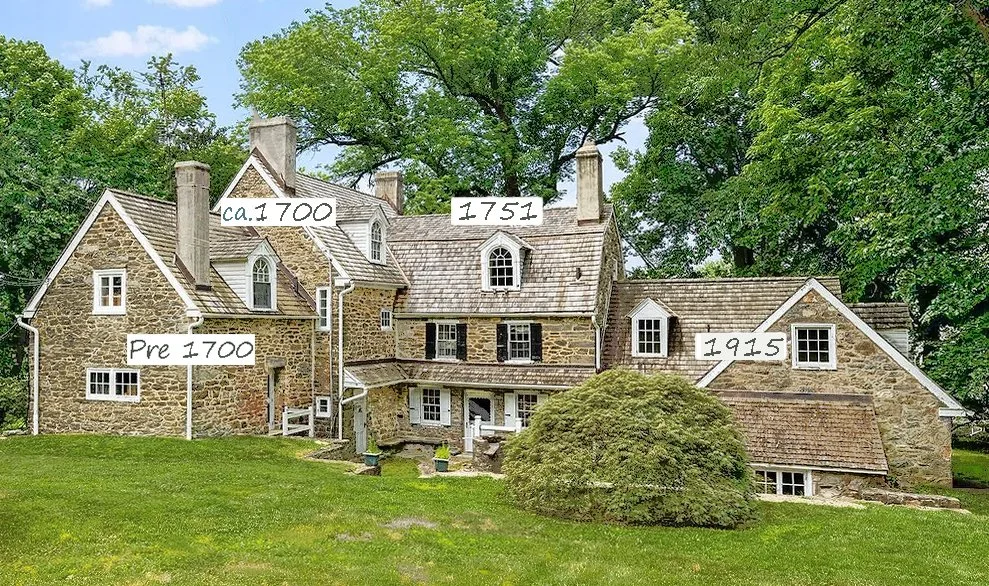
Above: The Sharpless House evolved as an additive house, with multiple additions over time. Southeast Pennsylvania is home to countless historic homes that look like a collection of additive building blocks of different heights. Image source: Bright MLS (dates added).
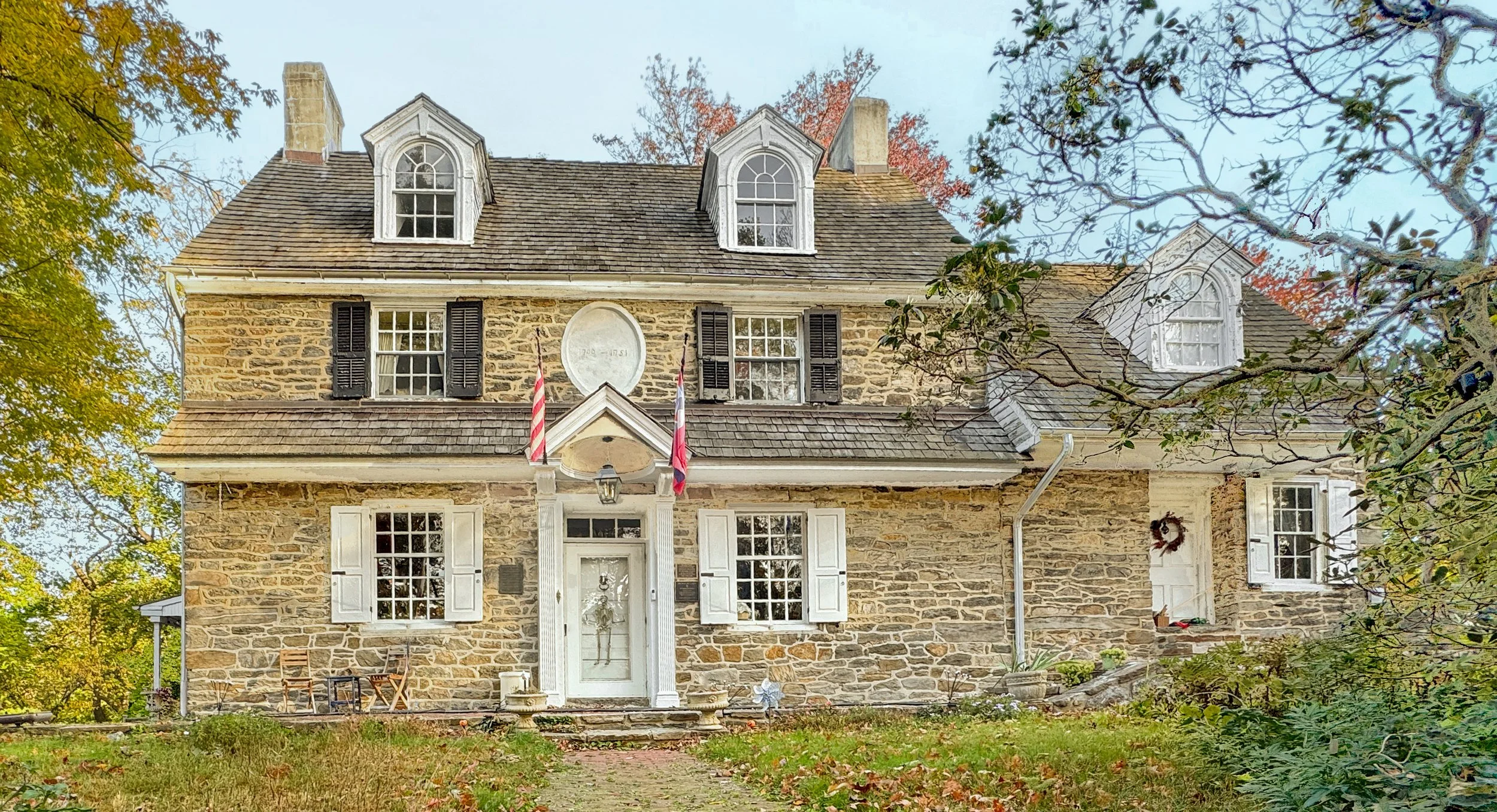
The historic homestead of the Sharples / Sharpless family in America has multiple additions for multiple generations. Image source: Lee J. Stoltzfus.
Joseph Sharples, Sr. (English Quaker immigrant) married Lydia Lewis (Welsh Quaker immigrant) in 1704 at Haverford Meeting. They built this home on Oele Stille’s Creek, [Oele Stillin's Kill] named for Olof [Oele] Stille, a prominent Swedish immigrant who had settled near here as early as 1641. Olof Stille was a millwright and judge at Fort Christina. His English neighbors called him Wolley Stille.
Joseph Sharples was constable for Nether Providence and was overseer for Providence Quaker Meeting.
Floor Plan of the Sharpless House:
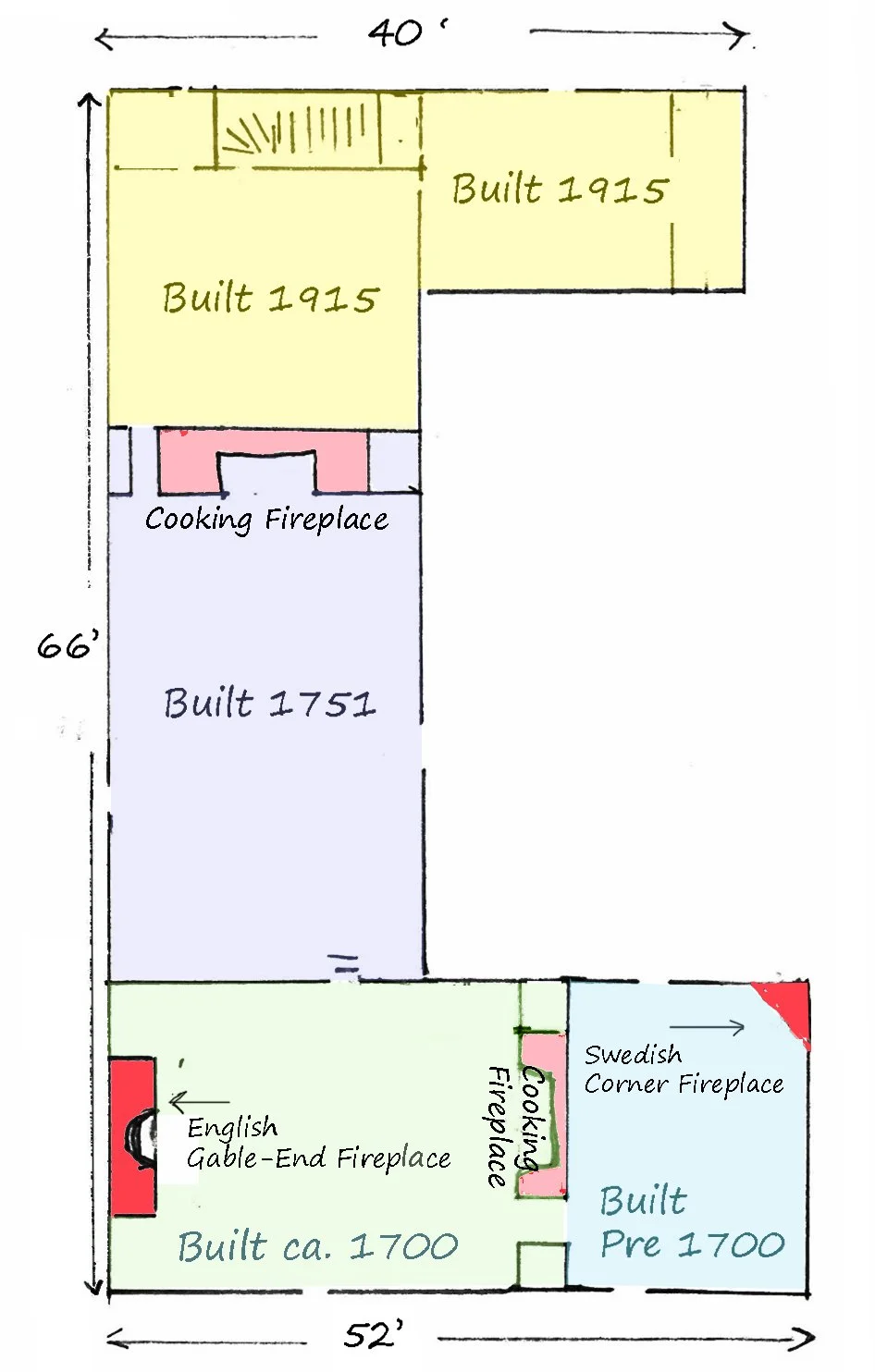
Above: Image source: Based on a floor plan in National Register of Historic Places nomination by J. and B. Schlosbon and N.V. Webster.
Architectural Cultural Exchange
English Quakers Adopt Swedish Fireplaces:
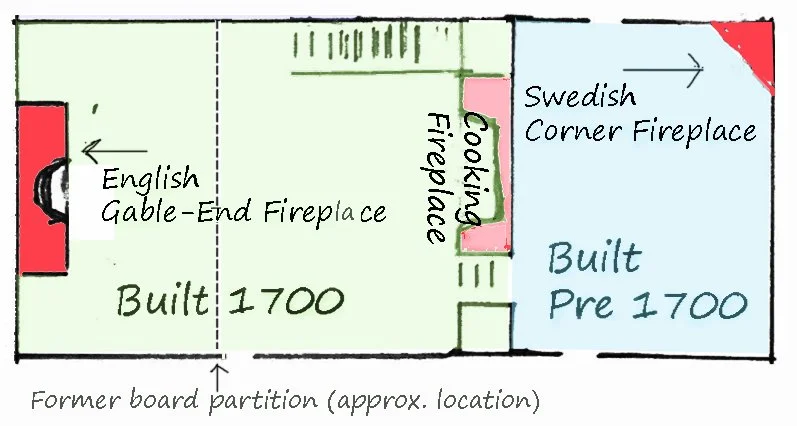
Above: Image source: Based on a floor plan in National Register of Historic Placesnomination, by J. and B. Schlosbon and N.V. Webster.
Corner fireplaces were also used at The Lower Swedish Cabin in Drexel Hill (ca. 1640–1655) and the Caesar Hoskins Cabin (ca. 1680). Descendants of Swedish colonists built the Mounce Jones House (1716), with an English hall-and-parlor plan and Swedish corner fireplace.
In this Sharples House, a partition previously divided the ca. 1700 room into a hall-and-parlor floor plan, which is a signature floor plan of early Pennsylvania Quaker houses.
Peter Kalm: Corner Fireplaces in 1749
“…are now called Swedish fireplaces here.”
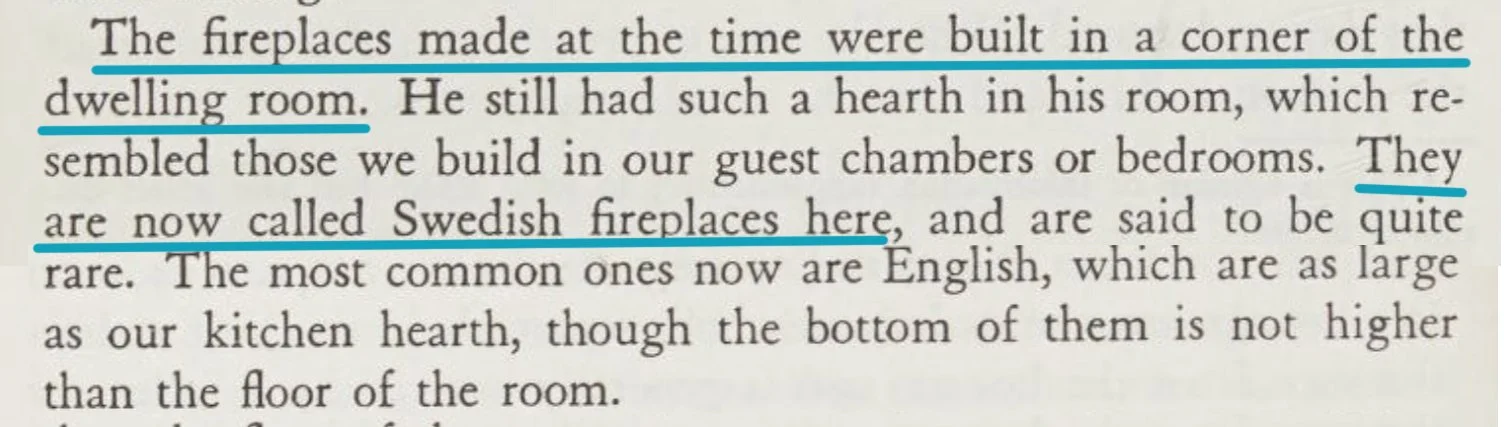
Above: Peter Kalm’s Travels in America, ed. Adolph B. Benson, Vol. II, 1937, Internet Archive
In 1749, the Swedish explorer Peter Kalm recorded the transition of the American landscape from a wilderness to a colonial society. His diaries include detailed descriptions of the vernacular architecture of Pennsylvania. In 1749 he described the log houses and corner fireplaces of New Sweden, above. Prototypes of corner fireplaces here in New Sweden include the hearths of Finnish savupirtti (smoke house).
Cultural Contrast in Heating
Early Pennsylvania Houses:
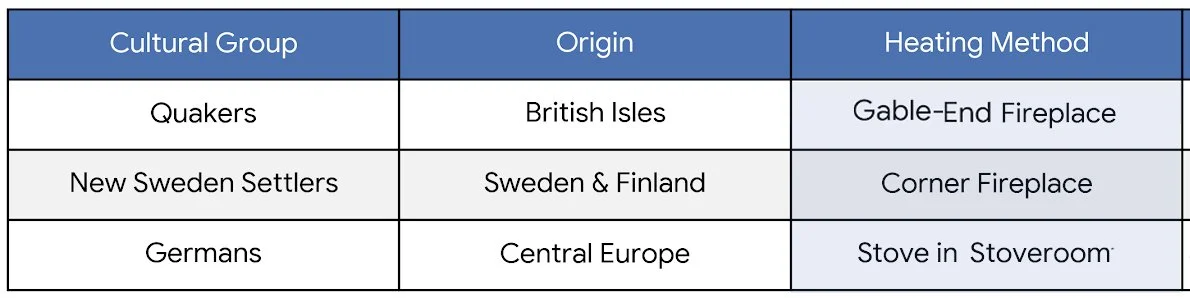
The Sharples House represents an architectural cross-cultural exchange here in Pennsylvania between the local settlers of New Sweden and their Quaker neighbors from the British Isles. This blending of styles was common in the Delaware Valley, where the established Swedish and Finnish building traditions influenced the incoming English Quakers.
The house’s earliest section, built before 1700, has a corner fireplace typical of Swedish and Finnish settlers. In contrast, the house’s addition built ca. 1700 has a gable-end fireplace typical of settlers from the British Isles.
A prototype for the Scandinavian corner fireplace is the stuga, a living room with a hearth diagonally positioned in a corner.
1679: Description of a Swedish Corner Fireplace
In a Nearby Log Cabin:
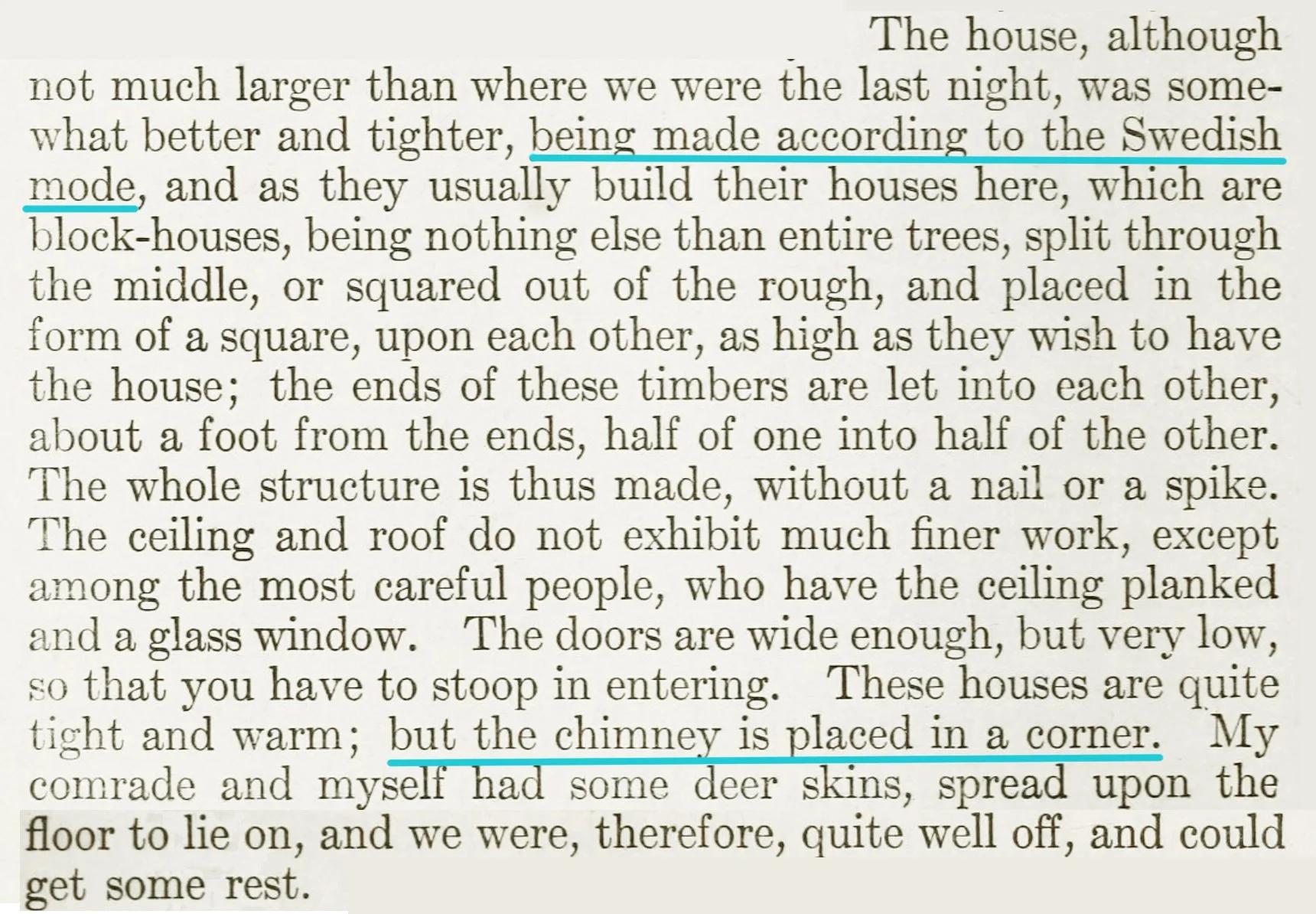
Above: Text image source: Journal of Jasper Danckaerts 1679 - 1680, Internet Archive
1748: Description of a Swedish Corner Fireplace
By Peter Kalm In New Jersey:
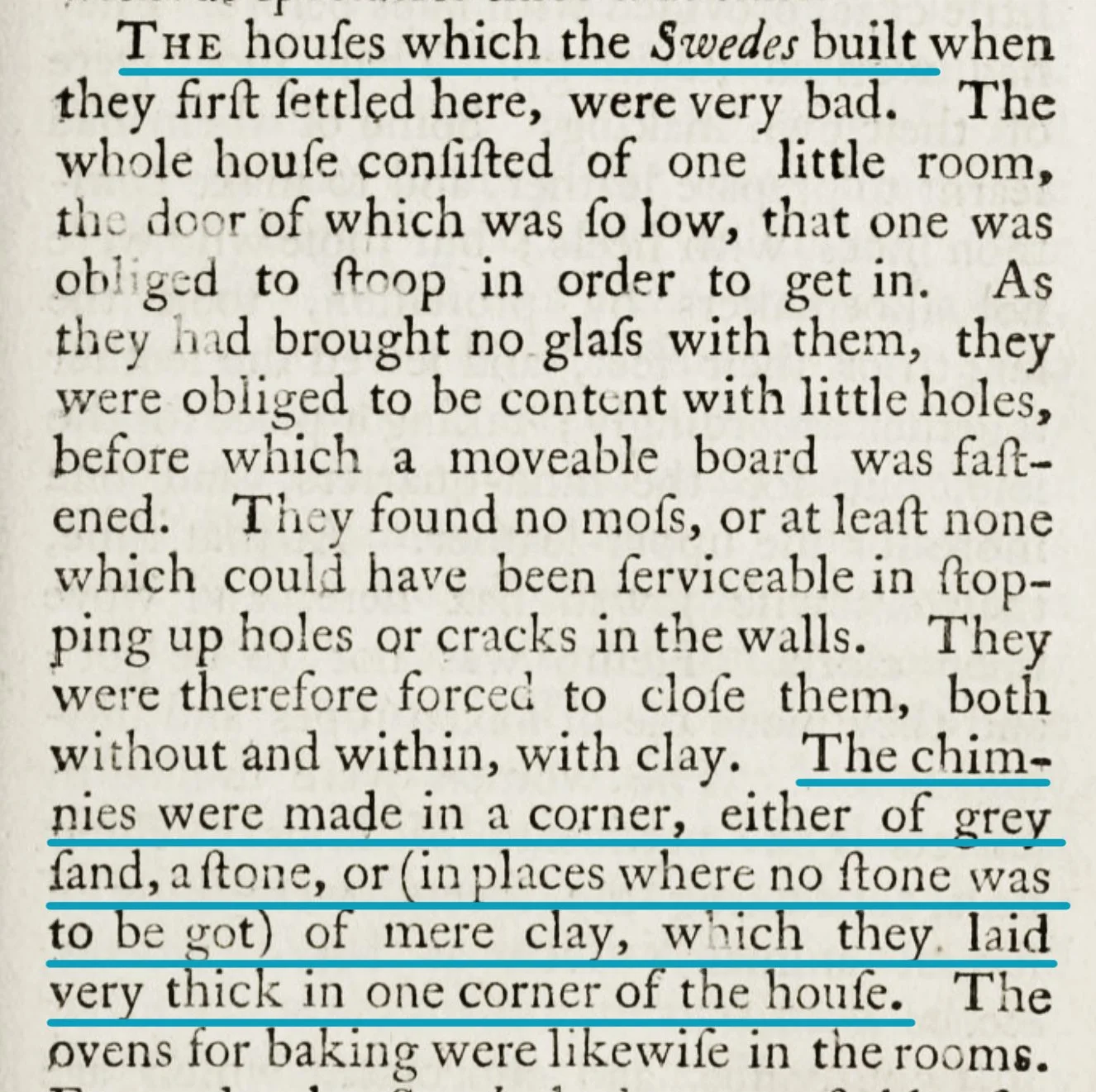
Above: Travels into North America, by Peter Kalm, London, 1771 (First English edition), Internet Archive
The Sharples Tract on a ca. 1715 Map:
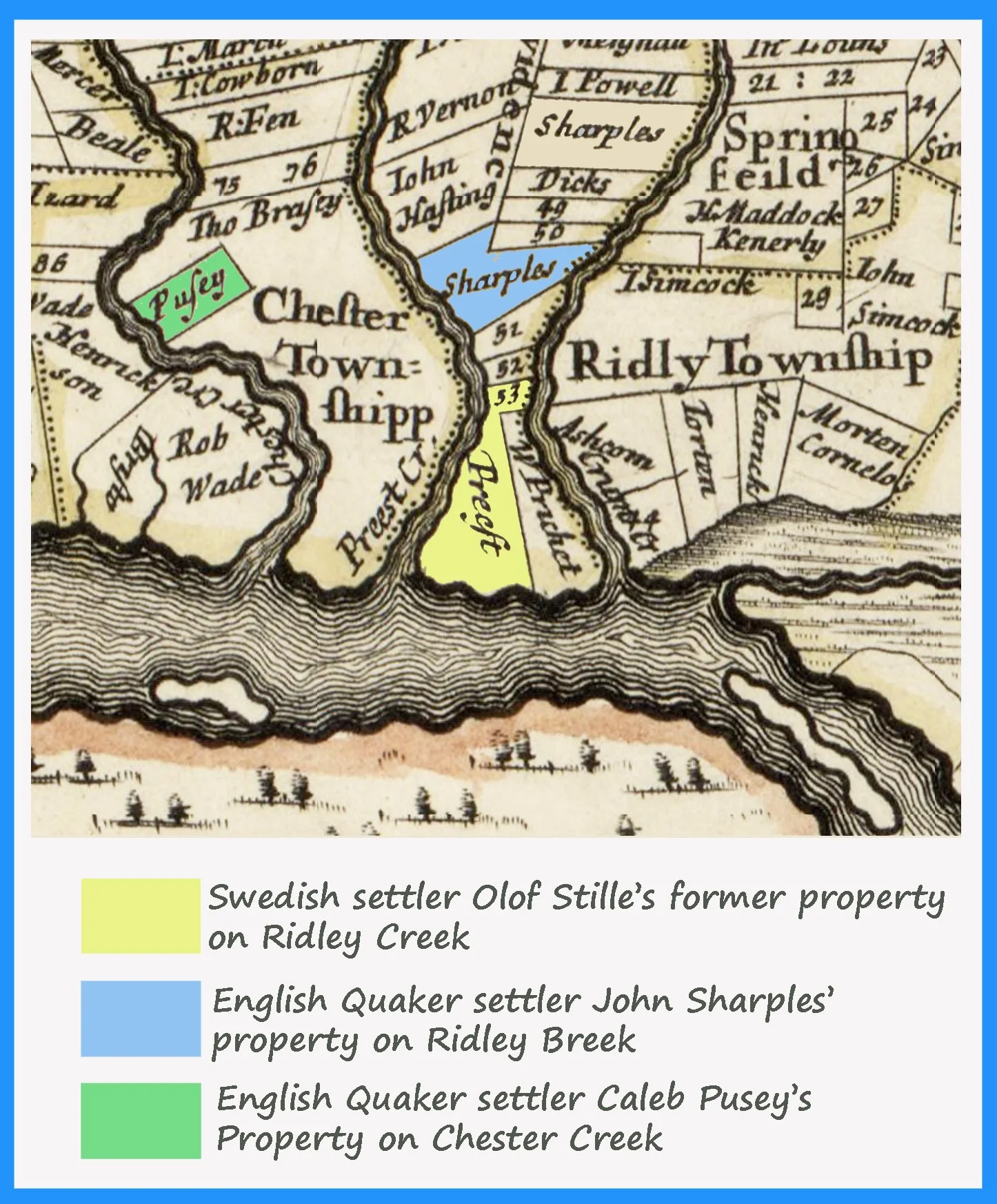
Above: Image source: A mapp of ye improved part of Pensilvania…, Thomas Holme, ca. 1715, Library of Congress.
In this 1715 map, Ridley Township and Chester Township are both located within the former New Sweden settlement area. The corner fireplaces of Swedish house design influenced how English Quakers built their earliest houses in this region.
The map also shows the location of the Pusey House, the earliest English-built house in Pennsylvania. The Pusey House, built in 1683 and ca. 1696, has two corner fireplaces.
The map also identifies Olof Stille's former property on Olof Stille’s Creek, by then known as Preest [Priest] Creek. The Stille property was owned by Pastor Lars Carlsson Lock. The creek later became Ridley Creek.
The Swedish Corner Fireplace
In the Pre-1700 Room:
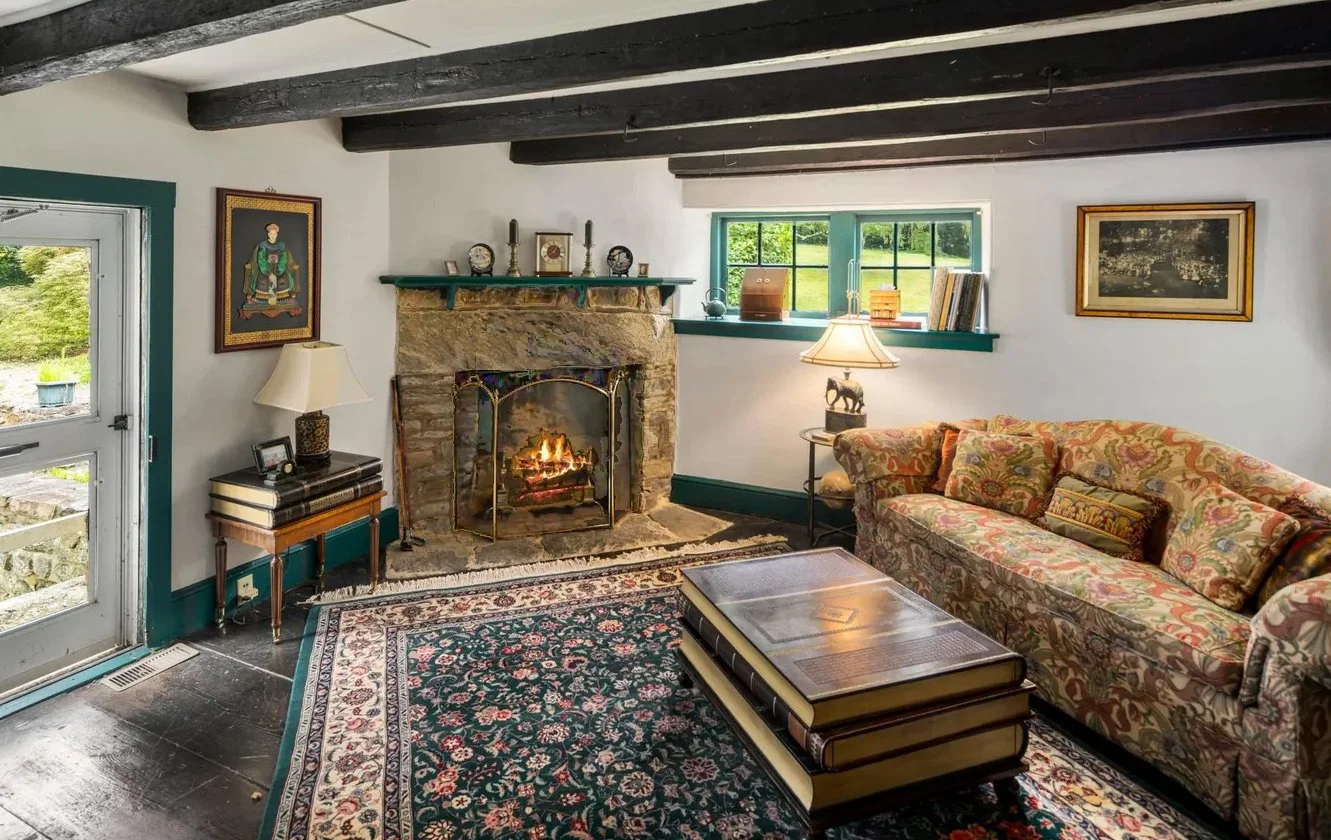
Above: The corner fireplace in the pre-1700 “weave room.” This corner fireplace represents the Swedish tradition of fireplace placement in room corners, rather than centered on gable walls. Image source: Bright MLS
The English Gable-End Fireplace
In the ca. 1700 Room:
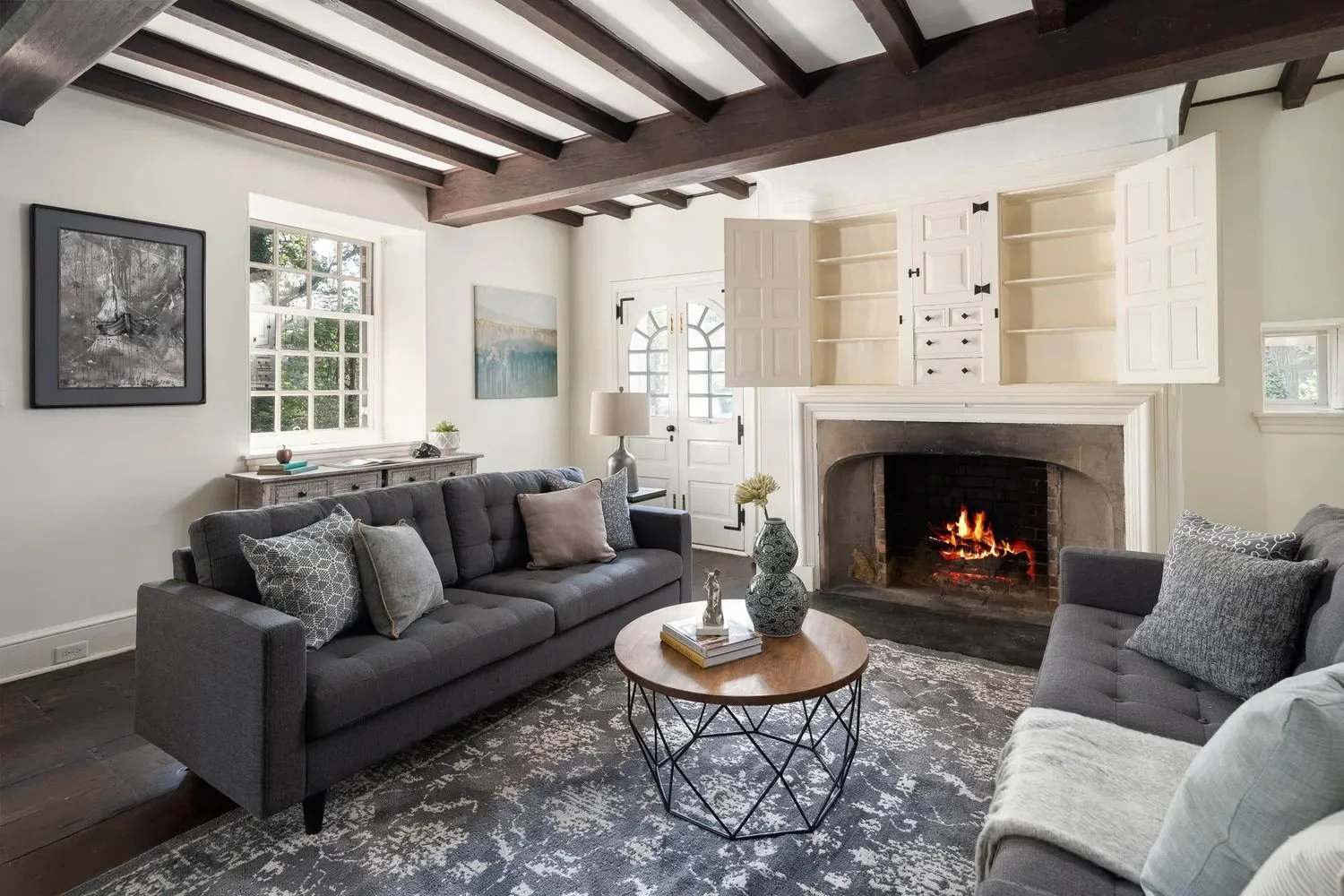
Above: The gable-end fireplace in the ca. 1700 “great hall.” This fireplace is centered on the gable wall and represents the English tradition of fireplace placement. Image source: Bright MLS
ca. 1887 Photo of the Sharpless House:
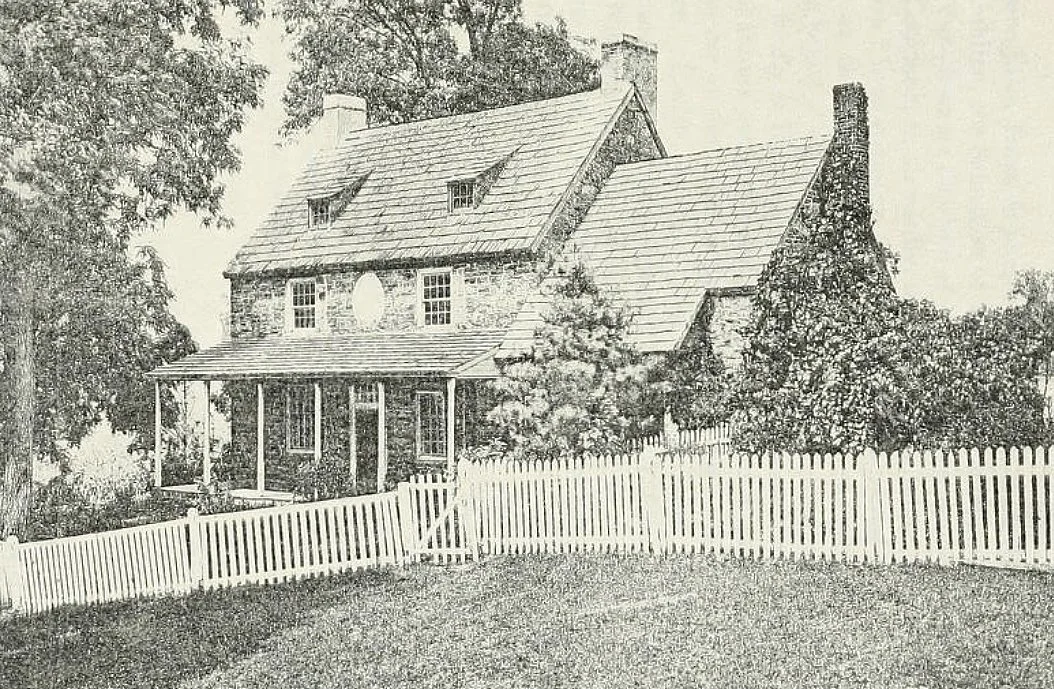
Above: Image source: Genealogy of the Sharpless Family…, Gilbert Cope, 1887, Internet Archive
In 1915 Architect Donald Robb added Colonial Revival renovation to this home. He changed the dormers from shed-style dormers to larger pedimented dormers. He also repositioned stairs, changed one "gunport" window to French doors, added a stone service wing for a modern kitchen. raised the roofline of the 1751 addition and changed it to a gambrel roof, removed a Victorian front porch and recreated the pent eave and door hood on the front facade, built stone steps and open-arch access between the 1750 section and the 1751 section, recut most doors to six-feet in height, and added modern plumbing and wiring.
This ca. 1887 photo reveals that the house’s unusual oval datestone predates that Colonial Revival addition.
Historical Markers for the Sharpless House:
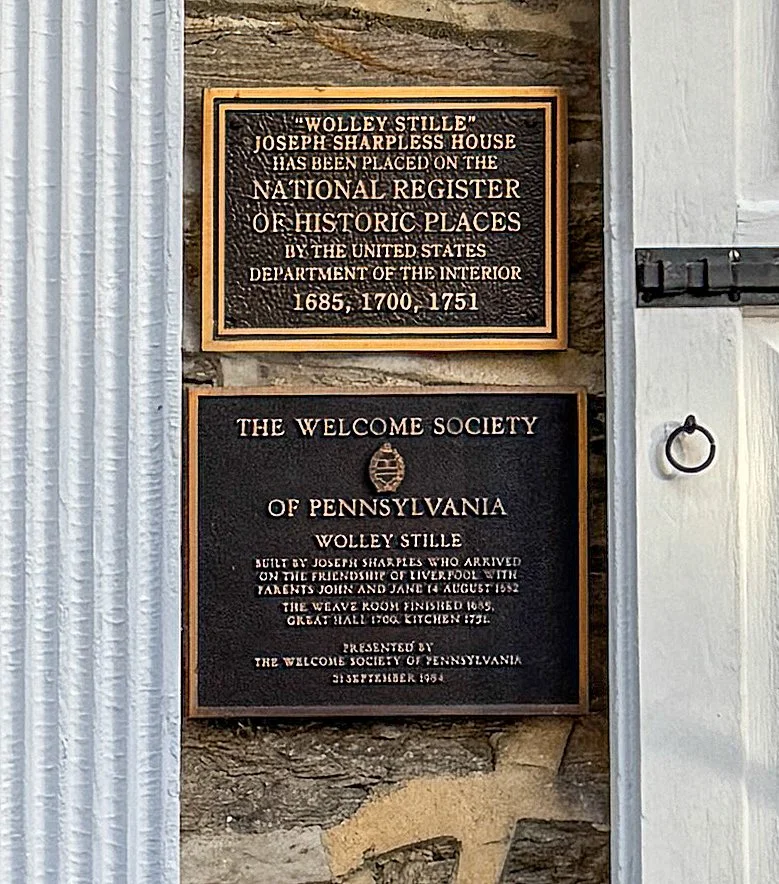
Above: Historical markers by the front door for the National Register of Historic Places and for the Welcome Society of Pennsylvania.
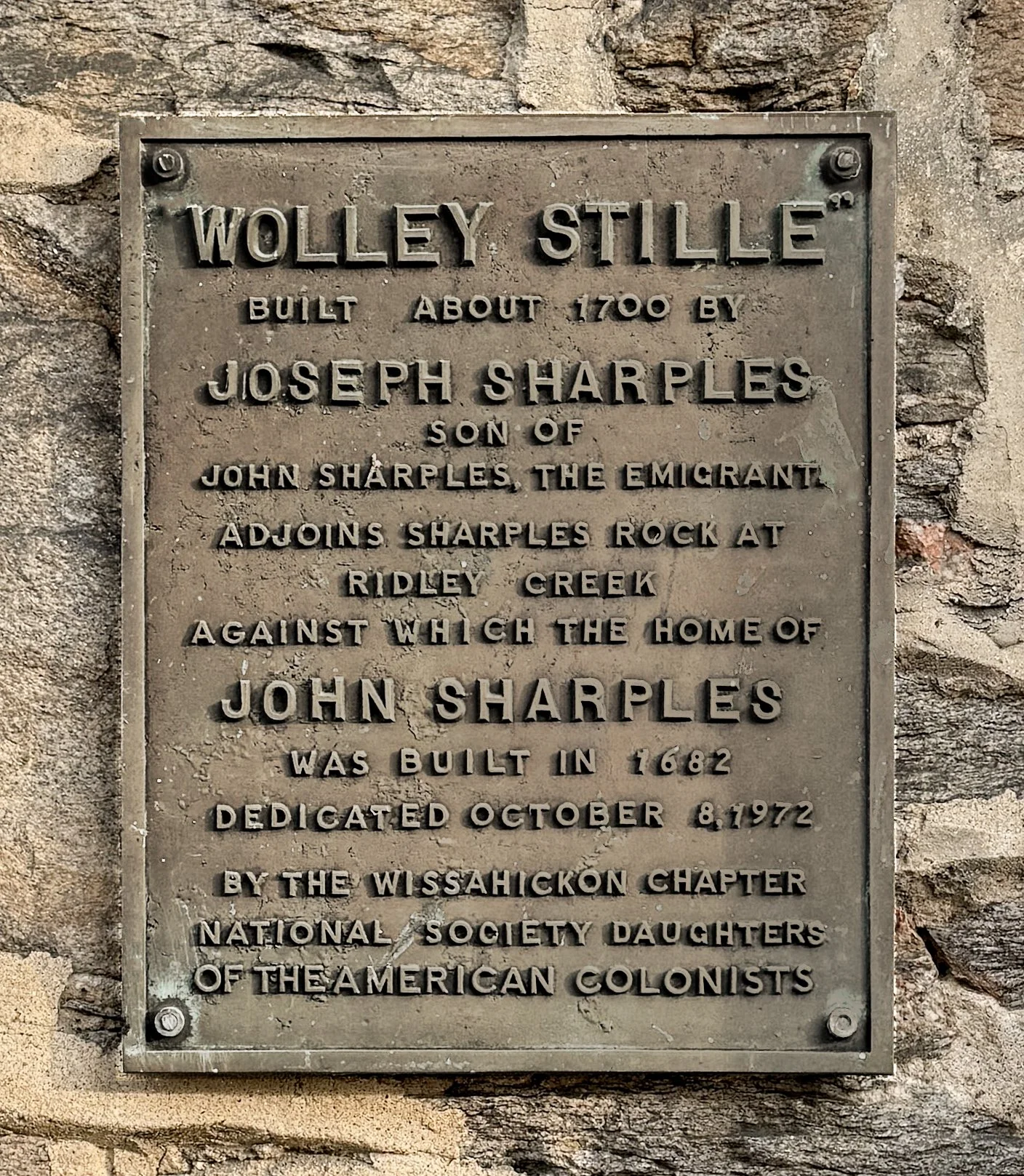
Above: A third historical marker by the front door.
Links: