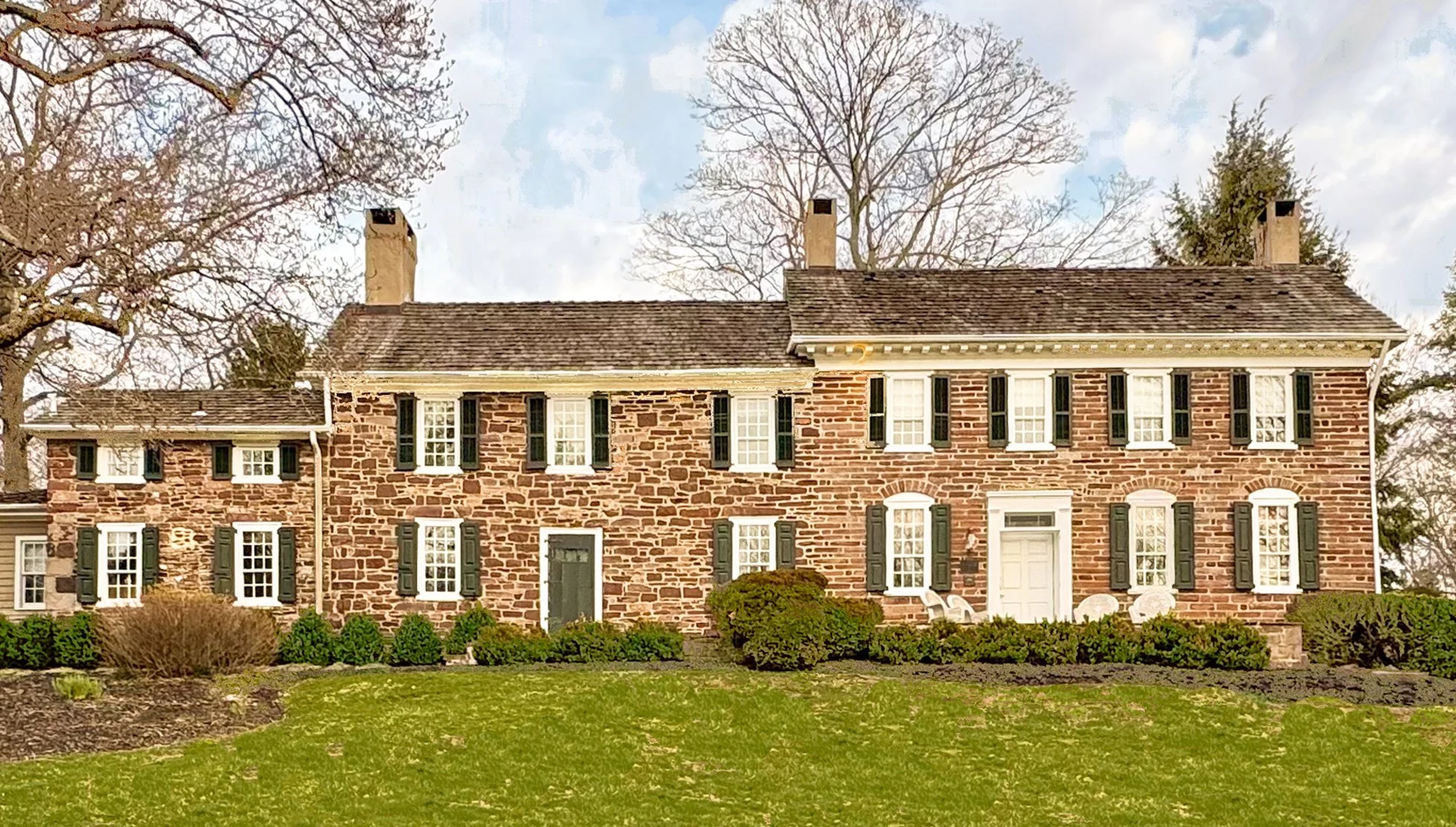
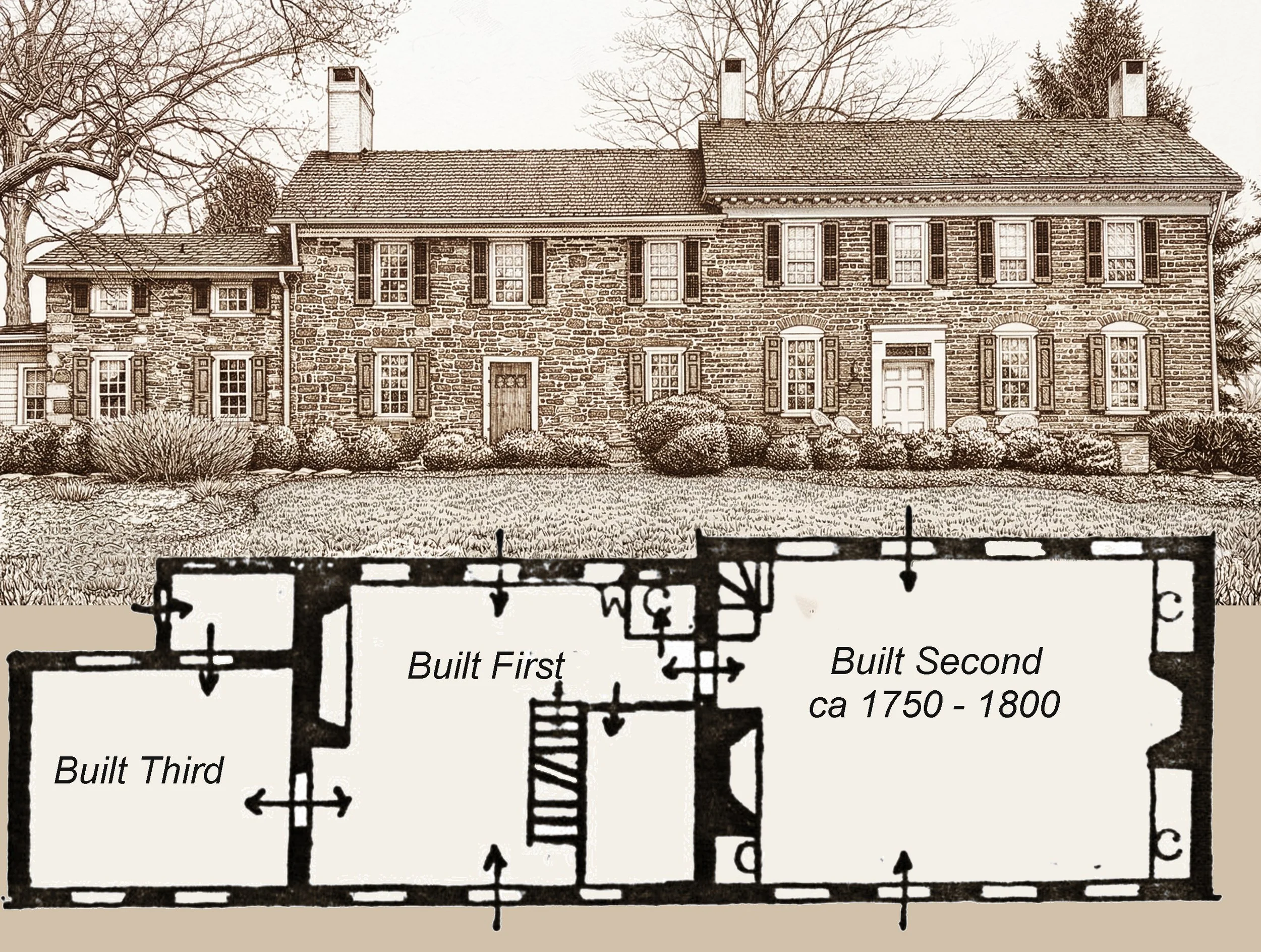
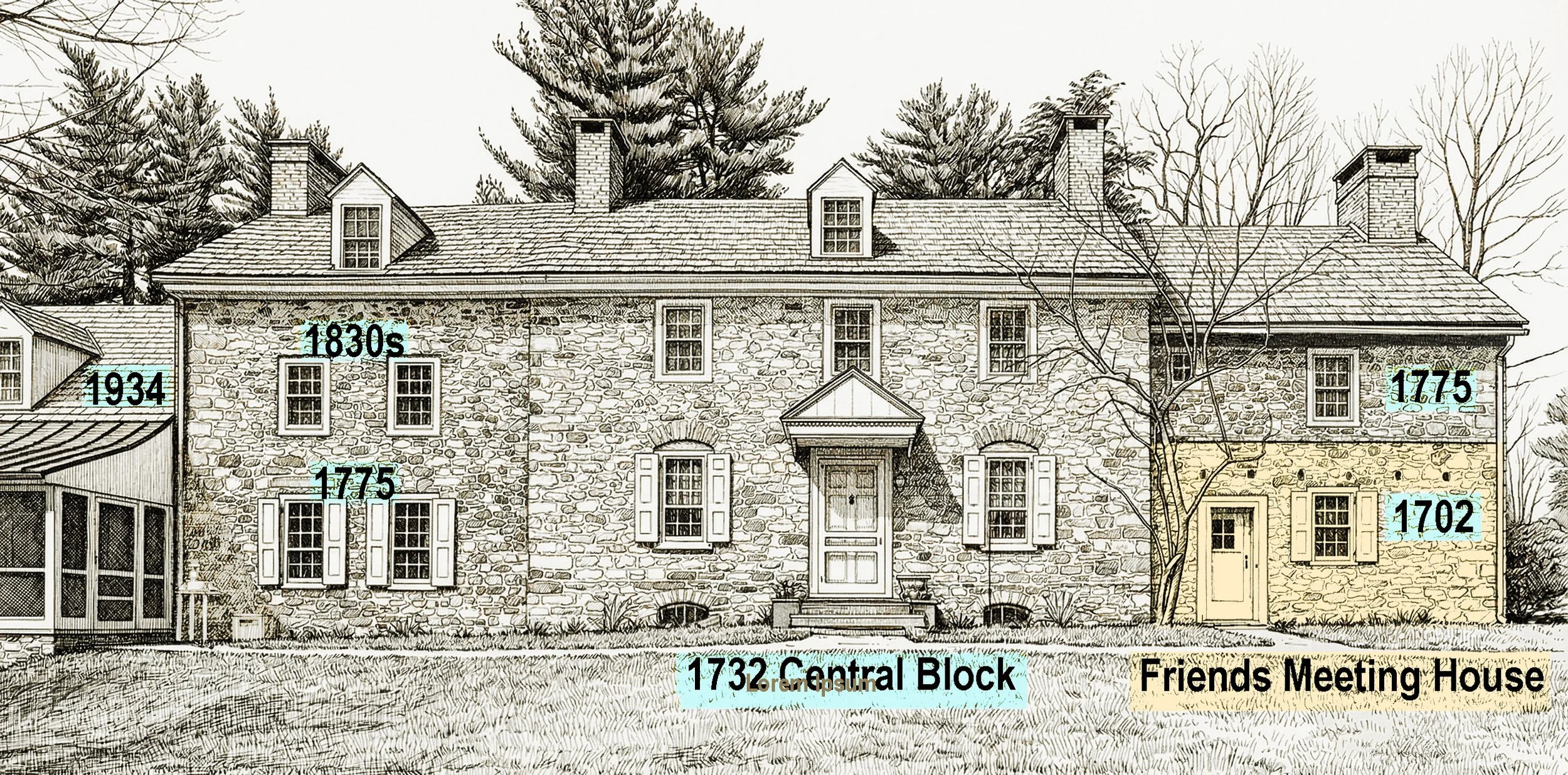
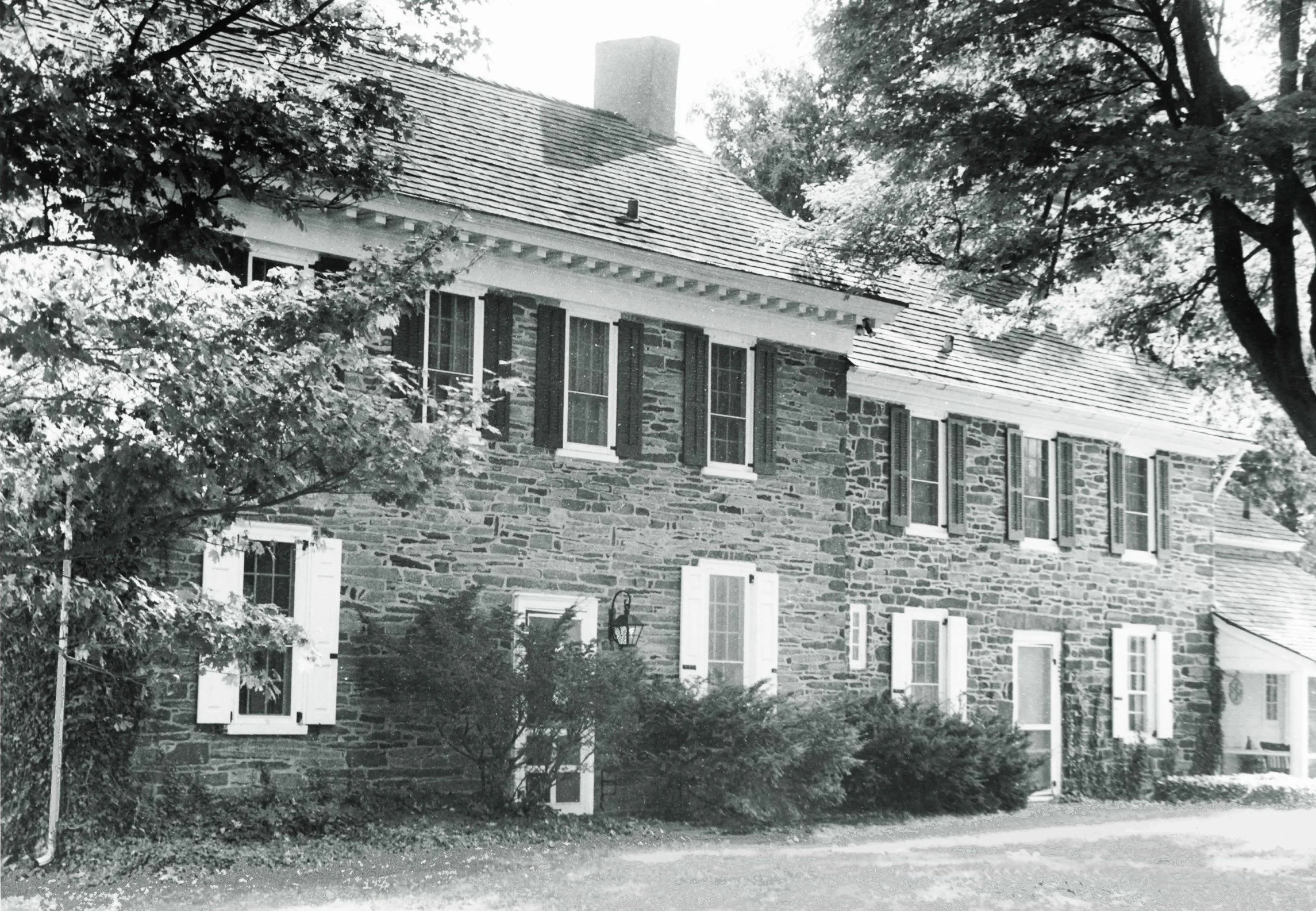
The main section of the house exhibits a combination of vernacular Georgian and later Federal features. This mix of styles has made precise dating and classification of the house difficult.
In the mid to late eighteenth century (local historican Arthur Edwein Bye merely states 1750-1800) the main section of the house was erected. This section was designed as a "mansion house" with fine coursed ashler stonework and the aforementioned segmental arches on the south facade.
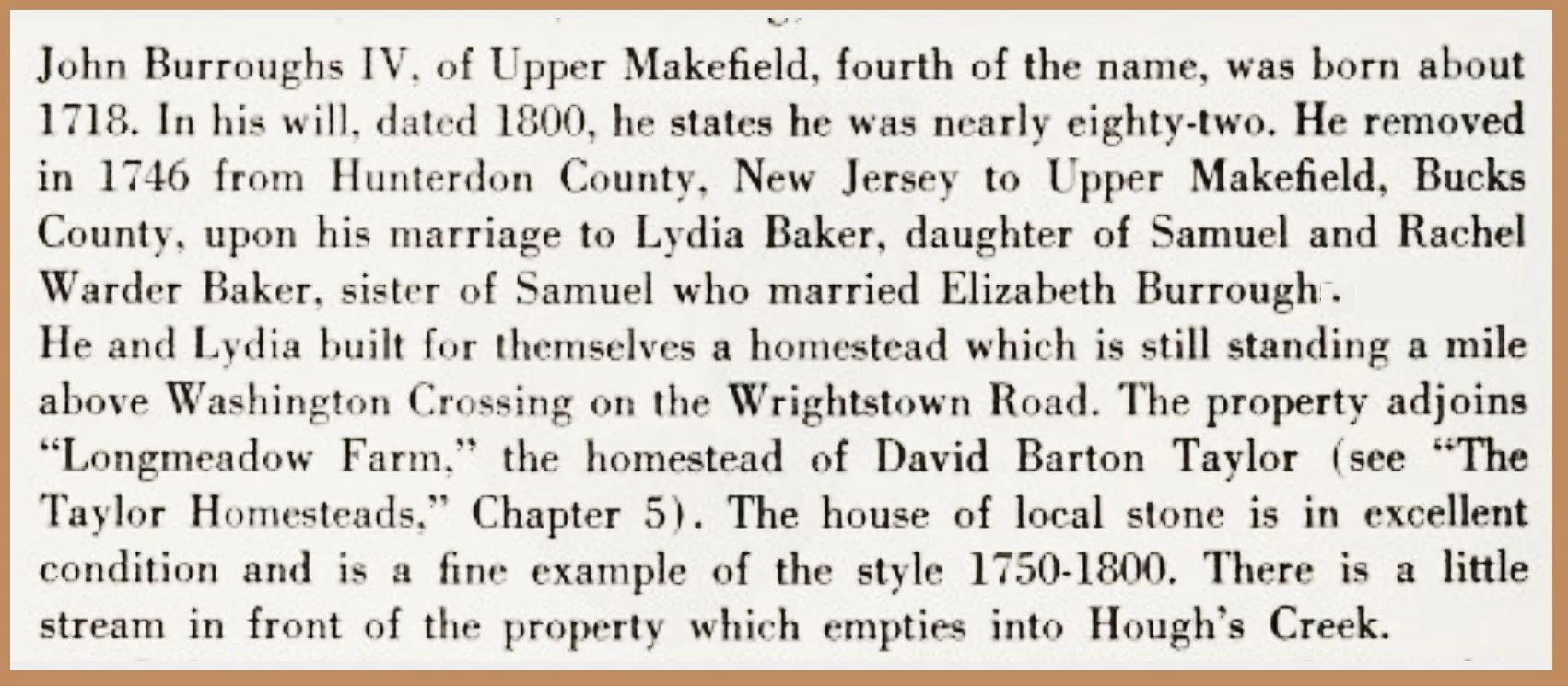
In 1746 Burroughs married Lydia Baker who was the daughter of Samuel Baker, Sr. In addition to his own fifty acre tract of land which he had owned since 1751, Burroughs acquired almost four hundred acres of land, including the Burroughs Homestead property; making him one of the township's largest land owner.
Three of John and Lydia Burroughs' nine children; Henry Burroughs, Samuel Burroughs, and Elizabeth Burroughs Taylor, were particularly significant. Henry Burroughs, who inherited the homestead, was involved in local government. . He served as tax collector among other positions. Samuel Burroughs followed a different path. He was one of the region's most famous Tories.
While Henry and Samuel Burroughs were important in their contemporary period the most lasting influence on the development of Upper Makefield was from Elizabeth Burroughs Taylor and her family. Elizabeth Burroughs was married to Benjamin Taylor, a prominent landowner in Upper Makefield, Lower Makefield, and Newtown Townships. In the late eigh-^ teenth and early nineteenth centuries Benjamin and Elizabeth Taylor, their sons, and their grandsons, were undoubtably the township's leading family.
However, the fact that John and Lydia Burroughs lived here during the first quarter of the l8th century when the township was being settled they were undoubtably the builders of the first permanent section of the house. John Burroughs was also the longest single inhabitant of the house and property, living there until his death in I8O6. The house and the majority of the property remained within his family until its sale by his grandson Benjamin Burroughs in I869 making a total of at least 123 years in the family.
The major historical significance of the house is as the Burroughs family homestead and its long association with the prominent Burroughs family. The Burroughs family owned the property upon which this house stands for three generations in the eighteenth and nineteenth centuries. Lydia Baker Burroughs' family actually owned the property from its original seventeenth century patent. Like most Bucks County properties the Burroughs homestead passed down through the male line; from John (c.1760-1806) to Henry (1806-1815) to Benjamin P. Burroughs (1815-1869).
John Burroughs one of the township's most important landowners of the eighteenth century and Samuel Burroughs one of the township's most well documented Loyalists among others; military as one of the few documented billets and hospitals for the lesser officers and men who parti cipated in the Battle of Trenton in December, 1776
The earliest portion of the nominated house appears to be a rebuilt log or frame cabin'which pre-dates John Burroughs presence. Upper Makefield tax records show John Burroughs living in the township as early as 1733 and it is possible he had settled on this tract by that date.
Another possible builder of the original cabin was the above mentioned Henry Baker, Lydia's brother.
that it was the site of Washington's famous crossing of the Delaware in December 1776. That event has eclipsed the fact that many area residents did not embrace the patriotic cause.
The second phase of construction dates from 17^6 to 1796 and is of a more elegant design. There is cut into the stone on the south face of this section the following inscription: H'B H* L This marking may represent Henry Burroughs as the owner and some unknown H L as the builder. Henry Burroughs was a wealthy man who served as township tax collector at the beginning of the 19th century and either built the entire section after his marriage in 1786 or ordered the large-scale renovations of the old house. The latter explanation would account for some of the very old panelling and other features in this section of the house. The interior of the section has numerous examples of old and unusual iron ware which is original as far as can be determined. The elegance is main tained by the high ceilings, chair rails, molding along the walls and detailed woodwork.
A newer kitchen addition was constructed at the turn of the 20th century in a style in strict keeping with the earlier sections of the house having matching stonework, cornice, roof style and material.
A well-preserved early l8th century dwelling, the Burroughs House replects the adaptation and growth of dwelling. Rather then build successive' dwellings, each periods growth was added on to the previous to form one large structure. This" practice is most common in Bucks, Chester and ^ Montgomery Counties, where stone was the typical building material.
John Burroughs was the first of three generations of Burroughs, also spelled Burrows, to live in this house. From John, the property, con sisting of some 200+ acres descended to his son Henry who was the Upper Makefield tax collector. Henry's will divided the estate between his • children, with his son Benjamin inheriting the homestead and over 125 acres.
Since the home stayed within the Burroughs family for three generations there is an absence of any hard evidence in the way of deeds to determine the original builder or actual age of the house. The situation is further complicated by the fact that John Burroughs apparently had no recorded deed for the property. Instead he received title for the land, and presumably the original section of the house, upon his marriage to Lydia Baker in 17^6. Lydia was part of the third generation of Bakers who held title to almost a thousand acres of land stretching nearly two miles from the Delaware River by virtue of several patents dating from 1685. Part of which was to become famous as Baker's Tavern and Ferry, later known as McConkey's and the site of Washington's Crossing of the Delaware in 1776.
brilliant career at Printon as a teacher, scholar, and museum director.
In 1910, he became professor of artandarchaeologyat Princeton. From 1922 to 1946 he was the director of Princeton University's art museum.[4
A crucial figure in determining Princeton’s early interest in American art and building the core of the art collection in this field.
he was an art critic with the New York Pose when he was hired to teach Renaisssance painting. he was an editorial writer for The Nation and was American editor for Burlington Magazine from 1904 to 1906
In 1973 the College Art Association named its annual award for art critism after him.
although he was a scholar and collector of Renaissance art, his work as a scholar and critic led him to write about American art,, and made him one of the few art historians of his generation to give serious attention to this subject.
beginning in 1933 he began to purchase American paintings and drawings for the museum. he built a private collection of old masters and American drawings and prints which he began donating to the museum in 1938, continuing to do so until shortly beore his death in 1953.
not until the Mather years 1922 to 1946 that the first significant number of American paintings and drawings came into the collection.
as early as 1914 he discovered the virtually unknown landscaper painter Homer Dodge Martin. A later discovery would be Moore about whom he wrote a monograph posthumously published in 1957.
He also contributed to The Ameican Spirit in Art (1927), one of the first surveys of its kind in the field. As early as 1906 he suggested the idea of creating a national collection of American art in washington D. C. which became the Smithsonian American Art Museum.
He wrote History of Italian Painting and at least 10 other comprehensive works.
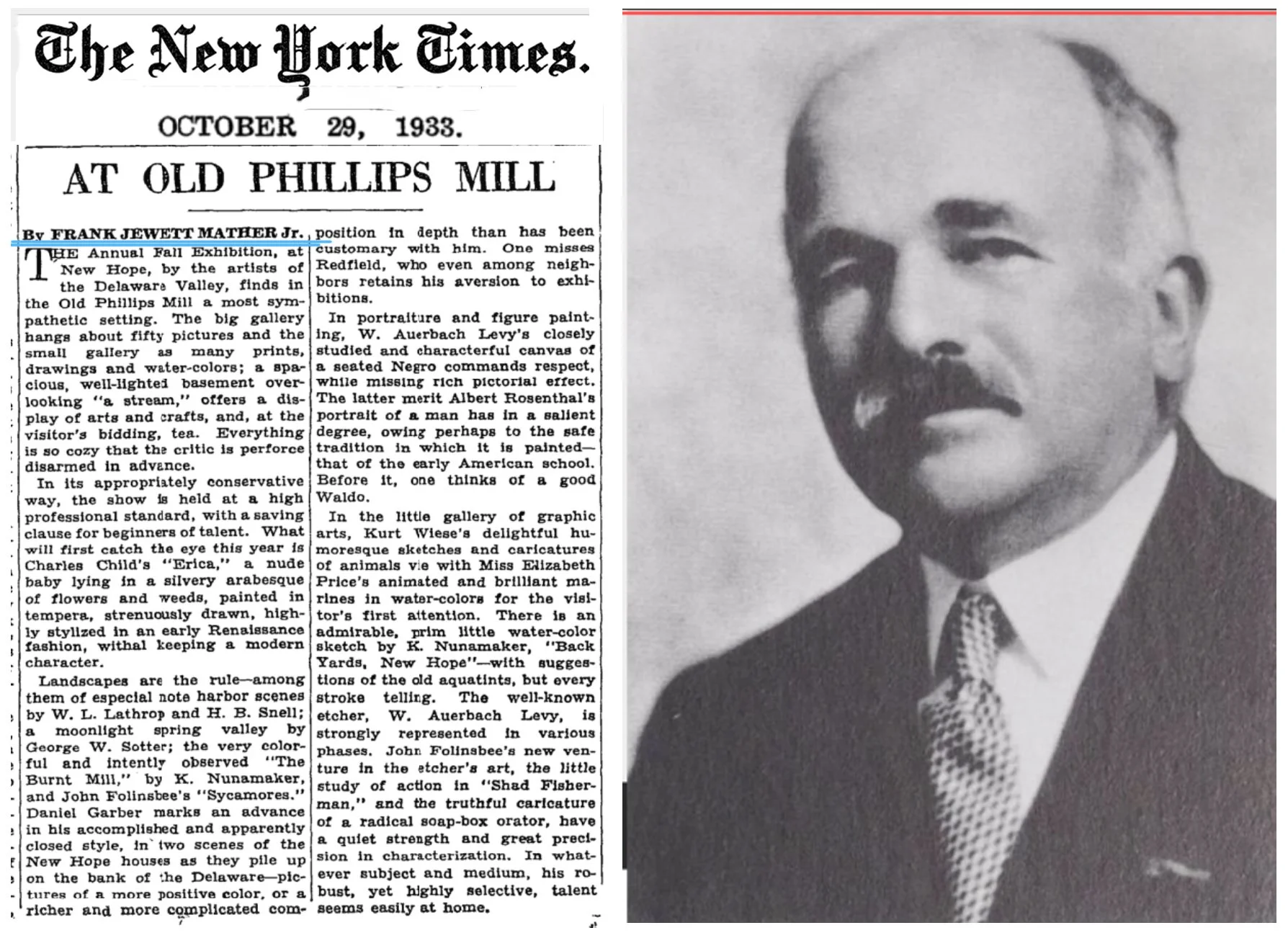
Among the 20th century owners of the house (1933-19^6) was Dr. Frank Jewett Mather, Jr. who was a noted author and art historian. Dr. Mather was a professor at Princeton University for 23 years and served as Director of the Museum of Historic Art. He was also a lecturer at numerous universities and institutions including Cornell University; University of Wisconsin; Union College as well as the Metropolitan Museum of Art.
Joined the Princeton University faculty in 1910 to teach Renaissance art. He became director of the museum in 1922. early effort to increase the importance of American art. He began the collection of American paintings and drawings
The Mather award for art journalism is one of the nation’s highest honors in the field.
With his own money he made more than 200 purchases for the museum, and introduced the first American art to the museum.
he encouraged gifts and donations and as a result seveal important collections were given to the museum.
Renaissance art specialist who also worked as a reporter and critic for The Nation and The New York Evening Post.IN