
Historic Quaker Houses of Philadelphia
Upsala: The Johnson House
6430 Germantown Avenue, Germantown
Built in 1798
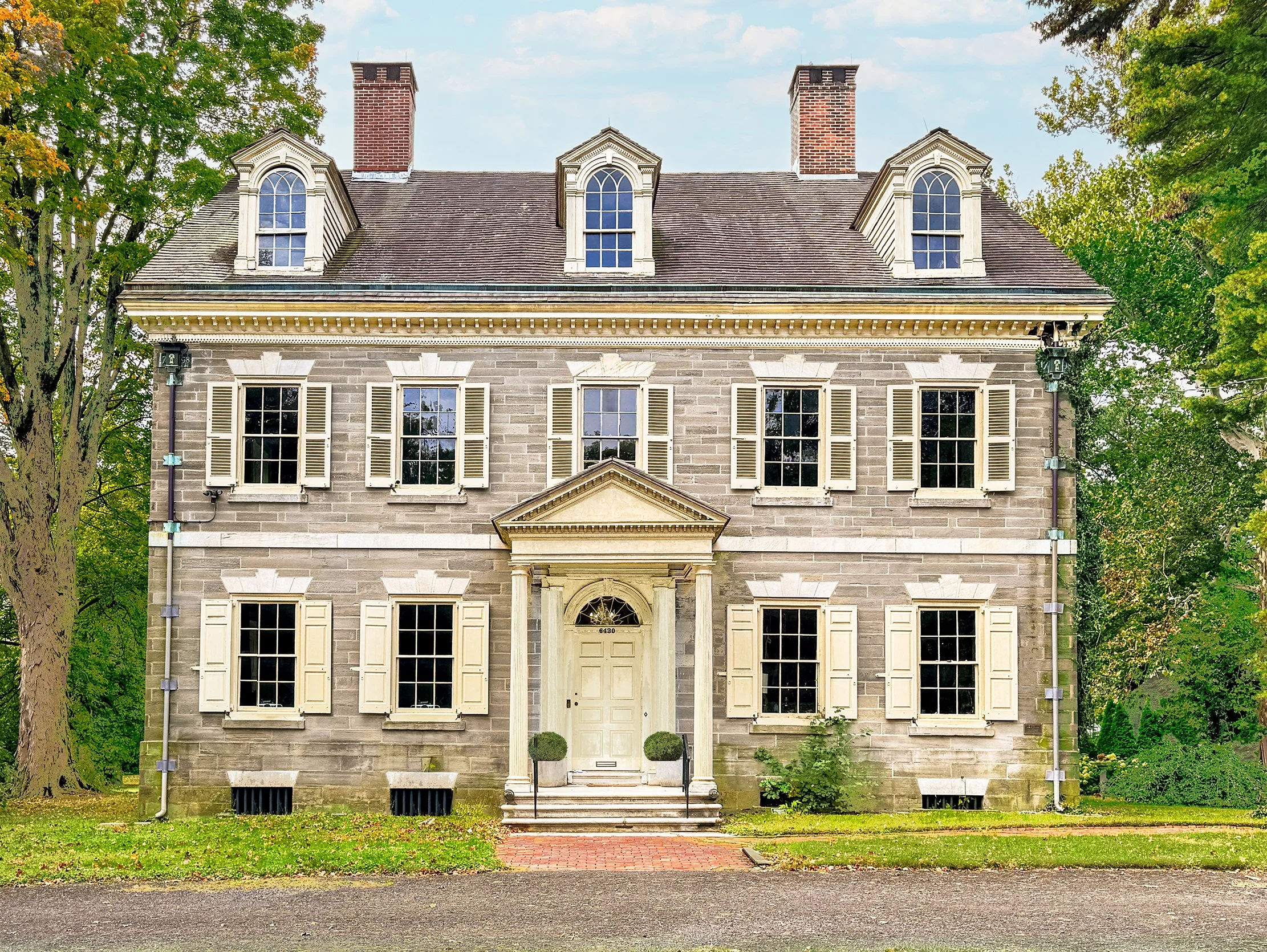
Above: Upsala is one of the finest Federal-style houses in the Germantown area. Marble details include the entry steps, window voussoirs, and a string course. Fluted Doric columns support a beautifully detailed portico. The entry has a carved architrave with a fanlight. An elaborate cornice continues across the gables. The dormers are unusually fine. Image source: Lee J. Stoltzfus.
John Johnson, Sr. (1709 - 1794) received ownership of this property in 1766. He was one of Germantown’s leading property owners and was one of the town’s wealthiest year-round residents by the mid-1700s. He was the son of Dirck Jansen and Margaret Millan Jansen, for whom the core section of the Wyck house was built.
Upon John Johnson, Sr.’s death in 1794, his son Joseph Johnson received the property. Joseph’s son John Johnson (1774-1825) inherited the land here and began building this house in 1798.
John Johnson married Sally Wheeler in 1801. The Johnsons were members of Germantown Meeting. They raised nine children here at Upsala. Apparently, Sally Johnson named the property Upsala in honor of Swedish author Frederika Bremer.
Floorplan of Upsala:
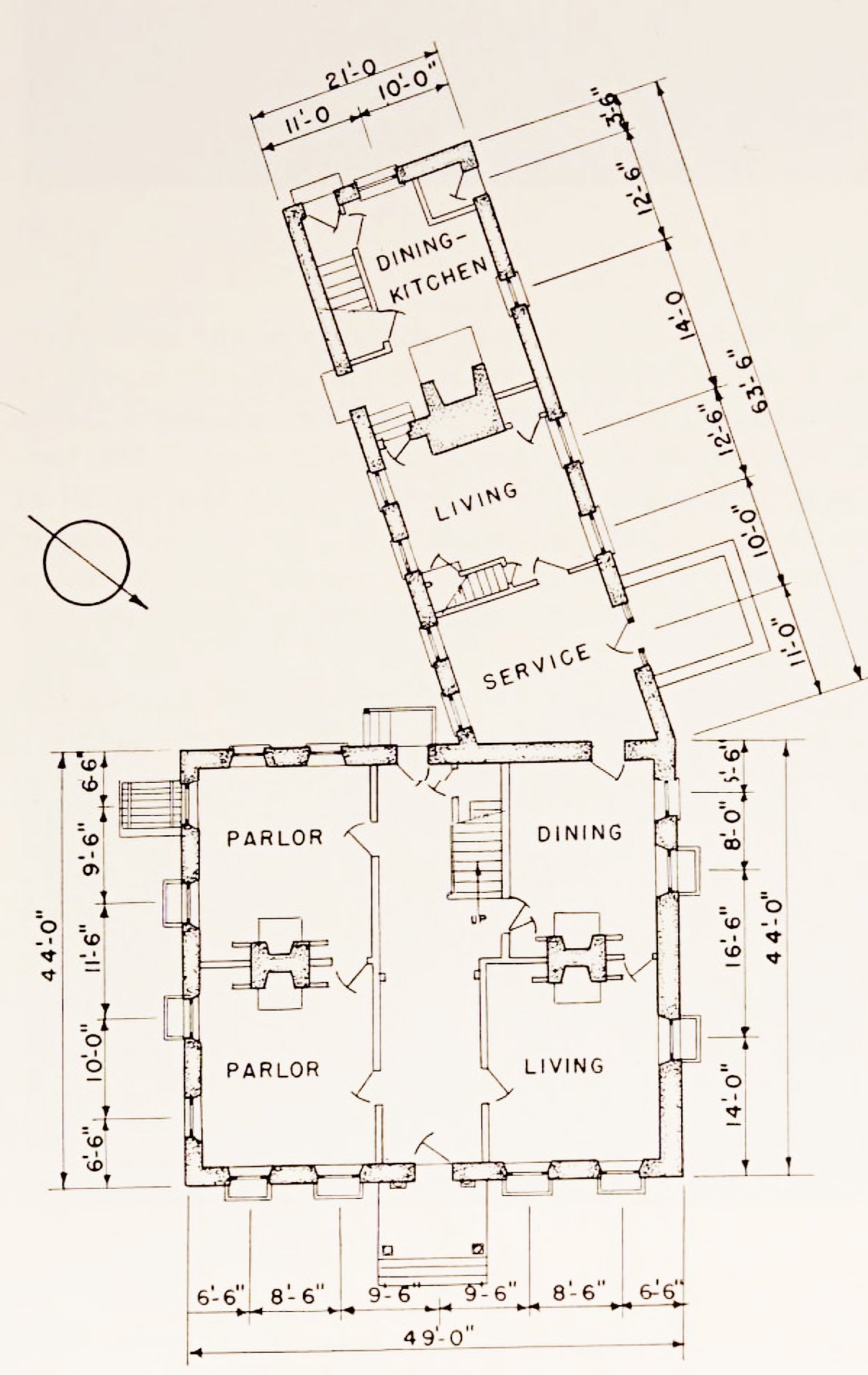
Above: Upsala floorplan. The plan follows a Federal center-hall layout. The rear extension is the earliest part of the house and is constructed of rubble stone. Image source: Historic Germantown: From the Founding…, American Philosophical Society, 1955, Internet Archive
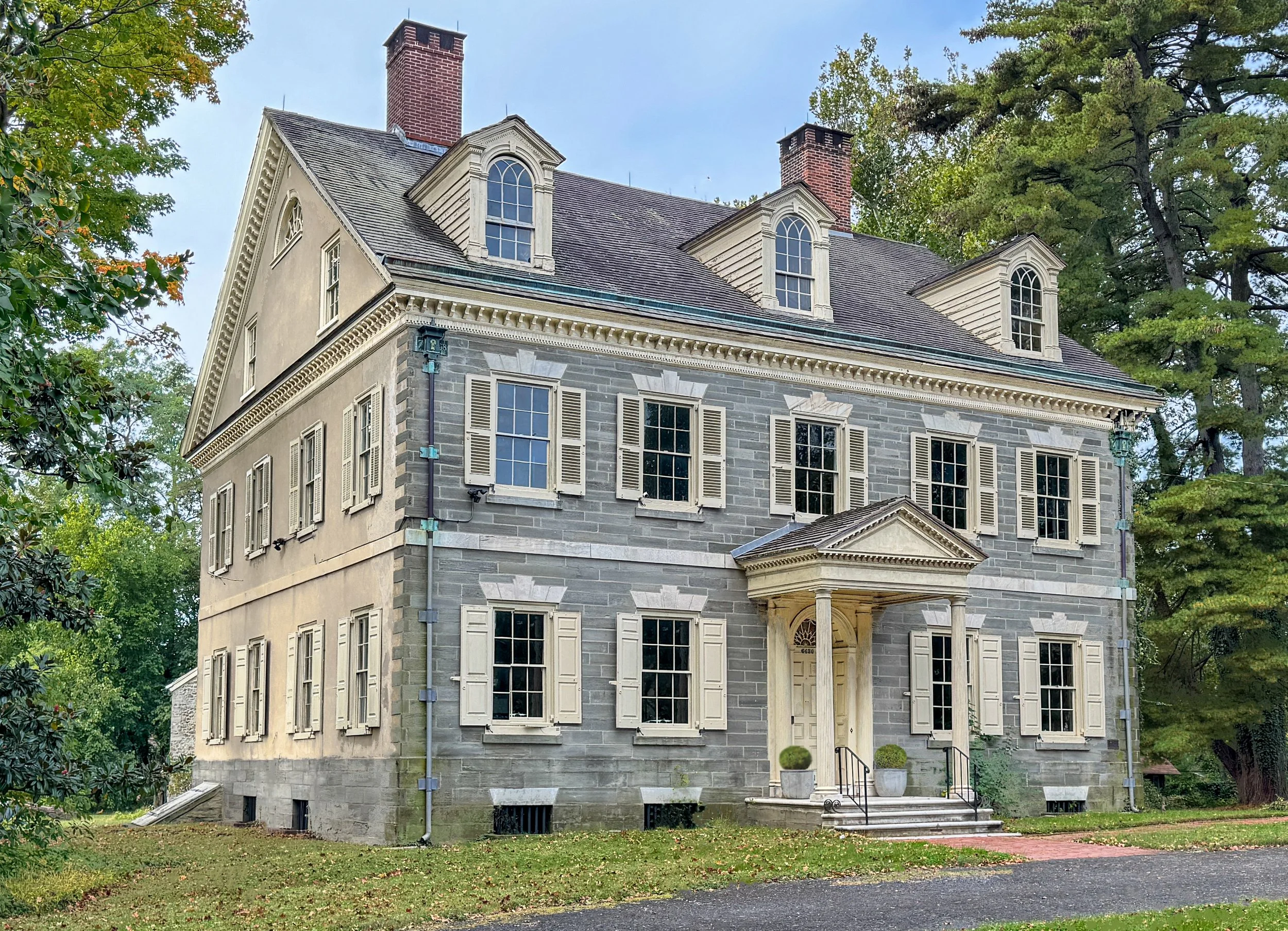
Above: Refined symmetry and careful balance define the Federal style of the late 18th century. The south elevation is stuccoed. Image source: Lee J. Stoltzfus.
A Copper Rain Head
is Dated 1798:
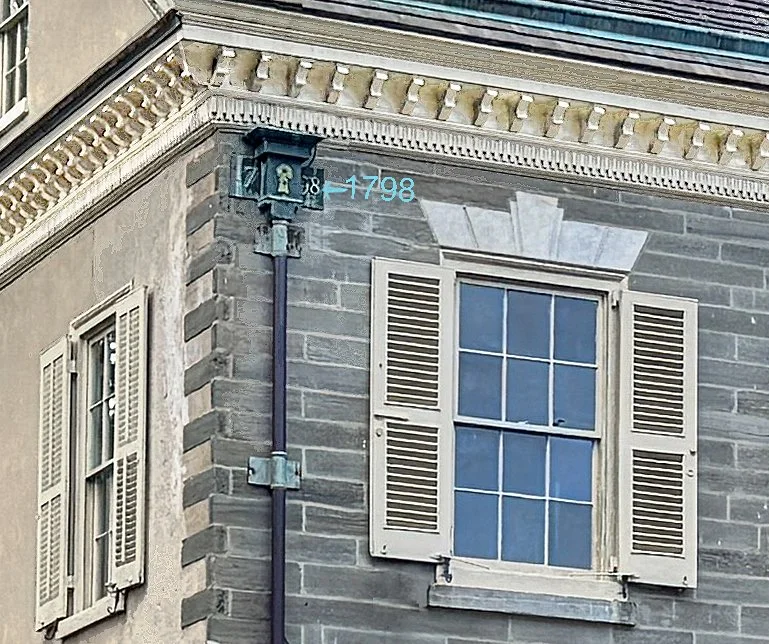
Above: A copper rainhead bears the date 1798. The elaborate cornice is detailed with denticulation and modillions, which are reflected in the portico trim. The cornice returns across the gables. The keystoned jack arches are marble, as are the entry steps and the string course. The front elevation has a veneer of three-inch thick ashlar applied to a rubble-stone wall behind.
The Building Stone of Germantown:
Wissahickon Schist:
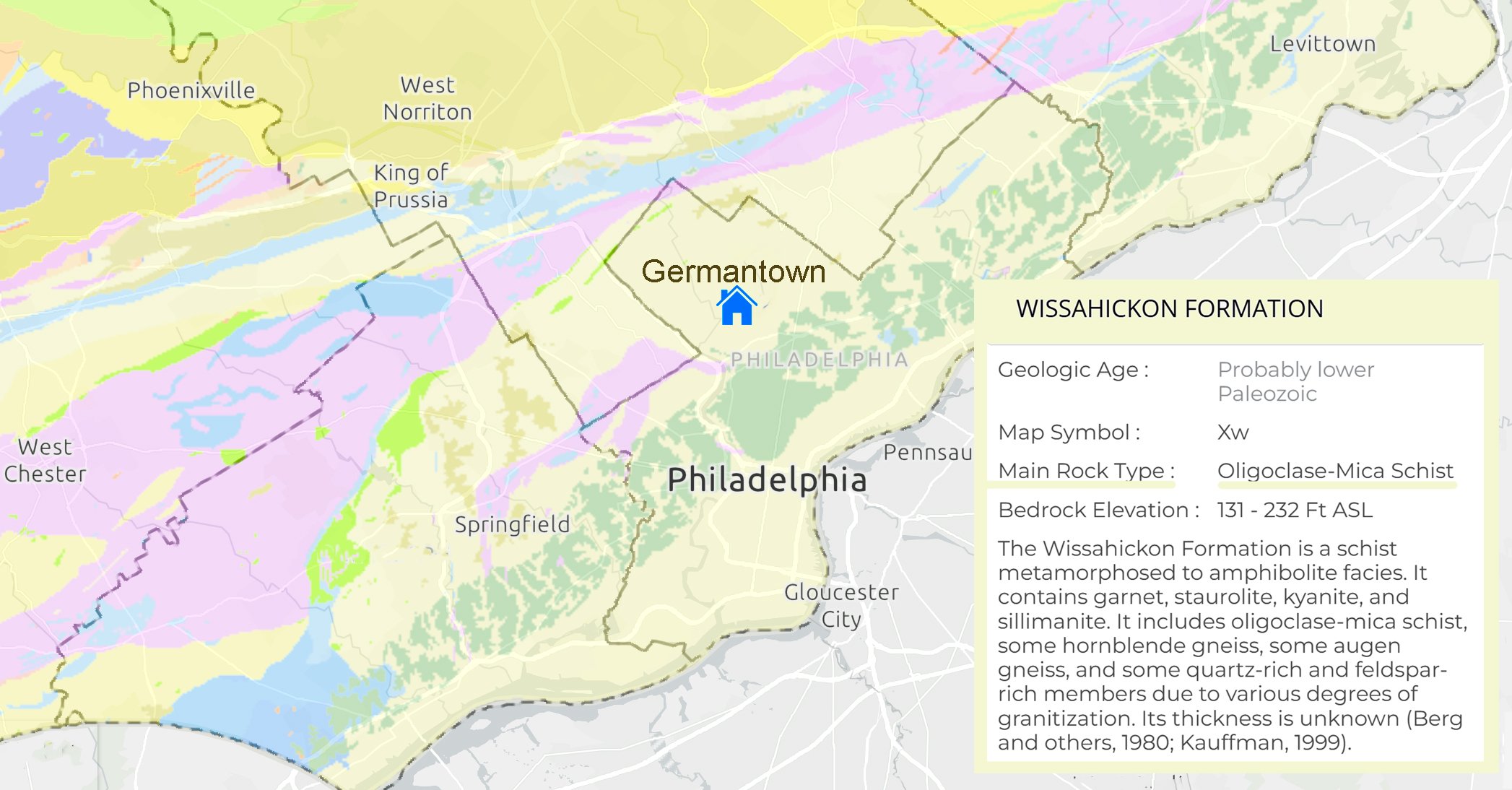
Above: Image source: PaGEODE, Pennsylvania Department of Conservation and Natural Resources.
Wissahickon schist is the main rock type and building stone in the Germantown region, as this map shows.
The geologic unit marked in green is feldspathic quartz sand. This sand is derived from weathering of the Wissahickon Formation and was commonly used as the aggregate in lime mortars and base-coat plasters for brick and stone construction.
This was the Site of the 1698 House
Built by Mennonite Heivert Papen:
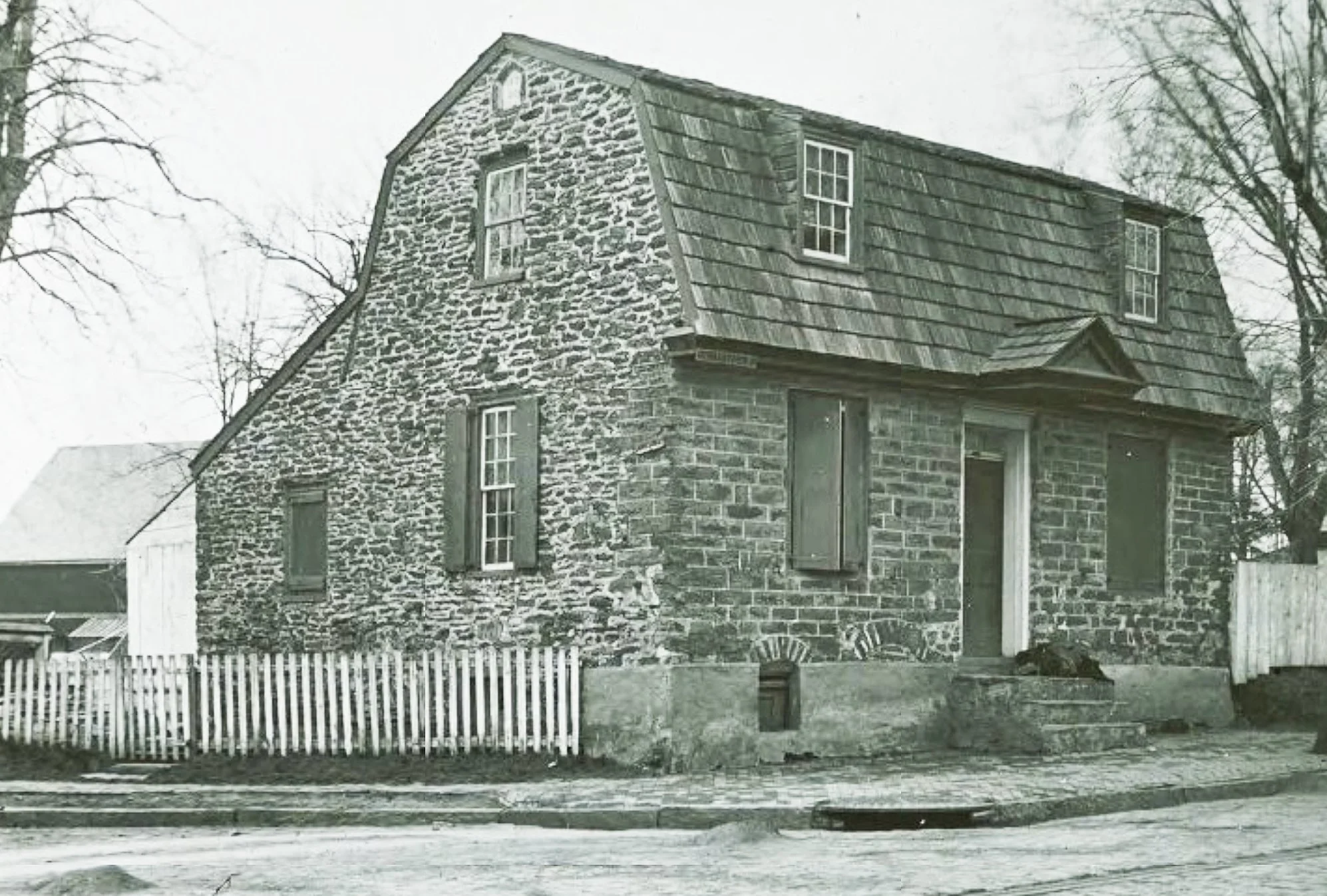
This gambrel-roofed house passed into the Johnson family early in the 18th century. It was built by Heivert Papen, a Mennonite who emigrated to Germantown from Germany in 1685. A gable datestone reads 1698. The house was demolished in 1883. At that time it was referred to as the oldest house in Germantown. Image source: Library Company of Philadelphia
The 1698 Heivert Papen House
”The First Stone House Built in Germantown”
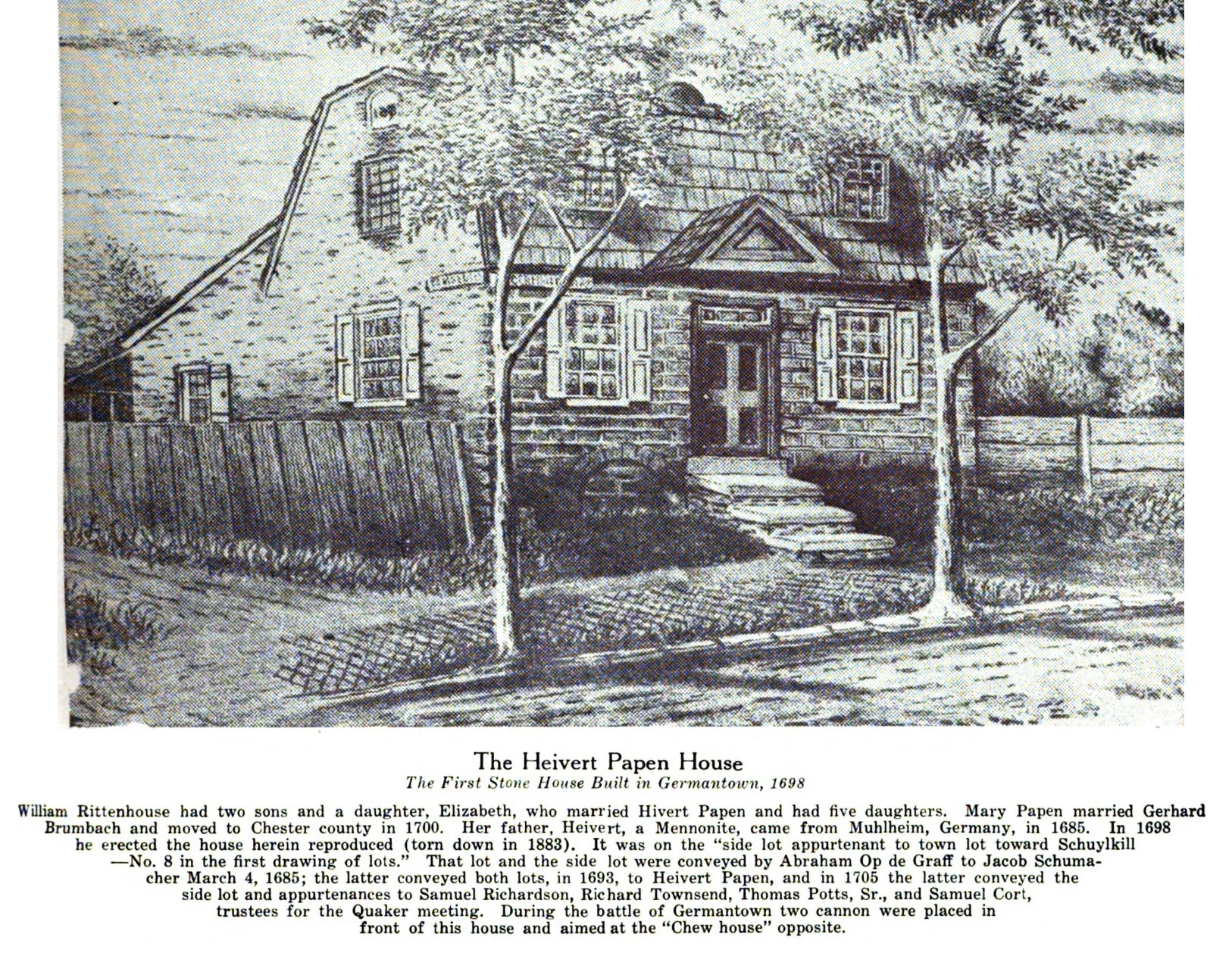
Above: The Rittenhouse family and the Papen family had lived in Mülheim, Germany, before emigrating to Germantown. These Mennonites maintained close contact with their Quaker neighbors. Both groups identify as historic Peace Churches, along with the Church of the Brethren. Germantown is an important center of early Peace Church activism in Pennsylvania. This community is also a birthplace of the anti-slavery movement in the American colonies, because of the human-rights advocacy associated with these historic peace churches.. Image source: The City of Firsts, George Morgan, 1926, HathiTrust.
Northern European Gambrel Roofs
On Delaware Valley Houses:
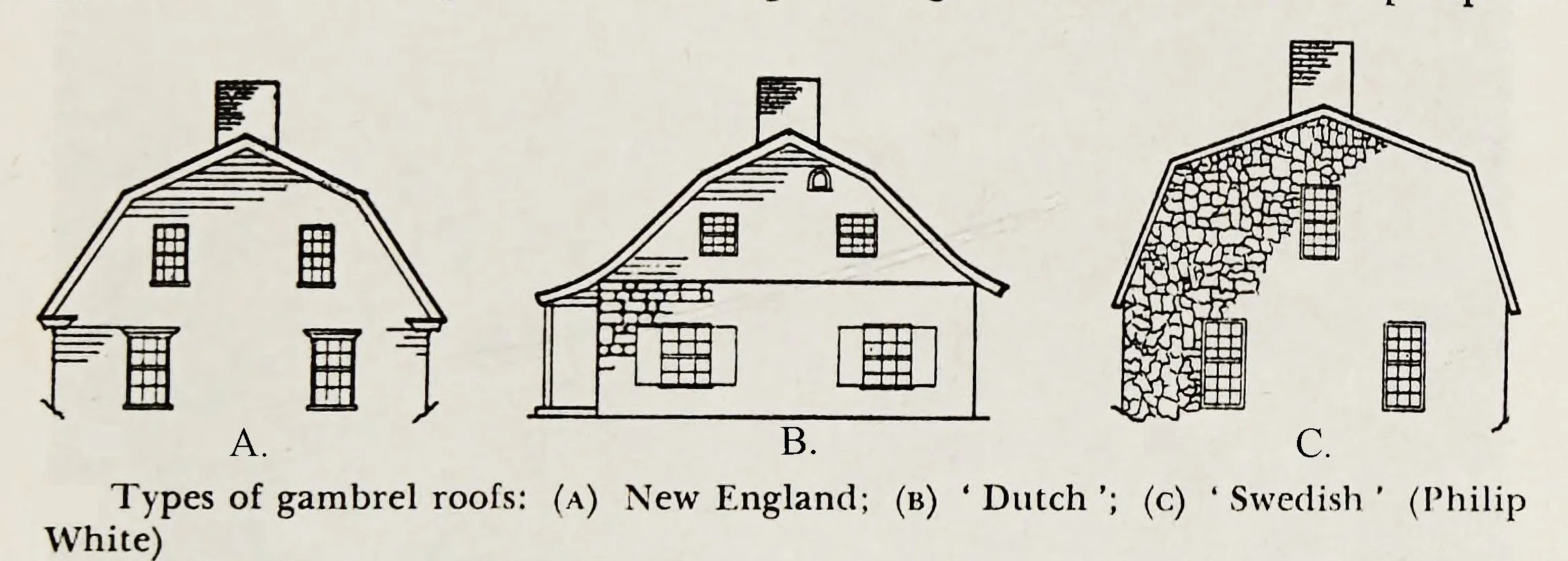
Above: Image source: Early American Architecture, Hugh Morrison, 1987, Internet Archive.
The gambrel roofs of the earliest colonial houses in the Delaware Valley are sometimes identified by historians as Swedish gambrel roofs. Immigrants emigrated here to New Sweden on the Delaware River from throughout Northern Europe. They brought with them their vernacular house traditions of long low cottages having two or three contiguous rooms with a gambrel roof. These gambrel roofs of Delaware Valley settler cottages can also be also called northern European gambrels or continental gambrels.
Description of the Earliest Quaker Houses
in Germantown
More Germanic than Anglo:
Above: Image source: Annals of Philadelphia and Pennsylvania…, John F. Watson, 1830, Vol. 2, HathiTrust
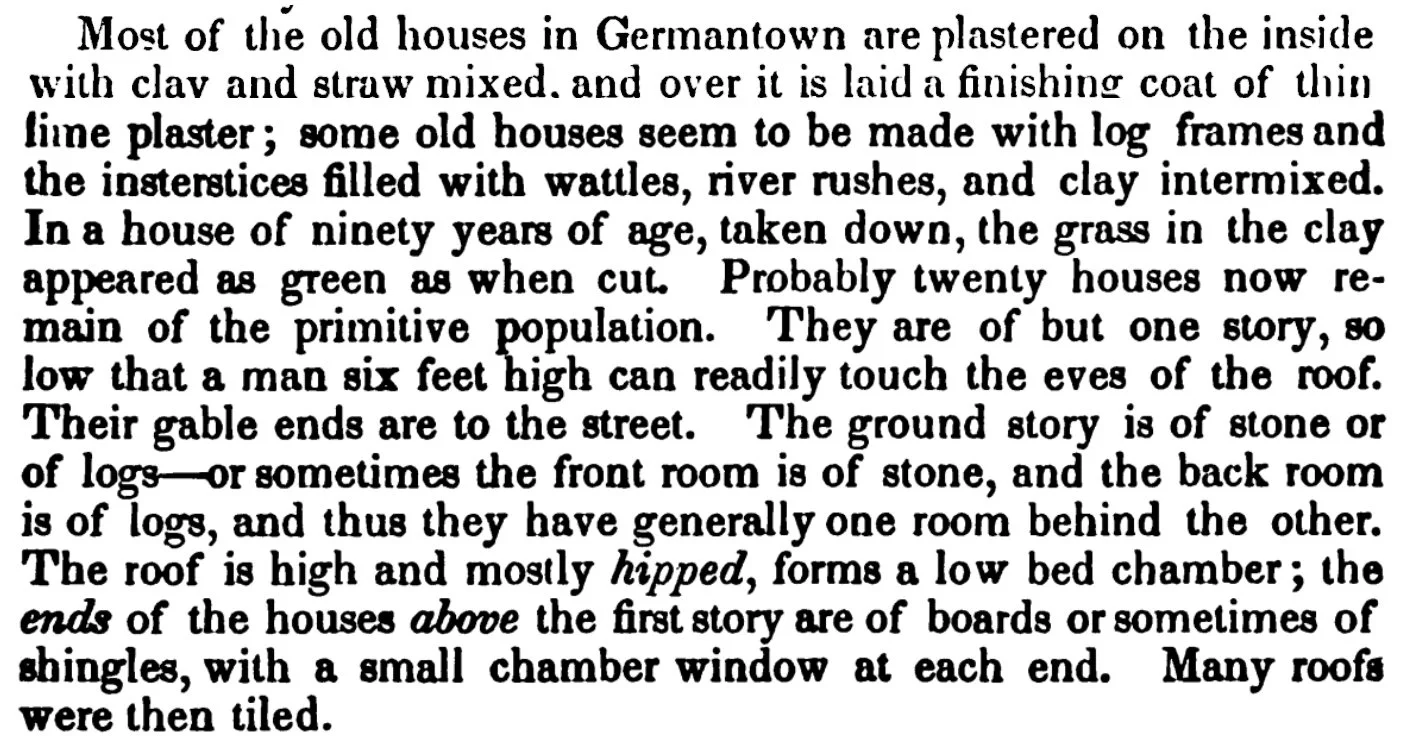
According to this 1830s description, Germantown’s earliest houses were one-story dwellings with “hipped” gambrel roofs. The houses’ gable ends faced the street, following German and Dutch tradition of town planning.
Two Houses - Two Generations of Johnsons
From Quaker Vernacular to Federal Style
From Brown Schist to Gray Schist:
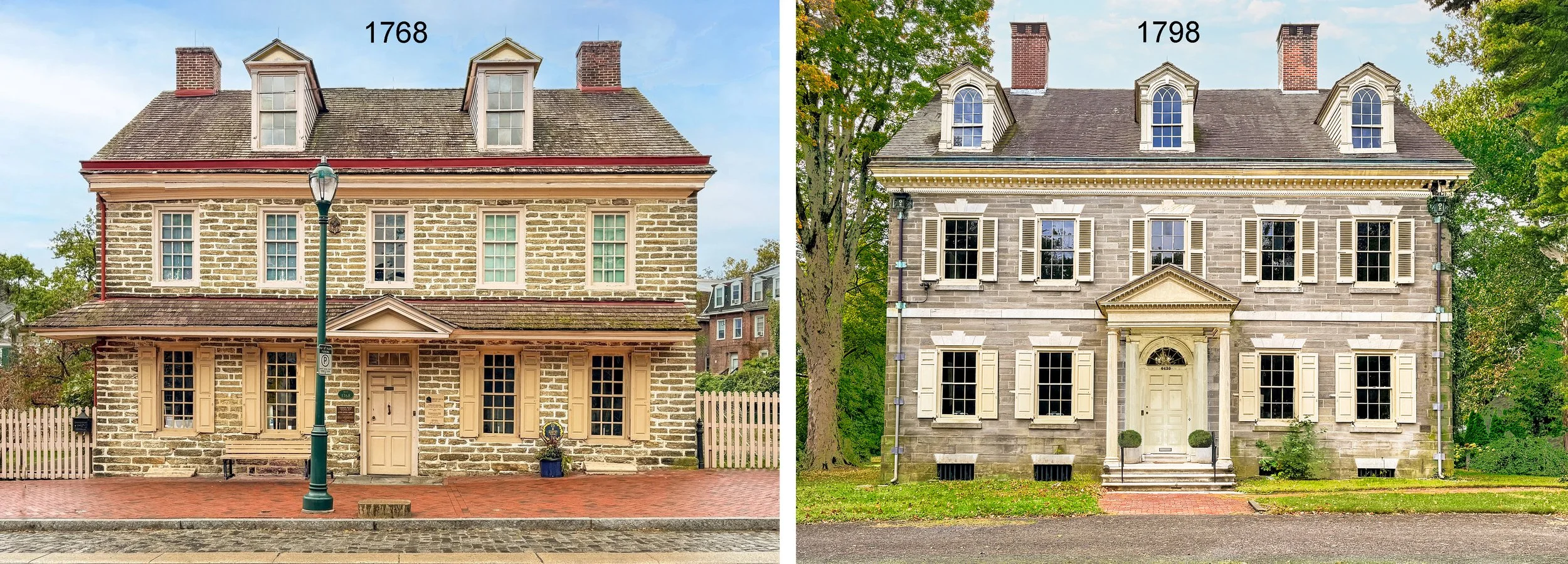
Above left:The aunt’s and uncle’s house: Built in 1768 for John Johnson, Jr. and Rachel (Livezey) Johnson
Above right: The nephew’s house: Built in 1798 for their nephew John Johnson and Sally (Wheeler) Johnson. Images source: Lee J. Stoltzfus.
The color of Wissahickon Schist varies from brown to gray. Stone near the earth’s surface is typically brown or tan because it has been exposed to oxygen and water, causing iron minerals within the rock to oxidize (rust).
In contrast, stone quarried from deeper underground remains silvery-gray because it has been shielded from weathering, preserving its original mica and quartz composition. Early Germantown builders often used the easily accessible brown fieldstone found on the surface, while later quarrying reached the deeper, gray seams.
Links: