
Historic Quaker Houses of Delaware County, PA
The Pratt House
Ridley Creek State Park
Colonial Pennsylvania Farmstead:
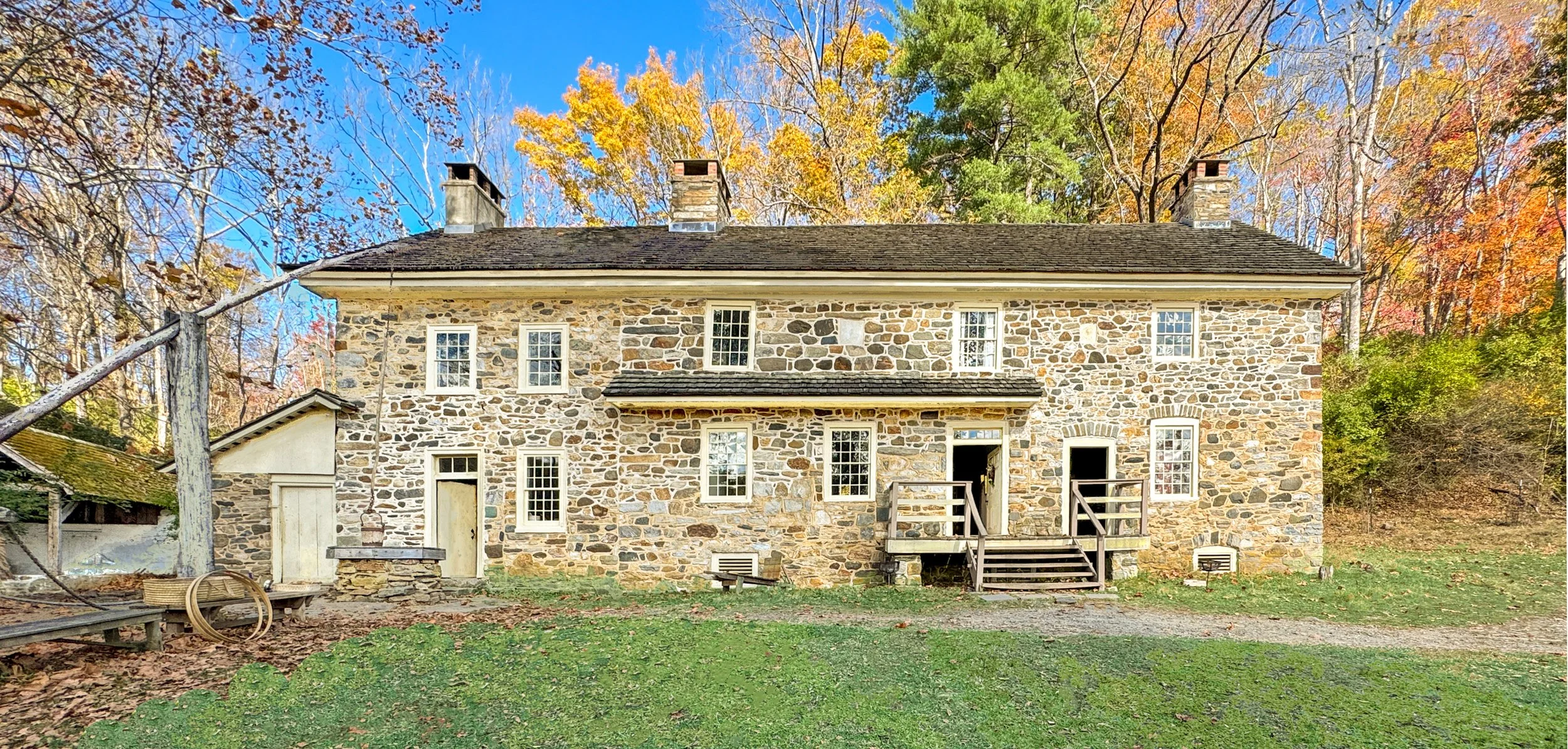
Above: A water bucket hangs from a well sweep in front of the farmhouse. The earliest part of the house, which predates 1700, is on the right side of the building. Image source: Lee J. Stoltzfus.
Colonial Pennsylvania Farmstead was the home of four generations of the Pratt family, part of the early English Quaker farming community in Edgmont. Abraham and Jane Pratt came to Pennsylvania in the 1680s, and their son Joseph Pratt purchased the Edgmont property in 1720 from the Lewis family. At that time, the farm was a 380-acre tract. Part of this farm survives inside today’s Ridley Creek State Park as a living history museum. The Pratt family worked this land from about 1720 to 1820. A 1774 tax list notes that Joseph Pratt owned more horses, cattle, and sheep than anyone else in Edgmont, a sign of the farm’s importance in the township.
The house was built in several sections over time. The earliest section, on the east, predates 1700. Today the house is virtually unchanged. The interior contains almost all of its original woodwork.
Early Stone Cabin on the Farmstead:
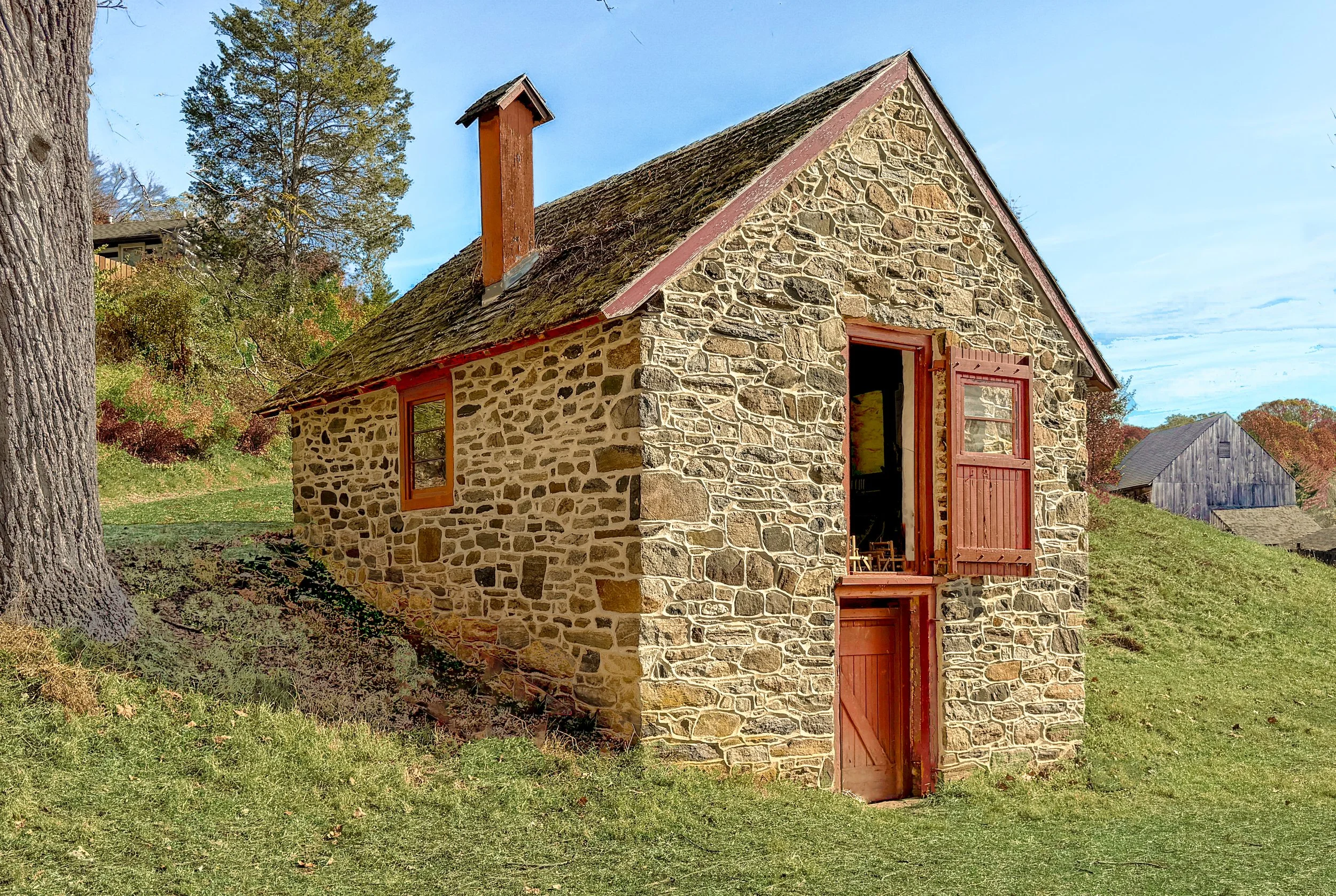
Above: The stone cabin near the farmhouse. Image source: Lee J. Stoltzfus.
This stone cabin probably had numerous uses over time. Its construction date is unknown. The cabin possibly was an early dwelling. Or it may have been used as a springhouse, smokehouse, or ice house. Mortar seams in the south eave show that the roof once had a steeper pitch suitable for thatch, which suggests a late seventeenth or early eighteenth-century date. This may have been the first building on the site.
The Earliest Part of the House
The East End:
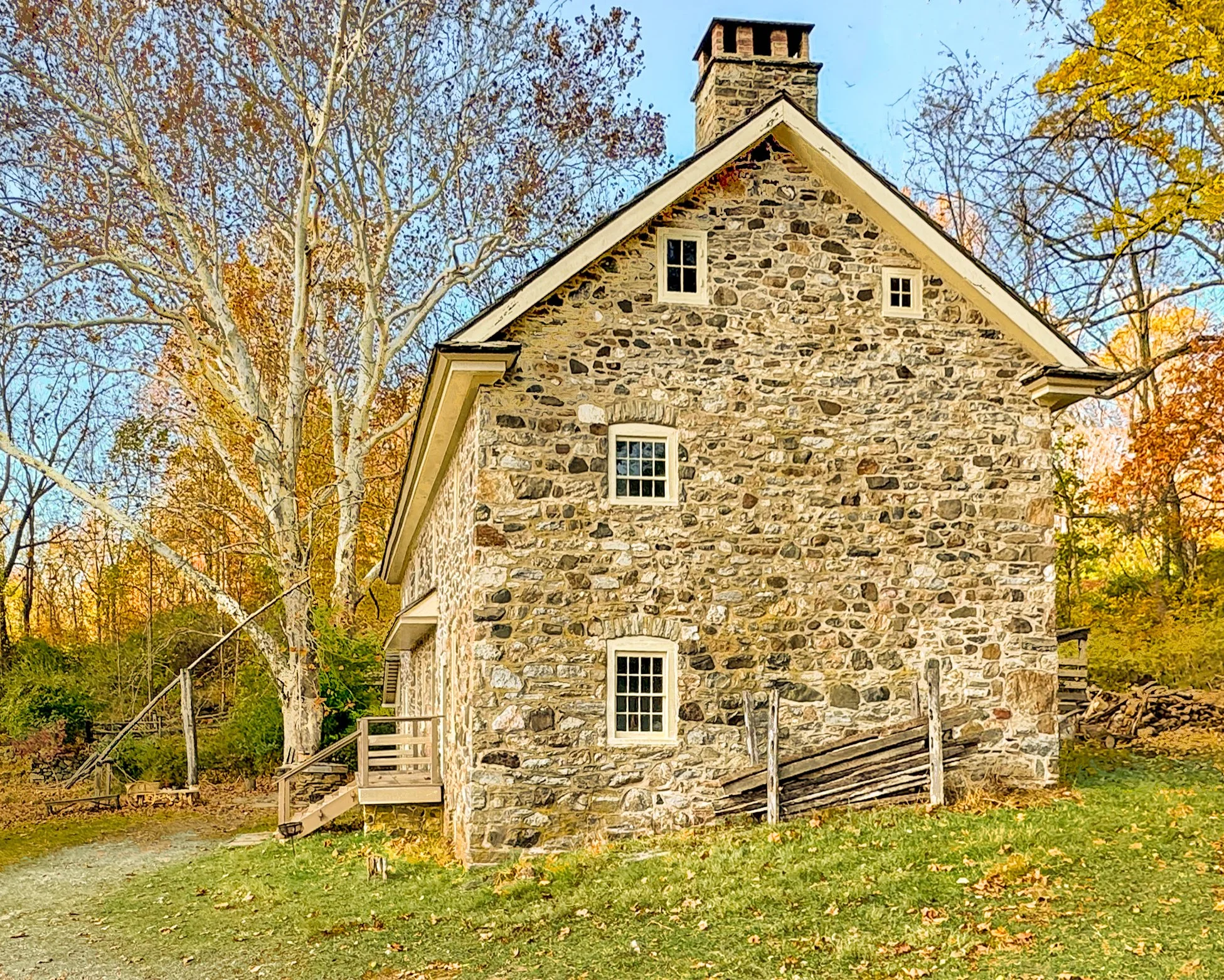
Above: The farmhouse’s east end is the building’s earliest part. It likely was built by Barnabas Wilcox before 1700. According to John C. McIlhenny, this section was likely built between 1686 and 1691. Image source: Lee J. Stoltzfus.
Construction of the House Sections:
The farmhouse design evolved over a period of about 130 years, mostly during four generations of the Pratt family.
1. Pre-1700: The east end. This is a full 2½-story section with a cellar that might have contained a spring.
2. ca. 1750: The central section. This is an addition on the west side of the east end, either one or 1½ stories tall.
3. ca. 1770: Central section raised to full 2½ stories, and enlarged to its current width. Central hall probably created during this time.
4.ca.1790: Addition of a stone kitchen in the same location as the current kitchen.
5. ca. 1830: Widening and raising of the kitchen to the same height and width as the rest of the house.
Information source: The Colonial Pennsylvania Farmstead’s interpretive manual.
Interior of the Central Section:
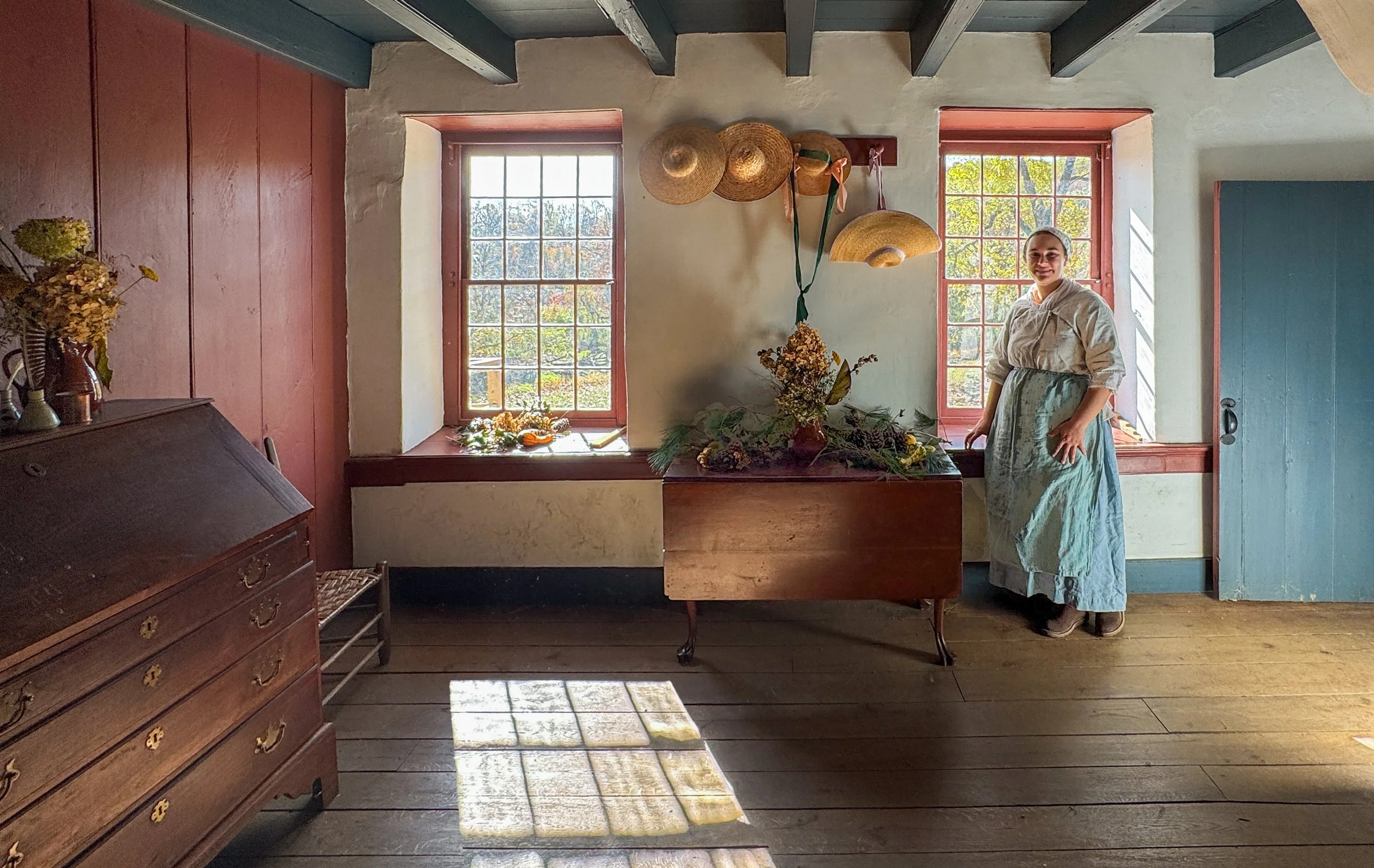
Above: In the farmhouse’s central section, a docent stands beside a walnut drop-leaf table made ca. 1740 in Chester County in the Queen Anne style. The walnut desk is a reproduction of an 18th-century Chester County desk. Image source: Lee J. Stoltzfus.
Detail of the Rubble Stone Construction:
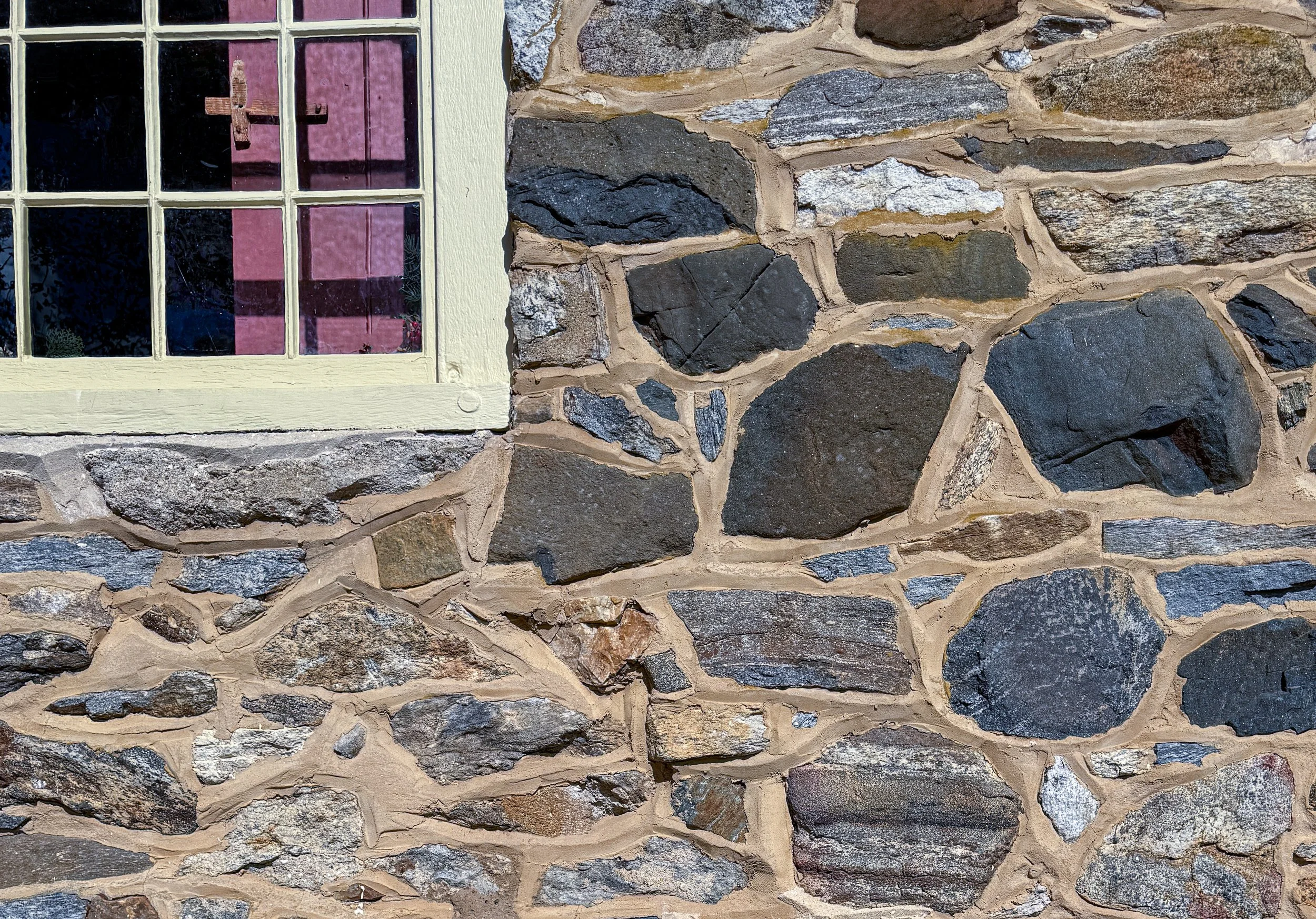
The farmhouse at the Colonial Pennsylvania Farmstead is constructed of local rubble stone. Most of the farmstead is underlain by Grenville-age gneisses. The rocks are Precambrian in age, one billion years old. The stone masonry of the farmhouse’s front elevation is beautifully pointed with beveled-ridge mortar joints. Image source: Lee J. Stoltzfus.
The Local Bedrock and Building Stone
Felsic and Intermediate Gneiss:
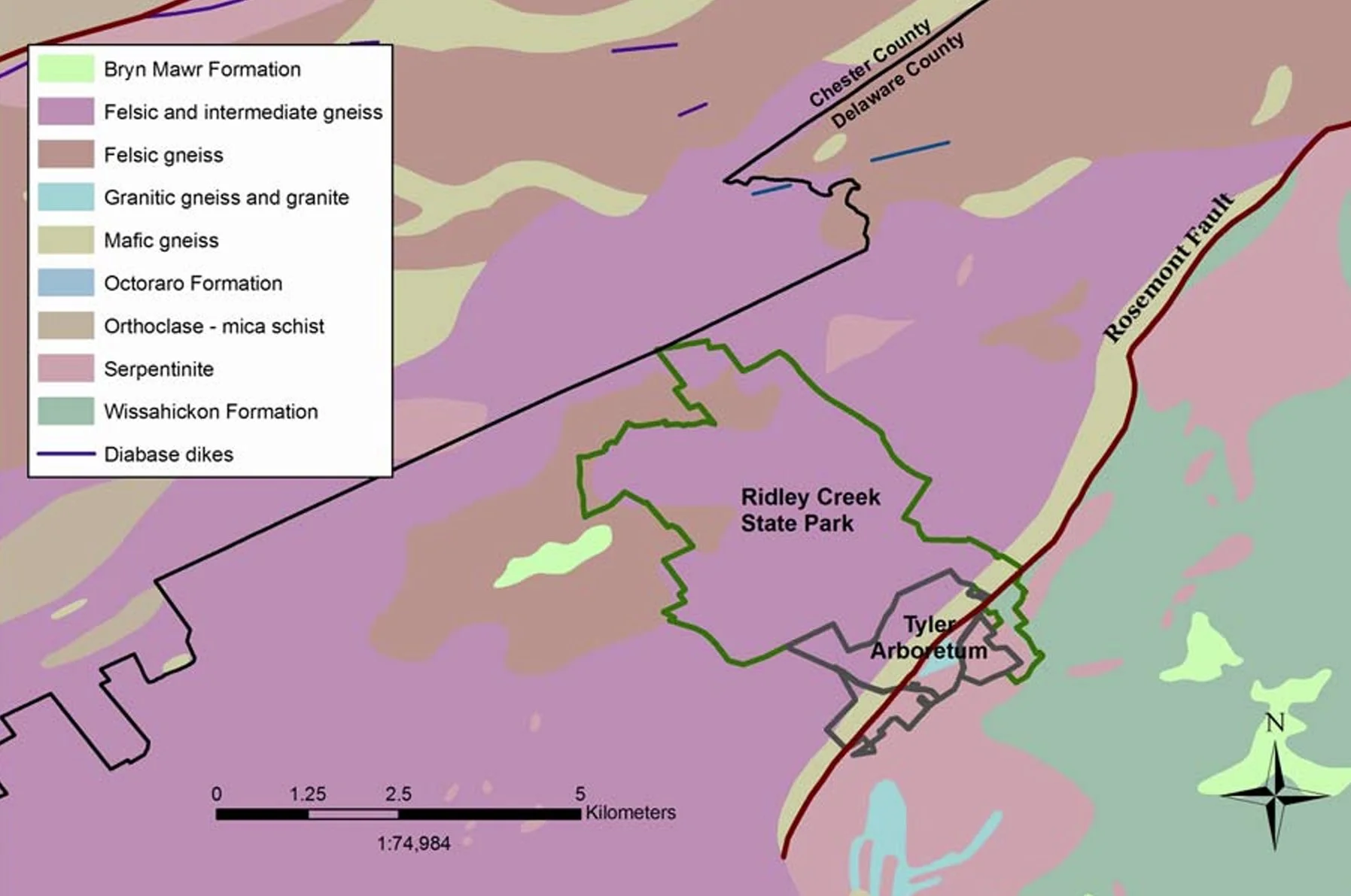
Image source: Friends of Ridley Creek State Park
Farmstead Painting by Nicholas Santoleri:

Image source: Nicholas Santoleri
Links: